
Title


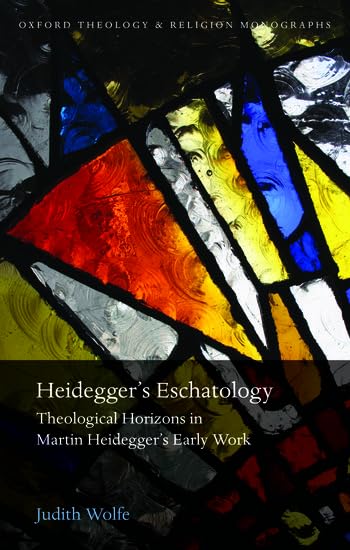
Heidegger's Eschatology: Theological Horizons in Martin Heidegger's Early Work (Oxford Theology and Religion Monographs),Used
Sold by Ergodebooks, an authorized reseller.
Returns accepted within 30 days | support@ergodebooks.com
Shipping Information
- Free Standard Shipping — United States only
- Processing Time: 3–5 business days
- Estimated Delivery: 6–10 business days after dispatch
- Double-boxed, fully insured & discreetly packaged
- Tracking number sent via email once dispatched
Returns & Refund
Returns accepted within 30 days of delivery.
Damaged or Defective Item
Free return shipping + replacement or full refund
Wrong Item Received
Free return shipping + replacement or full refund
Change of Mind
Return shipping at customer's expense · 25% restocking fee applies
Payment Option

Heidegger's Eschatology is a groundbreaking account of Heidegger's early engagement with theology, from his beginnings as an antiModernist Catholic to his turn towards an undogmatic Protestantism and finally to a resolutely atheistic philosophical method. The book centres on Heidegger's developing commitment to an eschatological vision, derived from theological sources but reshaped into a central resource for the development of an atheistic phenomenological account of human existence.This vision originated in Heidegger's attempt, in the late 1910s, to formulate a phenomenology of religious life that would take seriously the inherent temporality of human existence. In this endeavour, Heidegger turned to two trends in Protestant scholarship: the discovery of eschatology as a central preoccupation of the Early Church by A. Schweitzer and the "History of Doctrine" School, and the "existential" eschatology of Karl Barth and Eduard Thurneysen, indebted to Kierkegaard, Dostoevsky, and Franz Overbeck.His synthesis of such trends within a phenomenological framework (elaborated primarily via readings of Paul and Augustine in his lecture courses of 19212) led Heidegger to postulate an existential sense of eschatological unrest as the central characteristic of authentic Christian existence. His description of this expectant restlessness, however, was now inescapably at odds with its Christian sources, since Heidegger's commitment to a phenomenological description of the human situation led him to abstract the "existential" experience of expectation from its traditional object: the "blessed hope" for the Kingdom of God. Christian hope thus for Heidegger no longer constitutes, but rather negates "eschatological" unrest, because such hope projects an end to that unrest, and thus to authentic existence itself. Against the Christian vision, Heidegger therefore develops a systematic 'eschatology without eschaton', paradigmatically expressed as "beinguntodeath."Judith Wolfe tells the story of his reconception of eschatology, using a wealth of primary and newly available originallanguage sources, and offering indepth analysis of Heidegger's relationship to theological tradition and the theology of his time.
⚠️ WARNING (California Proposition 65):
This product may contain chemicals known to the State of California to cause cancer, birth defects, or other reproductive harm.
For more information, please visit www.P65Warnings.ca.gov.