
Title
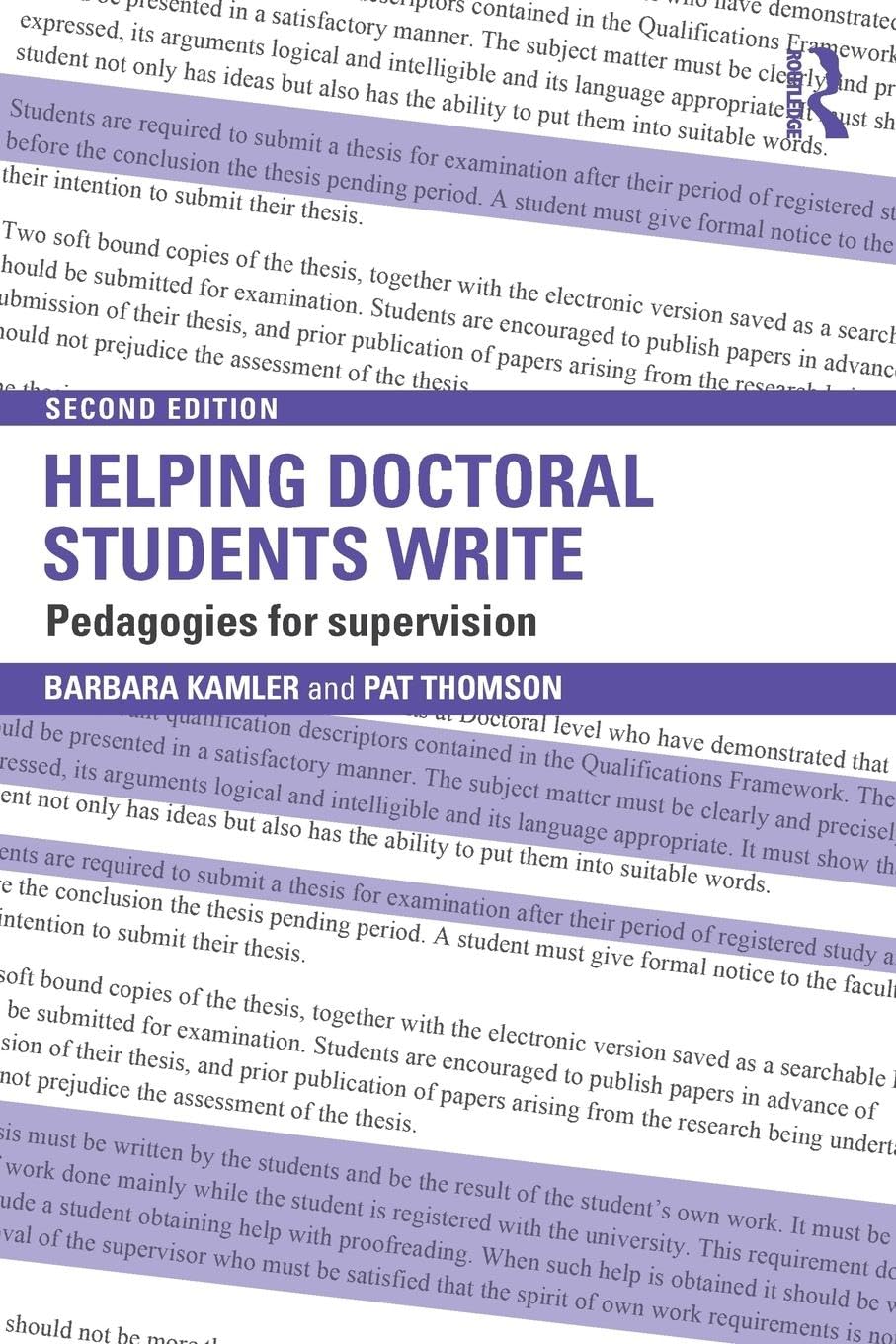
Helping Doctoral Students Write: Pedagogies for supervision,Used
Sold by Ergodebooks, an authorized reseller.
Returns accepted within 30 days | support@ergodebooks.com
Shipping Information
- Free Standard Shipping — United States only
- Processing Time: 3–5 business days
- Estimated Delivery: 6–10 business days after dispatch
- Double-boxed, fully insured & discreetly packaged
- Tracking number sent via email once dispatched
Returns & Refund
Returns accepted within 30 days of delivery.
Damaged or Defective Item
Free return shipping + replacement or full refund
Wrong Item Received
Free return shipping + replacement or full refund
Change of Mind
Return shipping at customer's expense · 25% restocking fee applies
Payment Option

Helping Doctoral Students Write offers a proven approach to effective doctoral writing. By treating research as writing and writing as research, the authors offer pedagogical strategies for doctoral supervisors that will assist the production of wellargued and lively dissertations.It is clear that many doctoral candidates find research writing complicated and difficult, but the advice they receive often glosses over the complexities of writing and/or locates the problem in the writer. Kamler and Thomson provide a highly effective framework for scholarly work that is located in personal, institutional and cultural contexts.The pedagogical approach developed in the book is based on the notion of writing as a social practice. This approach allows supervisors to think of doctoral writers as novices who need to learn new ways with words as they enter the discursive practices of scholarly communities. This involves learning sophisticated writing practices with specific sets of conventions and textual characteristics. The authors offer supervisors practical advice on helping with commonly encountered writing tasks such as the proposal, the journal abstract, the literature review and constructing the dissertation argument.The first edition of this book has helped many academics and thousands of research students produce better written material. Now fully updated the second edition includes:Examples from a broader range of academic disciplinesA new chapter on writing from the thesis for peer reviewed journalsMore advice on reading and note taking, performance and conferences,Further information on developing a personal academic writing style, andAdvice on the use of social media (blogs, tweets and wikis) to create transdisciplinary and transnational networks and conversations.Their discussion of the complexities of forming a scholarly identity is illustrated throughout by stories and writings of actual doctoral students.In conclusion, they present a persuasive and proven argument that universities must move away from simply auditing supervision to supporting the development of scholarly research communities. Any supervisor keen to help their students develop as academics will find the ideas and practical solutions presented in this book fascinating and insightful reading.
⚠️ WARNING (California Proposition 65):
This product may contain chemicals known to the State of California to cause cancer, birth defects, or other reproductive harm.
For more information, please visit www.P65Warnings.ca.gov.