
Title
Hemispheric Imaginings: The Monroe Doctrine And Narratives Of U.S. Empire (New Americanists),Used
Sold by Ergodebooks, an authorized reseller.
Returns accepted within 30 days | support@ergodebooks.com
Shipping Information
- Free Standard Shipping — United States only
- Processing Time: 3–5 business days
- Estimated Delivery: 6–10 business days after dispatch
- Double-boxed, fully insured & discreetly packaged
- Tracking number sent via email once dispatched
Returns & Refund
Returns accepted within 30 days of delivery.
Damaged or Defective Item
Free return shipping + replacement or full refund
Wrong Item Received
Free return shipping + replacement or full refund
Change of Mind
Return shipping at customer's expense · 25% restocking fee applies
Payment Option

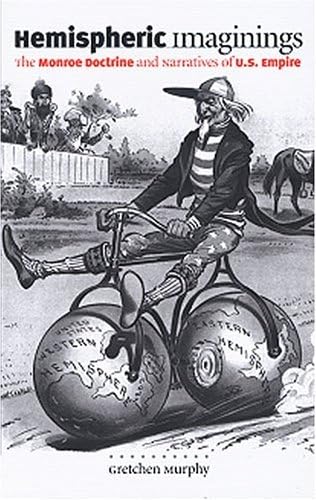
In 1823, President James Monroe announced that the Western Hemisphere was closed to any future European colonization and that the United States would protect the Americas as a space destined for democracy. Over the next century, these ideaswhich came to be known as the Monroe Doctrineprovided the framework through which Americans understood and articulated their military and diplomatic role in the world. Hemispheric Imaginings demonstrates that North Americans conceived and developed the Monroe Doctrine in relation to transatlantic literary narratives. Gretchen Murphy argues that fiction and journalism were crucial to popularizing and making sense of the Doctrines contradictions, including the fact that it both drove and concealed U.S. imperialism. Presenting fiction and popular journalism as key arenas in which such inconsistencies were challenged or obscured, Murphy highlights the major role writers played in shaping conceptions of the U.S. empire.Murphy juxtaposes close readings of novels with analyses of nonfiction texts. From uncovering the literary inspirations for the Monroe Doctrine itself to tracing visions of hemispheric unity and transatlantic separation in novels by Lydia Maria Child, Nathaniel Hawthorne, Mara Amparo Ruiz de Burton, Lew Wallace, and Richard Harding Davis, she reveals the Doctrines forgotten cultural history. In making a vital contribution to the effort to move American Studies beyond its limited focus on the United States, Murphy questions recent proposals to reframe the discipline in hemispheric terms. She warns that to do so risks replicating the Monroe Doctrines proprietary claim to isolate the Americas from the rest of the world.
⚠️ WARNING (California Proposition 65):
This product may contain chemicals known to the State of California to cause cancer, birth defects, or other reproductive harm.
For more information, please visit www.P65Warnings.ca.gov.