
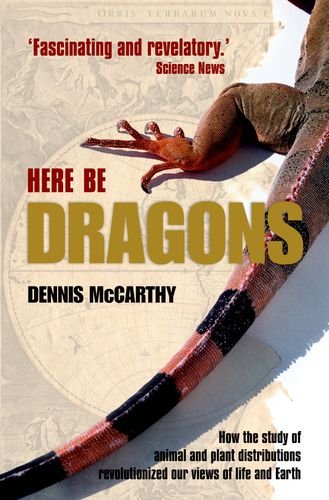
Title
Here Be Dragons: How The Study Of Animal And Plant Distributions Revolutionized Our Views Of Life And Earth,Used
Sold by Ergodebooks, an authorized reseller.
Returns accepted within 30 days | support@ergodebooks.com
Shipping Information
- Free Standard Shipping — United States only
- Processing Time: 3–5 business days
- Estimated Delivery: 6–10 business days after dispatch
- Double-boxed, fully insured & discreetly packaged
- Tracking number sent via email once dispatched
Returns & Refund
Returns accepted within 30 days of delivery.
Damaged or Defective Item
Free return shipping + replacement or full refund
Wrong Item Received
Free return shipping + replacement or full refund
Change of Mind
Return shipping at customer's expense · 25% restocking fee applies
Payment Option

Why Do We Find Polar Bears Only In The Arctic And Penguins Only In The Antarctic? Why Are Marsupials Found Only In Australia And South America? In A Book That Science News Called 'Fascinating And Revelatory,' Dennis Mccarthy Tells A Story That Encompasses Two Great, Insightful Theories That Together Explain The Strange Patterns Of Life Across The Worldevolution And Plate Tectonics. We Find Animals And Plants Where We Do Because, Over Time, The Continents Have Moved, Separating And Uniting In A Long, Slow Dance; Because Sea Levels Have Risen, Cutting Off One Bit Of Land From Another; Because New And Barren Volcanic Islands Have Risen Up From The Sea; And Because Animals And Plants Vary Greatly In Their Ability To Travel, And Separation Causes The Formation Of New Species. This Is The Story Of How Life Has Responded To, And Has In Turn Altered, The Everchanging Earth. And It Includes Many Fascinating Talesof Pygmy Mammoths And Elephant Birds And Of Radical Ideas By Bold Young Scientists.
⚠️ WARNING (California Proposition 65):
This product may contain chemicals known to the State of California to cause cancer, birth defects, or other reproductive harm.
For more information, please visit www.P65Warnings.ca.gov.
- Q: How many pages does the book have? A: The book has two hundred forty pages. This length provides ample content while remaining accessible for readers.
- Q: What is the binding type of this book? A: The book is paperback bound. This makes it lightweight and flexible, ideal for reading on the go.
- Q: What are the dimensions of the book? A: The book measures seven point six inches in length, five inches in height, and zero point six inches in width. These dimensions make it easy to handle and store.
- Q: What age group is this book suitable for? A: The book is suitable for teenagers and adults. Its themes of evolution and ecology are engaging for those with an interest in environmental science.
- Q: How can I apply the knowledge from the book? A: Readers can apply the knowledge by exploring ecological principles in real life. Understanding animal distributions can enhance awareness of conservation issues.
- Q: Is this book suitable for beginners in environmental science? A: Yes, it is suitable for beginners. The author presents complex ideas in an engaging and understandable manner.
- Q: How should I store this book? A: Store the book in a cool, dry place. Keeping it away from direct sunlight will help preserve the quality of the cover and pages.
- Q: Can I clean the book if it gets dirty? A: Yes, you can clean the book. Use a soft, dry cloth to gently wipe the cover and pages to remove dust or smudges.
- Q: What if the book arrives damaged? A: If the book arrives damaged, contact customer support for a return or exchange. Most retailers have policies to address this issue.
- Q: Is this book appropriate for academic study? A: Yes, it is appropriate for academic study. The book contains valuable insights into ecological and evolutionary theories relevant for coursework.
- Q: What makes this book stand out in its genre? A: This book stands out due to its unique combination of evolution and plate tectonics. It offers fresh perspectives on biodiversity and historical geography.
- Q: How does the book relate to current environmental issues? A: The book relates to current issues by explaining how species distribution affects conservation efforts. Understanding these patterns is critical for addressing biodiversity loss.
- Q: Is there a specific audience for this book? A: The specific audience includes students, educators, and nature enthusiasts. It appeals to anyone interested in the science behind life on Earth.
- Q: What topics are covered in the book? A: The book covers topics such as animal distribution, evolution, and geological changes. These subjects provide a comprehensive view of ecological dynamics.
- Q: Who is the author of this book? A: The author is Dennis McCarthy. He is known for his engaging writing style and expertise in environmental science.