
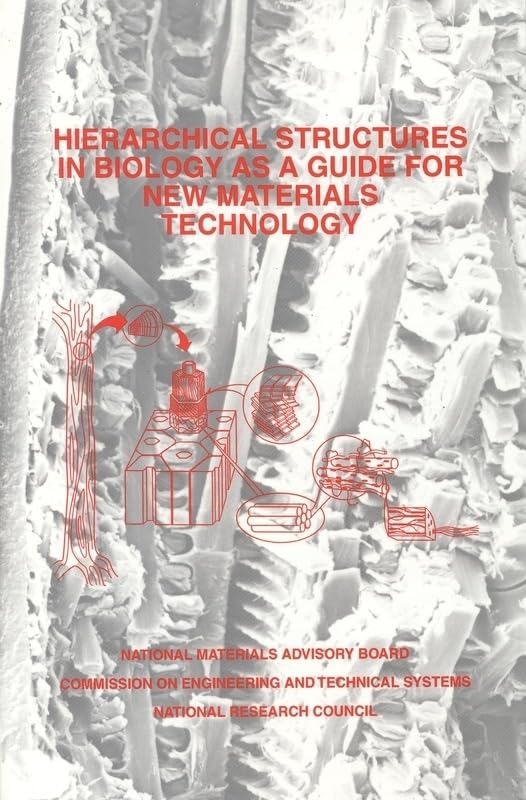
Title
Hierarchical Structures In Biology As A Guide For New Materials Technology (Nmab)
Sold by Ergodebooks, an authorized reseller.
Returns accepted within 30 days | support@ergodebooks.com
Shipping Information
- Free Standard Shipping — United States only
- Processing Time: 3–5 business days
- Estimated Delivery: 6–10 business days after dispatch
- Double-boxed, fully insured & discreetly packaged
- Tracking number sent via email once dispatched
Returns & Refund
Returns accepted within 30 days of delivery.
Damaged or Defective Item
Free return shipping + replacement or full refund
Wrong Item Received
Free return shipping + replacement or full refund
Change of Mind
Return shipping at customer's expense · 25% restocking fee applies
Payment Option

Product Description Hierarchical Structures Are Those Assemblages Of Molecular Units Or Their Aggregates Embedded Within Other Particles Or Aggregates That May, In Turn, Be Part Of Even Larger Units Of Increasing Levels Of Organization. This Volume Reviews The State Of The Art Of Synthetic Techniques And Processing Procedures For Assembling These Structures. Typical Naturaloccurring Systems Used As Models For Synthetic Efforts And Insight On Properties, Unusual Characteristics, And Potential Enduse Applications Are Identified. Suggestions Are Made For Research And Development Efforts To Mimic Such Structures For Broader Applications. From The Back Cover Hierarchical Structures Are Assemblages Of Molecular Units Or Their Aggregates That Are Embedded Or Intertwined With Other Phases, Which In Turn Are Similarly Organized At Increasing Size Levels. The Multilevel Architectures Are Capable Of Conferring Unique Properties To The Structure. Hierarchical Structures Are Found In Practically All Complex Systems, Particularly Naturally Occurring Ones. Synthetic Hierarchical Structures Can Be Prepared From Metals, Ceramics, Or Polymers, Or From Hybrids Of Various Classes Of These Materials. The Committee On Synthetic Hierarchical Structures Made An Assessment Of The Opportunities To Prepare Hierarchical Structures That Possess Useful And Unusual Physical Properties For Civilian And Military Applications. It Conducted Casestudies By Selecting Natural Material Systems To Be Used As Models For Synthetic Efforts. It Reviewed The State Of The Art Of Synthetic Techniques And Processes For Assembling Synthetic Hierarchical Structures. The Committee Also Characterized Properties, Unusual Characteristics, And Potential Enduse Applications For These Synthetic Systems. Finally, The Committee Recommended Research Directions To Expedite The Understanding Of The Complex Phenomena Involved, Lead To Increased Coordination Among Disciplines, And Provide Direction For Future Activities In The Field.
⚠️ WARNING (California Proposition 65):
This product may contain chemicals known to the State of California to cause cancer, birth defects, or other reproductive harm.
For more information, please visit www.P65Warnings.ca.gov.
- Q: How many pages does this book have? A: This book has one hundred forty-four pages. It provides a comprehensive overview of hierarchical structures in biology and their applications.
- Q: What are the dimensions of this book? A: The book measures six point zero three inches in length, zero point four inches in width, and nine point zero two inches in height. These dimensions make it easy to store or carry.
- Q: What type of binding does this book have? A: This book is available in paperback binding. This choice of binding ensures durability while remaining lightweight.
- Q: Who is the author of this book? A: The author of this book is the National Research Council. They provide insights into synthetic hierarchical structures.
- Q: What category does this book belong to? A: This book is categorized under Materials Science. It explores the intersection of biology and material technology.
- Q: What is the main subject of this book? A: The main subject is hierarchical structures in biology and their implications for new materials technology. It reviews synthetic techniques and their applications.
- Q: How can I apply the knowledge from this book? A: You can apply the knowledge by exploring synthetic techniques to create materials that mimic natural hierarchical structures. This could be beneficial in various scientific fields.
- Q: Is this book suitable for beginners in materials science? A: Yes, this book is suitable for beginners. It provides a foundational understanding of hierarchical structures and their applications.
- Q: What kind of applications does this book discuss? A: The book discusses potential applications in both civilian and military contexts. It reviews properties and characteristics of synthetic hierarchical structures.
- Q: How should I store this book? A: Store this book in a dry, cool place to maintain its condition. Avoid direct sunlight to prevent fading of the cover.
- Q: Can I clean this book if it gets dirty? A: Yes, you can clean it gently. Use a soft, dry cloth to wipe the cover and avoid using water or cleaning solutions.
- Q: What if I receive a damaged book? A: If you receive a damaged book, contact customer service for assistance with returns or exchanges. They typically have a straightforward return policy.
- Q: Is this book appropriate for advanced studies? A: Yes, this book can serve as a resource for advanced studies. It includes insights that are valuable for researchers in materials science.
- Q: What type of audience would benefit from this book? A: Researchers, students, and professionals in materials science would benefit from this book. It addresses both theoretical and practical aspects.
- Q: Does this book cover case studies? A: Yes, this book includes case studies of natural material systems. These case studies provide practical insights for synthetic efforts.
- Q: What unique properties are discussed in this book? A: The book discusses unique properties conferred by hierarchical structures, including their unusual characteristics and potential end-use applications.