
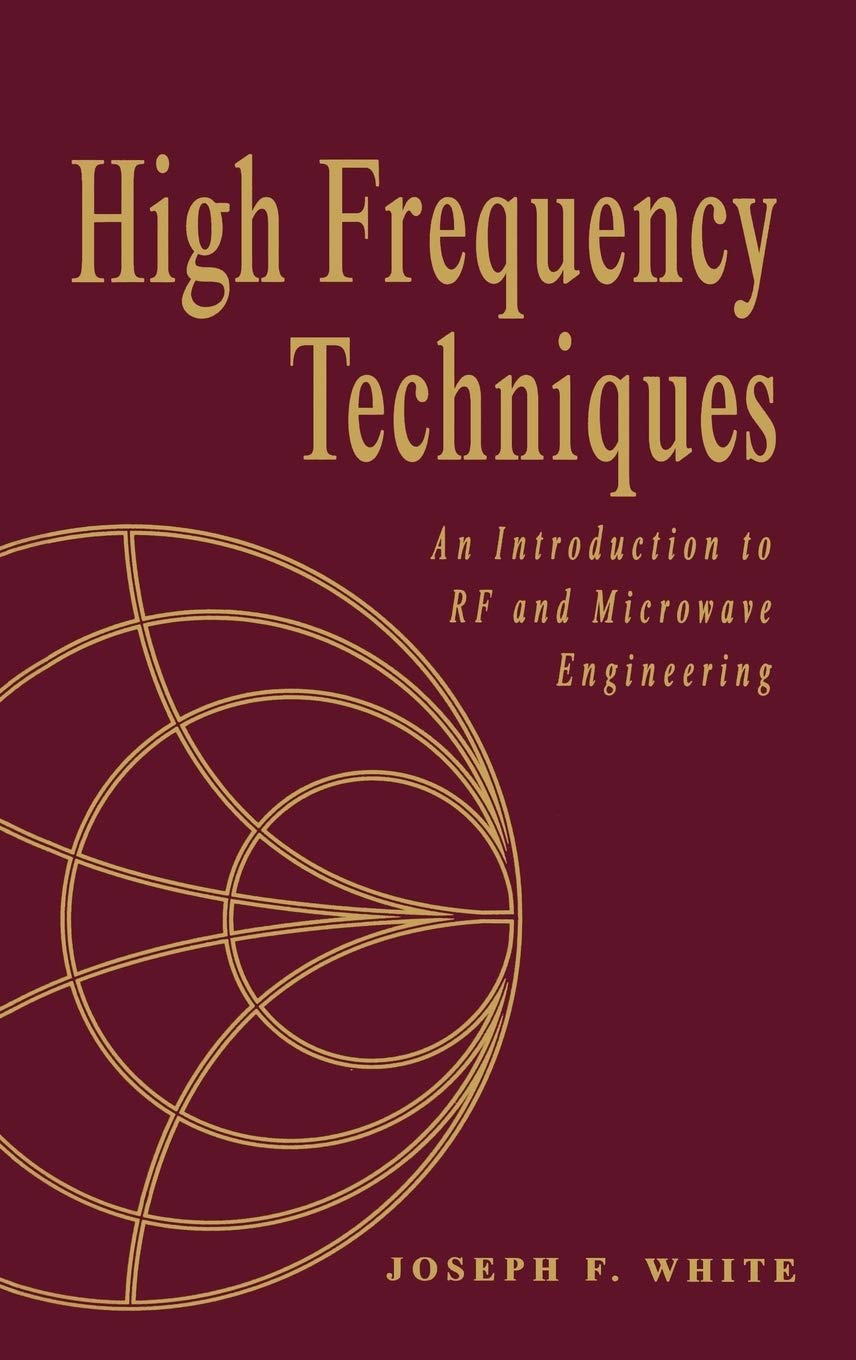
Title
High Frequency Techniques: An Introduction to RF and Microwave Design and Computer Simulation,Used
Sold by Ergodebooks, an authorized reseller.
Returns accepted within 30 days | support@ergodebooks.com
Shipping Information
- Free Standard Shipping — United States only
- Processing Time: 3–5 business days
- Estimated Delivery: 6–10 business days after dispatch
- Double-boxed, fully insured & discreetly packaged
- Tracking number sent via email once dispatched
Returns & Refund
Returns accepted within 30 days of delivery.
Damaged or Defective Item
Free return shipping + replacement or full refund
Wrong Item Received
Free return shipping + replacement or full refund
Change of Mind
Return shipping at customer's expense · 25% restocking fee applies
Payment Option

This textbook is an introduction to microwave engineering. The scope of this book extends from topics for a first course in electrical engineering, in which impedances are analyzed using complex numbers, through the introduction of transmission lines that are analyzed using the Smith Chart, and on to graduate level subjects, such as equivalent circuits for obstacles in hollow waveguides, analyzed using Greens Functions. This book is a virtual encyclopedia of circuit design methods.Despite the complexity, topics are presented in a conversational manner for ease of comprehension. The book is not only an excellent text at the undergraduate and graduate levels, but is as well a detailed reference for the practicing engineer.Consider how well informed an engineer will be who has become familiar with these topics as treated in High Frequency Techniques: (in order of presentation)Brief history of wireless (radio) and the Morse codeU.S. Radio Frequency AllocationsIntroduction to vectorsAC analysis and why complex numbers and impedance are usedCircuit and antenna reciprocityDecibel measureMaximum power transferSkin effectComputer simulation and optimization of networksLC matching of one impedance to anotherCoupled ResonatorsUniform transmission lines for propagationVSWR, return Loss and mismatch errorThe Telegrapher Equations (derived)Phase and Group VelocitiesThe Impedance Transformation Equation for lines (derived)Fano's and Bode's matching limitsThe Smith Chart (derived)Slotted Line impedance measurementConstant Q circles on the Smith ChartApproximating a transmission line with lumped L's and C'sABCD, Z, Y and Scattering matrix analysis methods for circuitsStatistical Design and Yield Analysis of productsElectromagnetic FieldsGauss's LawVector Dot Product, Divergence and CurlStatic Potential and GradientAmpere's Law and Vector CurlMaxwell's Equations and their visualizationThe LaplacianRectangular, cylindrical and spherical coordinatesSkin EffectThe Wave EquationThe Helmholtz EquationsPlane Propagating WavesRayleigh FadingCircular (elliptic) PolarizationPoynting's TheoremEM fields on Transmission LinesCalculating the impedance of coaxial linesCalculating and visualizing the fields in waveguidesPropagation constants and waveguide modesThe Taylor Series ExpansionFourier Series and Green's FunctionsHigher order modes and how to suppress themVector Potential and Retarded PotentialsWire and aperture antennasRadio propagation and path lossElectromagnetic computer simulation of structuresDirectional couplersThe Rat Race HybridEven and Odd Mode Analysis applied to the backward wave couplerNetwork analyzer impedance and transmission measurementsTwoport Scattering Parameters (s matrix)The Hybrid Ring couplerThe Wilkinson power dividerFilter design: Butterworth, Maximally flat & Tchebyscheff responsesFilter QDiplexer, Bandpass and Elliptic filtersRichard's Transformation & Kurodas IdentitiesMumford's transmission line stub filtersTransistor Amplifier Design: gain, biasing, stability, and conjugate matchingNoise in systems, noise figure of an amplifier cascadeAmplifier nonlinearity, and spurious free dynamic rangeStatistical Design and Yield Analysis
⚠️ WARNING (California Proposition 65):
This product may contain chemicals known to the State of California to cause cancer, birth defects, or other reproductive harm.
For more information, please visit www.P65Warnings.ca.gov.