If you have any questions, you are always welcome to contact us. We'll get back to you as soon as possible, withing 24 hours on weekdays.
Customer service
All questions about your order, return and delivery must be sent to our customer service team by e-mail at yourstore@yourdomain.com
Sale & Press
If you are interested in selling our products, need more information about our brand or wish to make a collaboration, please contact us at press@yourdomain.com
Help
If you have any questions, you are always welcome to contact us. We'll get back to you as soon as possible, withing 24 hours on weekdays.
Customer service
All questions about your order, return and delivery must be sent to our customer service team by e-mail at yourstore@yourdomain.com
Sale & Press
If you are interested in selling our products, need more information about our brand or wish to make a collaboration, please contact us at press@yourdomain.com
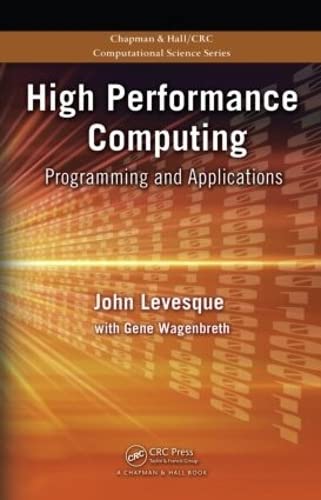
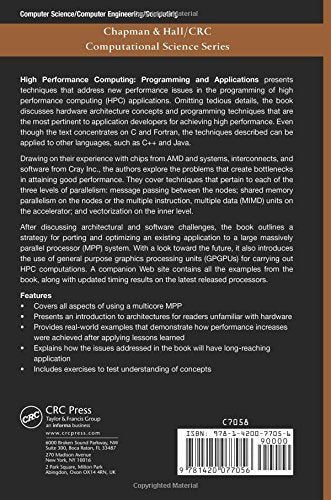
High Performance Computing: Programming and Applications presents techniques that address new performance issues in the programming of high performance computing (HPC) applications. Omitting tedious details, the book discusses hardware architecture concepts and programming techniques that are the most pertinent to application developers for achieving high performance. Even though the text concentrates on C and Fortran, the techniques described can be applied to other languages, such as C++ and Java.Drawing on their experience with chips from AMD and systems, interconnects, and software from Cray Inc., the authors explore the problems that create bottlenecks in attaining good performance. They cover techniques that pertain to each of the three levels of parallelism: Message passing between the nodes Shared memory parallelism on the nodes or the multiple instruction, multiple data (MIMD) units on the accelerator Vectorization on the inner levelAfter discussing architectural and software challenges, the book outlines a strategy for porting and optimizing an existing application to a large massively parallel processor (MPP) system. With a look toward the future, it also introduces the use of general purpose graphics processing units (GPGPUs) for carrying out HPC computations. A companion website at www.hybridmulticoreoptimization.com contains all the examples from the book, along with updated timing results on the latest released processors.
⚠️ WARNING (California Proposition 65):
This product may contain chemicals known to the State of California to cause cancer,
birth defects, or other reproductive harm.
For MAP (Minimum Advertised Price) violations and Intellectual Property (IP) or Trademark concerns, please contact:
support@ergodebooks.com
⚠️ California Proposition 65 Warning: Some products sold on this website may expose you to chemicals known to the State of California to cause cancer, birth defects, or other reproductive harm. For more information, visit www.P65Warnings.ca.gov.