
Title
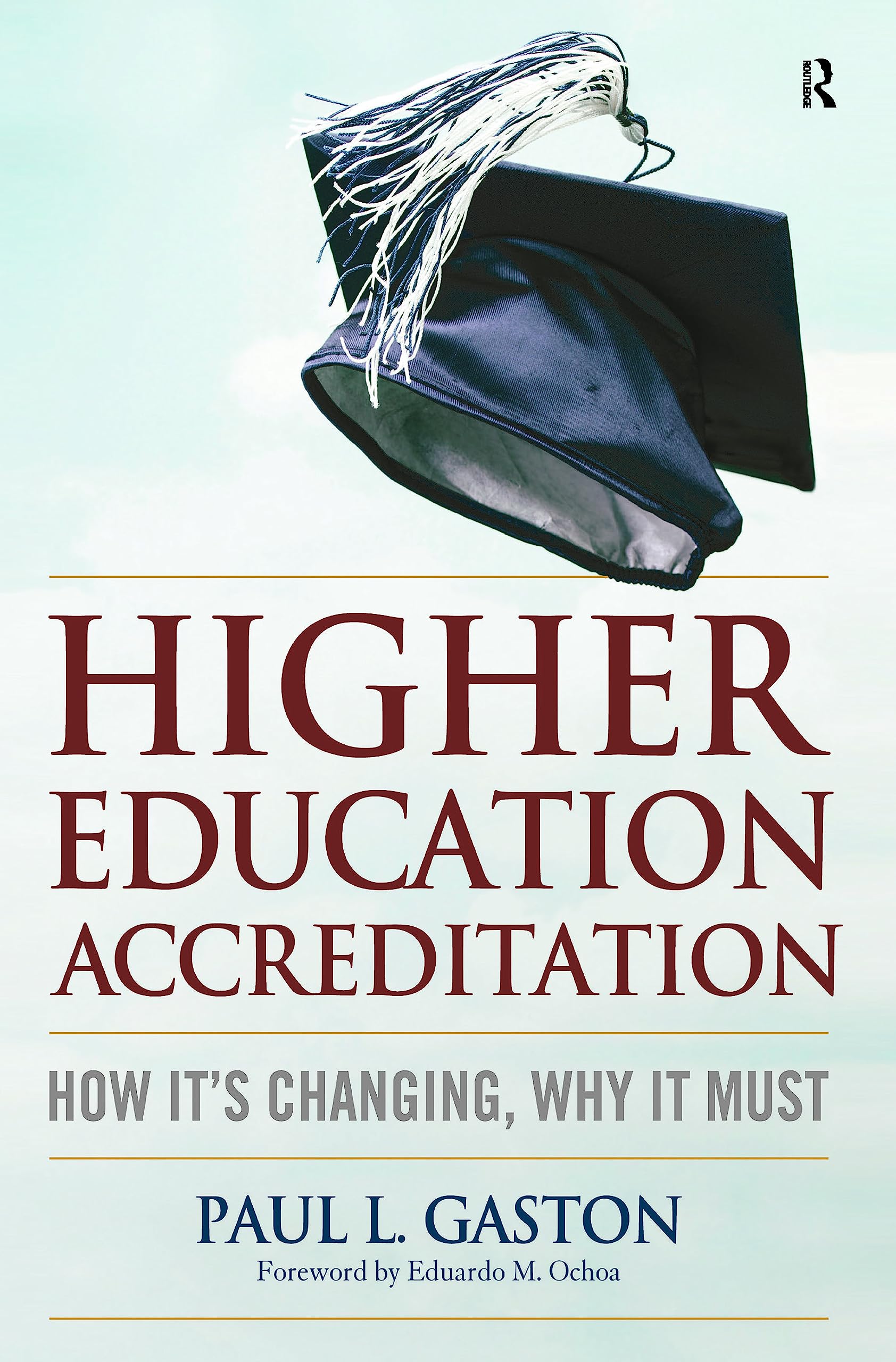
Higher Education Accreditation: How It's Changing, Why It Must,Used
Sold by Ergodebooks, an authorized reseller.
Returns accepted within 30 days | support@ergodebooks.com
Shipping Information
- Free Standard Shipping — United States only
- Processing Time: 3–5 business days
- Estimated Delivery: 6–10 business days after dispatch
- Double-boxed, fully insured & discreetly packaged
- Tracking number sent via email once dispatched
Returns & Refund
Returns accepted within 30 days of delivery.
Damaged or Defective Item
Free return shipping + replacement or full refund
Wrong Item Received
Free return shipping + replacement or full refund
Change of Mind
Return shipping at customer's expense · 25% restocking fee applies
Payment Option

Is the accreditation system broken as claimed by successive Secretaries of Education and some recent reports? This book addresses this question headon, asking whether accreditation is indeed in need of radical reform, and whether the agencies authority should be curtailed; or whether in fact the changes now underway that accrediting agencies contend ensure rigorous and consistent standards and degrees that are a reliable gauge of student attainment are moving the academy and the nation in the right direction. In a sweeping and ambitious book, Paul Gaston deploys his knowledge and experience as a peer reviewer for three regional accrediting agencies, a former board member and chair of the Association of Specialized and Professional Accreditors, and his involvement in the early stages of the Council for Higher Education Accreditation, to go beyond the polemics to explore whether a strategy that builds on the emerging values and good practices can achieve the substantive and positive improvements the public is demanding.As an introduction for readers new to the debate, he provides a brief overview of the development of accreditation, its terminology, and structure, describing how it currently works, and what it has achieved; and offers insight into the proliferation of the missions of accreditation as well as the multiplicity of stakeholders with an interest in its outcomes to question whether the mandate of accreditation should, as some contend, be expanded, or particular missions reassigned or abandoned. This established, he undertakes a dispassionate analysis of the arguments and recommendations of critics and supporters of the current direction of accreditation to identify common ground and explore constructive ways forward, paying specific attention to current and potential reforms of the three sectors of higher education accreditation: the seven regional accrediting associations, the national accreditors, and programmatic, or specialized accreditation. The book concludes by outlining a comprehensive approach to reform. His proposal would preserve practices that already work well while advancing important changes that can be incrementally implemented. The result would be a higher education accreditation structure more cost effective, more efficient, more transparent and accountable, and more responsive to institutional and public needs.
⚠️ WARNING (California Proposition 65):
This product may contain chemicals known to the State of California to cause cancer, birth defects, or other reproductive harm.
For more information, please visit www.P65Warnings.ca.gov.
- Q: How many pages does this book have? A: This book has two hundred seventy-four pages. It provides an in-depth exploration of higher education accreditation.
- Q: What is the binding type of the book? A: The book is hardcover. This makes it durable and suitable for long-term use.
- Q: What are the dimensions of the book? A: The book measures six point twenty-four inches in length, zero point eighty-three inches in width, and nine point twenty-five inches in height.
- Q: Who is the author of this book? A: The author is Paul L. Gaston. He has extensive experience in the field of higher education accreditation.
- Q: What is the main topic of this book? A: The book focuses on higher education accreditation. It discusses potential reforms and the current state of the accreditation system.
- Q: Is this book suitable for beginners in education policy? A: Yes, this book is suitable for beginners. It provides an overview of accreditation concepts and practices.
- Q: How should I care for this hardcover book? A: To care for this book, keep it in a cool, dry place. Avoid exposure to direct sunlight to preserve its condition.
- Q: Can this book be stored on a bookshelf? A: Yes, you can store this book on a bookshelf. Its hardcover design allows it to stand upright without damage.
- Q: What if the book arrives damaged? A: If the book arrives damaged, you should contact customer support for a replacement. Most retailers offer return policies for damaged items.
- Q: Is there a warranty for this book? A: No, there is typically no warranty for books. However, check the retailer’s return policy for additional support.
- Q: Are there any special features in this book? A: Yes, the book is labeled as a used book in good condition. This means it may show minor signs of wear but is still functional.
- Q: What is the publisher of this book? A: The publisher is Routledge. They are well-known for their academic publications.
- Q: Is this book a good resource for educators? A: Yes, this book is an excellent resource for educators. It addresses current issues in accreditation and offers insights for improvement.
- Q: Does this book discuss the history of accreditation? A: Yes, the book provides a brief overview of the development of accreditation. It covers key terms and structures.
- Q: What kind of readers would benefit from this book? A: Readers interested in higher education policy, accreditation processes, and institutional reform will benefit from this book.