If you have any questions, you are always welcome to contact us. We'll get back to you as soon as possible, withing 24 hours on weekdays.
Customer service
All questions about your order, return and delivery must be sent to our customer service team by e-mail at yourstore@yourdomain.com
Sale & Press
If you are interested in selling our products, need more information about our brand or wish to make a collaboration, please contact us at press@yourdomain.com
Help
If you have any questions, you are always welcome to contact us. We'll get back to you as soon as possible, withing 24 hours on weekdays.
Customer service
All questions about your order, return and delivery must be sent to our customer service team by e-mail at yourstore@yourdomain.com
Sale & Press
If you are interested in selling our products, need more information about our brand or wish to make a collaboration, please contact us at press@yourdomain.com
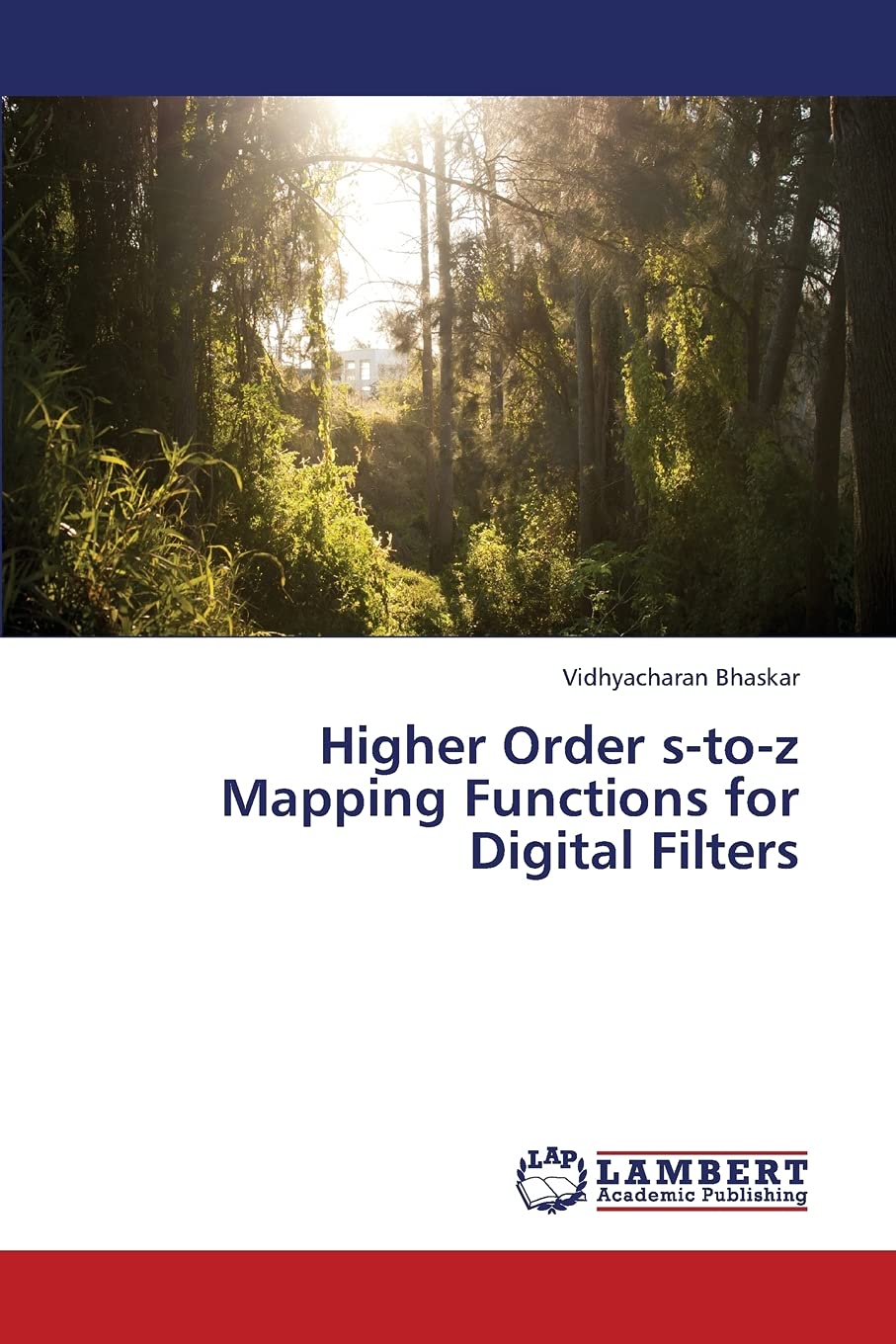
Digital filters are frequently designed by taking an analog (continuoustime) filter and converting it into its digital (discretetime) equivalent. Linear, timeinvariant discretetime filters with fixed sampling rates are usually designed by conversions from the analog using bilinear transformation. This book deals with conversions from analog domain into digital domain by higher order stoz transformations. By using higher order rules, we obtain better accuracy in digitizing continuoustime filters. Unlike the bilinear transformation, the higher order rules do not have a stability region which cover the entire lefthalf of the splane. The sampling period used in the digitizing process has to be selected in such a way that all the poles of the continuoustime filter lie inside the stability region of the selected rule. Otherwise, the discretetime filter will be unstable. The startup error obtained due to the discontinuity in the input signal is also discussed.
⚠️ WARNING (California Proposition 65):
This product may contain chemicals known to the State of California to cause cancer,
birth defects, or other reproductive harm.
For MAP (Minimum Advertised Price) violations and Intellectual Property (IP) or Trademark concerns, please contact:
support@ergodebooks.com
⚠️ California Proposition 65 Warning: Some products sold on this website may expose you to chemicals known to the State of California to cause cancer, birth defects, or other reproductive harm. For more information, visit www.P65Warnings.ca.gov.