
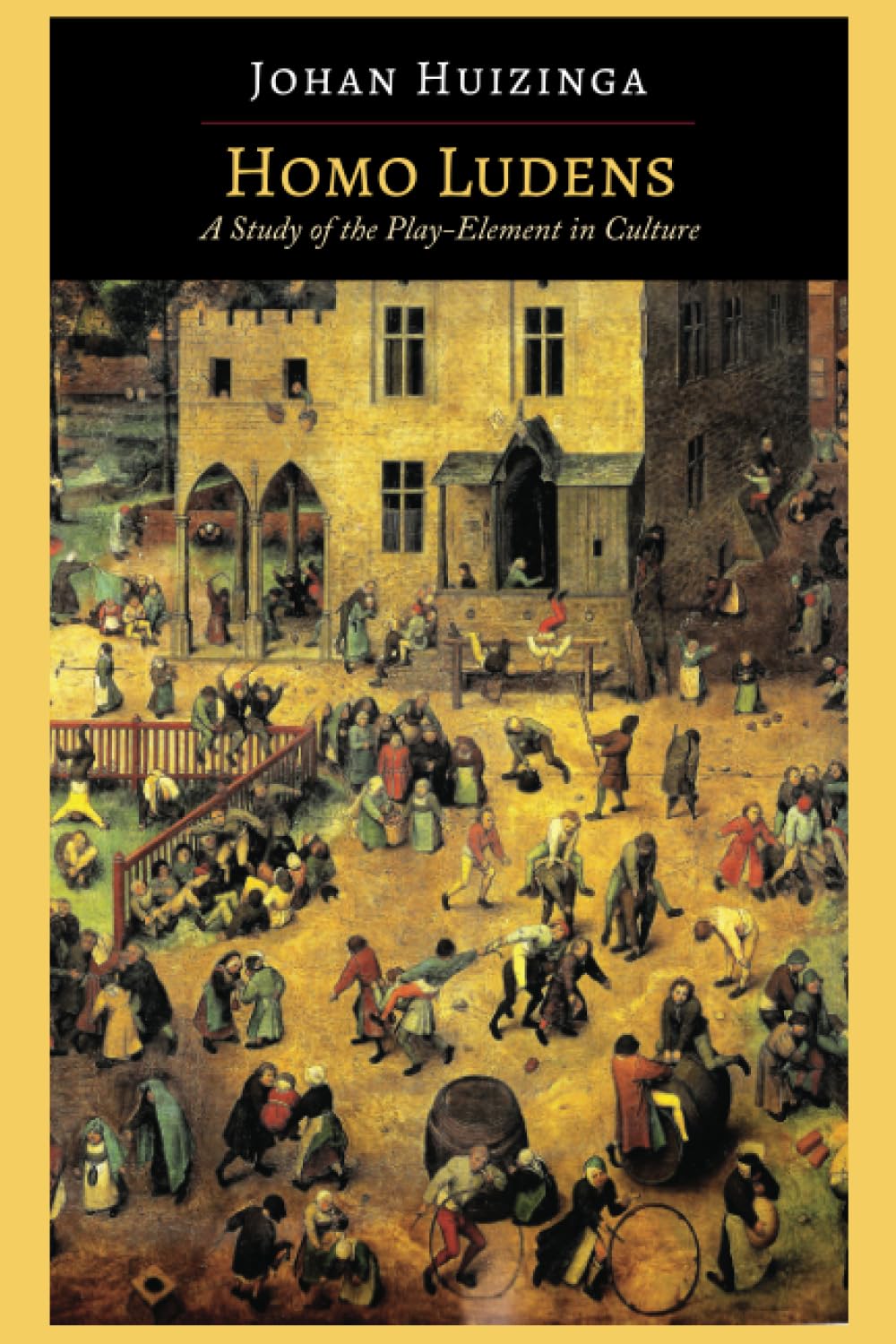
Title


Homo Ludens: A Study Of The Playelement In Culture
Sold by Ergodebooks, an authorized reseller.
Returns accepted within 30 days | support@ergodebooks.com
Shipping Information
- Free Standard Shipping — United States only
- Processing Time: 3–5 business days
- Estimated Delivery: 6–10 business days after dispatch
- Double-boxed, fully insured & discreetly packaged
- Tracking number sent via email once dispatched
Returns & Refund
Returns accepted within 30 days of delivery.
Damaged or Defective Item
Free return shipping + replacement or full refund
Wrong Item Received
Free return shipping + replacement or full refund
Change of Mind
Return shipping at customer's expense · 25% restocking fee applies
Payment Option

2014 Reprint Of 1955 Edition. Full Facsimile Of The Original Edition. Not Reproduced With Optical Recognition Software. In Homo Ludens, The Classic Evaluation Of Play That Has Become A Mustread For Those In Game Design, Dutch Philosopher Johan Huizinga Defines Play As The Central Activity In Flourishing Societies. Like Civilization, Play Requires Structure And Participants Willing To Create Within Limits. Starting With Plato, Huizinga Traces The Contribution Of Homo Ludens, Or Man The Player Through Medieval Times, The Renaissance, And Into Our Modern Civilization. Huizinga Defines Play Against A Rich Theoretical Background, Using Crosscultural Examples From The Humanities, Business, And Politics. Homo Ludens Defines Play For Generations To Come.
⚠️ WARNING (California Proposition 65):
This product may contain chemicals known to the State of California to cause cancer, birth defects, or other reproductive harm.
For more information, please visit www.P65Warnings.ca.gov.
- Q: How many pages does the book have? A: This book has two hundred thirty-two pages. It features a comprehensive exploration of play in culture by Johan Huizinga.
- Q: What are the dimensions of the book? A: The dimensions of the book are six inches in length, zero point fifty-nine inches in width, and nine point zero two inches in height.
- Q: What type of binding does this book have? A: This book has a paperback binding. This makes it lightweight and easy to handle.
- Q: Who is the author of 'Homo Ludens'? A: The author is Johan Huizinga. He is a renowned Dutch philosopher known for his analysis of culture and play.
- Q: Is this book suitable for all ages? A: Yes, this book is suitable for various ages. However, it is primarily aimed at individuals interested in game design and cultural studies.
- Q: What themes does 'Homo Ludens' explore? A: The book explores themes of play as a central activity in culture and civilization. It discusses the role of play in different historical contexts.
- Q: How should I care for this book? A: To care for the book, keep it in a dry place and avoid exposure to direct sunlight. This will help preserve its condition.
- Q: Can I store this book on a bookshelf? A: Yes, you can store this book on a bookshelf. Ensure it is placed upright to maintain its shape and prevent damage.
- Q: Is this book a good choice for academic study? A: Yes, this book is an excellent choice for academic study. It provides in-depth insights into the concept of play in culture.
- Q: What if the book arrives damaged? A: If the book arrives damaged, you should contact customer service for return instructions. Most retailers offer return policies for such issues.
- Q: Are there any illustrations in the book? A: No, the book does not contain illustrations. It focuses on text and theoretical analysis without visual aids.
- Q: Is there a digital version of this book available? A: No, this listing is for a physical edition only. There is no mention of a digital version available.
- Q: How does this book compare to other works on play? A: This book is considered a seminal work in the field of play studies. It offers a unique philosophical perspective not found in many other titles.
- Q: What is the publication date of this edition? A: This edition was reprinted in two thousand fourteen. It is a full facsimile of the original nineteen fifty-five edition.
- Q: Does this book reference historical figures? A: Yes, the book references several historical figures, including Plato. It contextualizes the concept of play throughout history.