
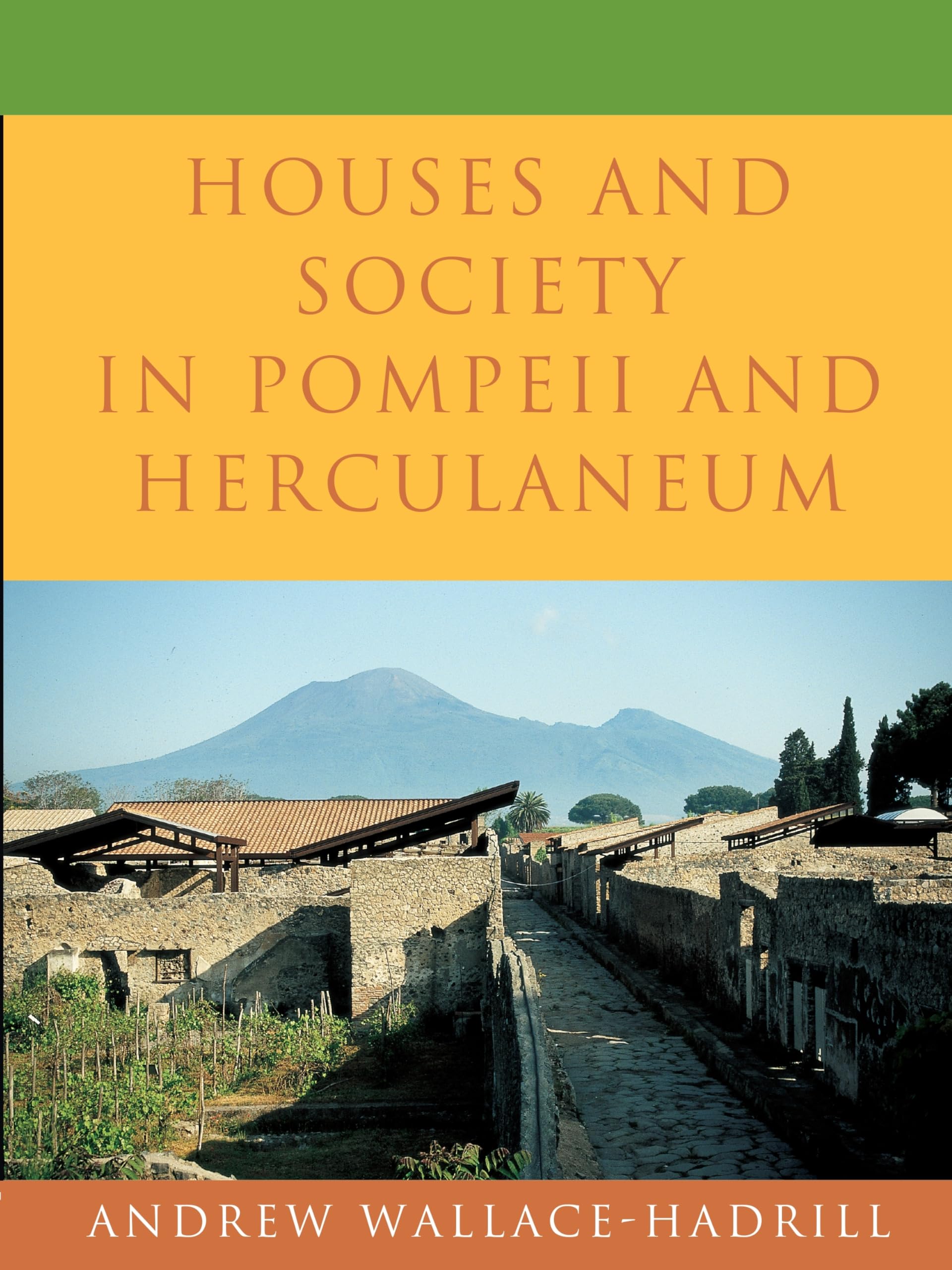
Title
Houses and Society in Pompeii and Herculaneum,Used
Sold by Ergodebooks, an authorized reseller.
Returns accepted within 30 days | support@ergodebooks.com
Shipping Information
- Free Standard Shipping — United States only
- Processing Time: 3–5 business days
- Estimated Delivery: 6–10 business days after dispatch
- Double-boxed, fully insured & discreetly packaged
- Tracking number sent via email once dispatched
Returns & Refund
Returns accepted within 30 days of delivery.
Damaged or Defective Item
Free return shipping + replacement or full refund
Wrong Item Received
Free return shipping + replacement or full refund
Change of Mind
Return shipping at customer's expense · 25% restocking fee applies
Payment Option

Few sources reveal the life of the ancient Romans as vividly as do the houses preserved by the eruption of Vesuvius. Wealthy Romans lavished resources on shaping their surroundings to impress their crowds of visitors. The fashions they set were taken up and imitated by ordinary citizens. In this illustrated book, Andrew WallaceHadrill explores the rich potential of the houses of Pompeii and Herculaneum to offer new insights into Roman social life. Exposing misconceptions derived from contemporary culture, he shows the close interconnection of spheres we take as discrete: public and private, family and outsiders, work and leisure.Combining archaeological evidence with Roman texts and comparative material from other cultures, WallaceHadrill raises a range of new questions. How did the organization of space and the use of decoration help to structure social encounters between owner and visitor, man and woman, master and slave? What sort of 'households' did the inhabitants of the Roman house form? How did the world of work relate to that of entertainment and leisure? How widely did the luxuries of the rich spread among the houses of craftsmen and shopkeepers? Through analysis of the remains of over two hundred houses, WallaceHadrill reveals the remarkably dynamic social environment of early imperial Italy, and the vital part that houses came to play in defining what it meant 'to live as a Roman.'
⚠️ WARNING (California Proposition 65):
This product may contain chemicals known to the State of California to cause cancer, birth defects, or other reproductive harm.
For more information, please visit www.P65Warnings.ca.gov.
- Q: What is the size of the book 'Houses and Society in Pompeii and Herculaneum'? A: The book measures seven point seven six inches in length, zero point seven five inches in width, and ten point two five inches in height.
- Q: How many pages does 'Houses and Society in Pompeii and Herculaneum' have? A: The book contains two hundred sixty-four pages, offering an in-depth exploration of ancient Roman social life.
- Q: What type of binding does this book have? A: This book is available in paperback binding, making it lightweight and easy to handle.
- Q: Who is the author of 'Houses and Society in Pompeii and Herculaneum'? A: The author is Andrew Wallace-Hadrill, a noted scholar in Roman history and archaeology.
- Q: What is the main focus of the book? A: The book explores the social life of ancient Romans through the analysis of houses preserved by the eruption of Vesuvius.
- Q: How can I use this book for academic purposes? A: You can use this book as a scholarly resource for understanding Roman architecture, social structures, and cultural dynamics.
- Q: Is this book suitable for beginners in Roman history? A: Yes, the book is suitable for beginners, as it provides accessible insights while also engaging more advanced readers.
- Q: Can this book be used in a classroom setting? A: Yes, this book can be effectively used in classrooms to discuss ancient Roman society and its architectural significance.
- Q: How should I store this book to keep it in good condition? A: Store the book upright on a shelf away from direct sunlight to prevent damage to the cover and pages.
- Q: Is there any special care needed for this paperback book? A: No special care is needed; simply keep it dry and away from moisture to maintain its condition.
- Q: What if the book arrives damaged? A: If the book arrives damaged, you should contact the seller for information on their return policy and refund process.
- Q: Can I return the book if I'm not satisfied? A: Yes, you can typically return the book within a specified period if you are not satisfied, but check the seller's return policy for details.
- Q: Is this book appropriate for children? A: While the book is not specifically targeted at children, it can be suitable for older students interested in history.
- Q: What themes does the book explore? A: The book explores themes of public and private life in Rome, including family dynamics and social interactions.
- Q: How does this book compare to other historical texts on Rome? A: This book offers a unique perspective by focusing on domestic spaces, unlike other texts that might concentrate on political history.
- Q: What kind of archaeological evidence is discussed in the book? A: The book discusses archaeological evidence from over two hundred houses in Pompeii and Herculaneum, providing rich insights into Roman life.