
Title
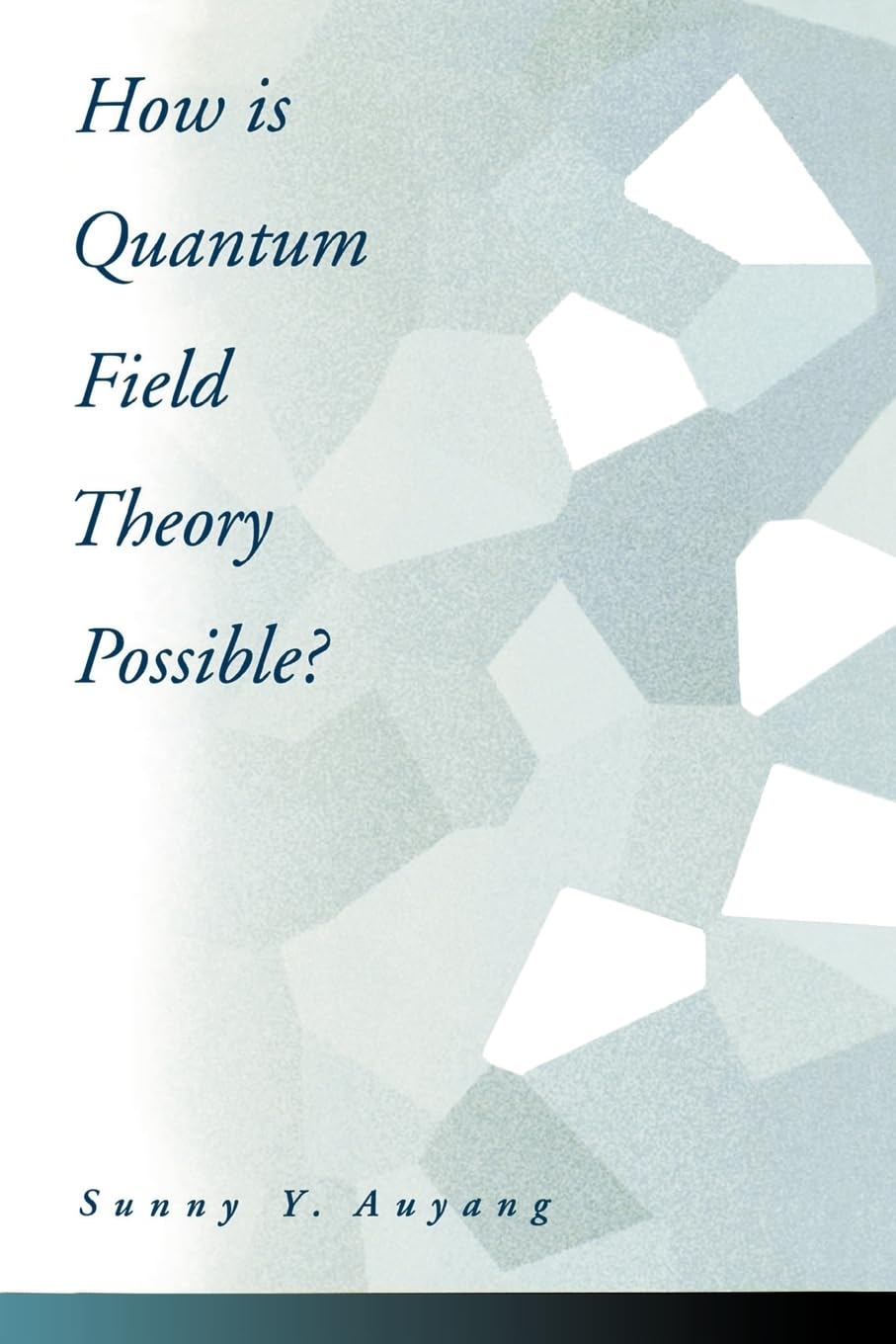
How Is Quantum Field Theory Possible?,New
Sold by Ergodebooks, an authorized reseller.
Returns accepted within 30 days | support@ergodebooks.com
Shipping Information
- Free Standard Shipping — United States only
- Processing Time: 3–5 business days
- Estimated Delivery: 6–10 business days after dispatch
- Double-boxed, fully insured & discreetly packaged
- Tracking number sent via email once dispatched
Returns & Refund
Returns accepted within 30 days of delivery.
Damaged or Defective Item
Free return shipping + replacement or full refund
Wrong Item Received
Free return shipping + replacement or full refund
Change of Mind
Return shipping at customer's expense · 25% restocking fee applies
Payment Option

Quantum field theory (QFT) combines quantum mechanics with Einstein's special theory of relativity and underlies elementary particle physics. This book presents a philosophical analysis of QFT. It is the first treatise in which the philosophies of spacetime, quantum phenomena, and particle interactions are encompassed in a unified framework. Describing the physics in nontechnical terms, and schematically illustrating complex ideas, the book also serves as an introduction to fundamental physical theories. The philosophical interpretation both upholds the reality of the quantum world and acknowledges the irreducible cognitive elements in its representation. The interpretation is based on an analysis of our ways of thinking as the are embedded in the logical structure of QFT. The author argues that philosophical categories are significant only if they play active and essential roles in our knowledge and hence constitute part of the theories in actual use. Thus she regards physical theories as primary, extracts their categorical structure, and uses it to rethink key philosophical questions. Among the questions this book tries to answer are: What are the quantum properties independent of measurements? How do we refer to individual things in a continuous field? How do theories relate to objects? What are the general conditions of the world and of our ways of thinking that make possible our knowledge of the microscopic realm, which is so intangible and counterintuitive? As a penetrating analysis of vital themes in contemporary science, the book will engage the interest of students and professionals in physics and philosophy alike.
⚠️ WARNING (California Proposition 65):
This product may contain chemicals known to the State of California to cause cancer, birth defects, or other reproductive harm.
For more information, please visit www.P65Warnings.ca.gov.
- Q: What is the main focus of 'How Is Quantum Field Theory Possible?' A: The book provides a philosophical analysis of quantum field theory (QFT), integrating concepts from quantum mechanics and Einstein's theory of relativity, particularly in the context of elementary particle physics.
- Q: Who is the author of this book? A: The author of 'How Is Quantum Field Theory Possible?' is Sunny Y. Auyang.
- Q: What topics does this book cover? A: It discusses space-time, quantum phenomena, and particle interactions within a unified philosophical framework, exploring key questions about quantum properties and the nature of knowledge.
- Q: Is this book suitable for beginners? A: Yes, the book describes complex physics concepts in nontechnical terms, making it accessible for readers new to quantum field theory.
- Q: How many pages does the book have? A: The book contains 288 pages.
- Q: What is the binding type of this book? A: The book is available in paperback binding.
- Q: When was 'How Is Quantum Field Theory Possible?' published? A: The book was published on July 27, 1995.
- Q: What are some key philosophical questions addressed in the book? A: The book addresses questions such as the independence of quantum properties from measurements and the relationship between theories and objects.
- Q: What is the condition of the book? A: The book is in new condition.
- Q: In which category is this book classified? A: It is classified under Cognitive Psychology.