
Title
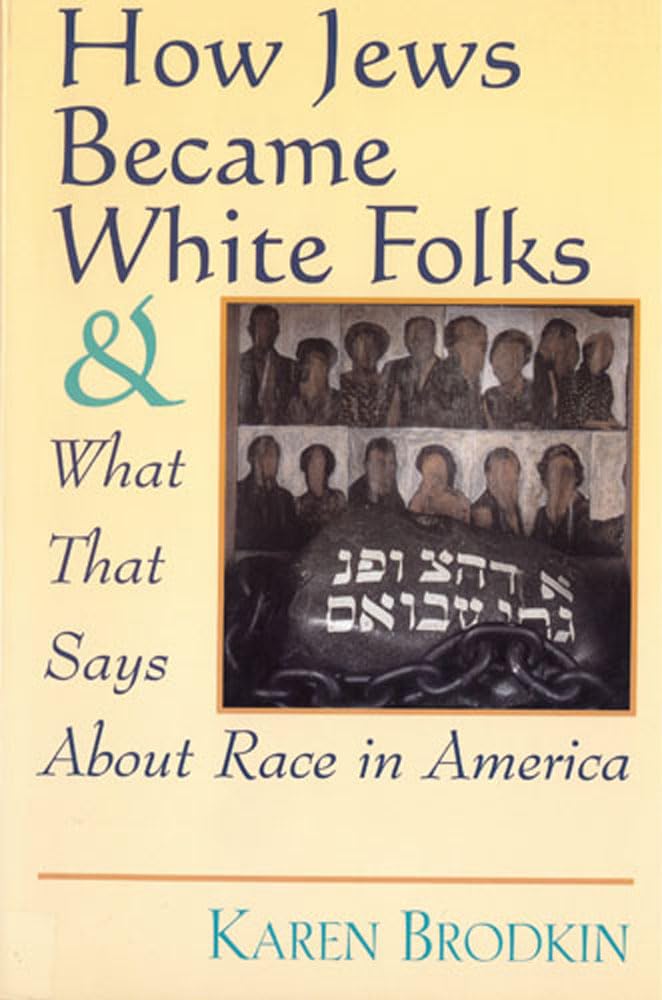
How Jews Became White Folks and What That Says About Race in America,Used
Sold by Ergodebooks, an authorized reseller.
Returns accepted within 30 days | support@ergodebooks.com
Shipping Information
- Free Standard Shipping — United States only
- Processing Time: 3–5 business days
- Estimated Delivery: 6–10 business days after dispatch
- Double-boxed, fully insured & discreetly packaged
- Tracking number sent via email once dispatched
Returns & Refund
Returns accepted within 30 days of delivery.
Damaged or Defective Item
Free return shipping + replacement or full refund
Wrong Item Received
Free return shipping + replacement or full refund
Change of Mind
Return shipping at customer's expense · 25% restocking fee applies
Payment Option

The fashion identities in the context of a wider conversation about American nationhood, to whom it belongs and what belonging means. Race and ethnicity, class, gender, and sexuality are all staple ingredients in this conversation. They are salient aspects of social being from which economic practices, political policies, and popular discourses create 'Americans.' Because all of these facets of social being have such significant meaning on a national scale, they also have major consequences for both individuals and groups in terms of their success and wellbeing, as well as how they perceive themselves socially and politically.The history of Jews in the United States is one of racial change that provides useful insights on race in America. Prevailing classifications have sometimes assigned Jews to the white race and at other times have created an offwhite racial designation for them. Those changes in racial assignment have shaped the ways American Jews of different eras have constructed their ethnoracial identities. Brodkin illustrates these changes through an analysis of her own family's multigenerational experience. She shows how Jews experience a kind of double vision that comes from racial middleness: on the one hand, marginality with regard to whiteness; on the other, whiteness and belonging with regard to blackness.Class and gender are key elements of racemaking in American history. Brodkin suggests that this country's racial assignment of individuals and groupsconstitutes an institutionalized system of occupational and residential segregation, is a key element in misguided public policy, and serves as a pernicious foundational principle in the construction of nationhood. Alternatives available to nonwhite and alien 'others' have been either to whiten or to be consigned to an inferior underclass unworthy of full citizenship. The American ethnoracial mapwho is assigned to each of these polesis continually changing, although the binary of black and white is not. As a result, the structure within which Americans form their ethnoracial, gender, and class identities is distressingly stable. Brodkin questions the means by which Americans construct their political identities and what is required to weaken the hold of this governing myth.
⚠️ WARNING (California Proposition 65):
This product may contain chemicals known to the State of California to cause cancer, birth defects, or other reproductive harm.
For more information, please visit www.P65Warnings.ca.gov.
- Q: What is the main theme of 'How Jews Became White Folks and What That Says About Race in America'? A: The book explores the complex relationship between race, ethnicity, and identity in America, particularly focusing on the historical experiences of Jews and how their racial classification has evolved.
- Q: Who is the author of this book? A: The author of the book is Karen Brodkin.
- Q: What is the publication date of this book? A: The book was published on October 1, 1998.
- Q: What are the key topics discussed in the book? A: Key topics include race and ethnicity, class, gender, and sexuality in relation to American identity and the historical context of Jews in America.
- Q: How many pages does the book have? A: The book contains 264 pages.
- Q: What is the condition of the book being sold? A: The book is listed as a used book in good condition.
- Q: What type of binding does this book have? A: The book is available in paperback binding.
- Q: Is this book suitable for academic studies? A: Yes, the book provides valuable insights and analyses that can be useful for academic studies on race and identity in the United States.
- Q: Does the book include personal narratives or case studies? A: Yes, Brodkin includes personal narratives and case studies, including her family's multi-generational experiences to illustrate changes in ethnoracial identities.
- Q: What makes this book a significant contribution to discussions on race in America? A: The book challenges conventional racial classifications and offers a nuanced understanding of the complexities surrounding race, identity, and belonging in American society.