
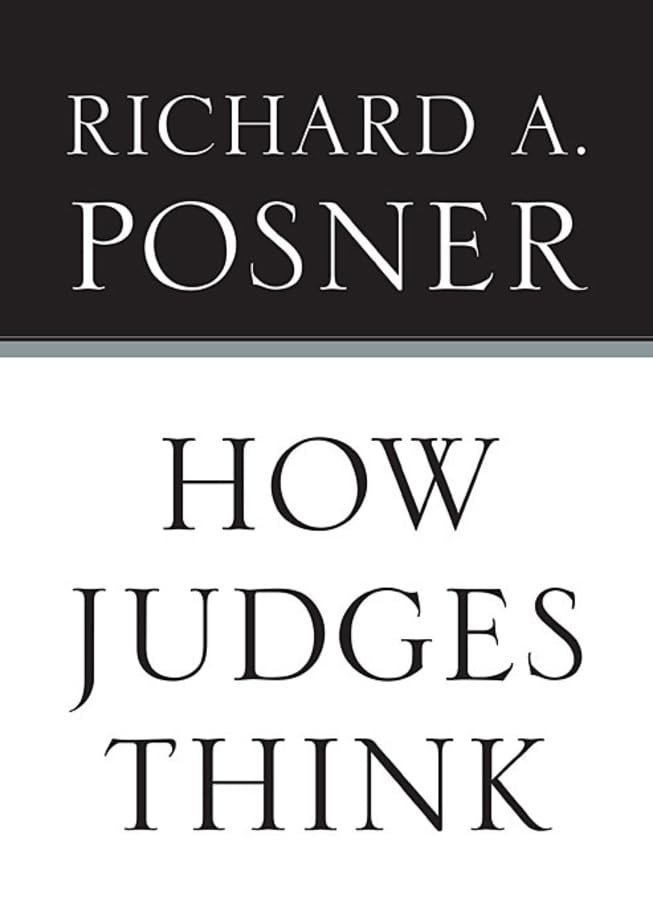
Title
How Judges Think (Pims Polity Immigration And Society Series),New
Sold by Ergodebooks, an authorized reseller.
Returns accepted within 30 days | support@ergodebooks.com
Shipping Information
- Free Standard Shipping — United States only
- Processing Time: 3–5 business days
- Estimated Delivery: 6–10 business days after dispatch
- Double-boxed, fully insured & discreetly packaged
- Tracking number sent via email once dispatched
Returns & Refund
Returns accepted within 30 days of delivery.
Damaged or Defective Item
Free return shipping + replacement or full refund
Wrong Item Received
Free return shipping + replacement or full refund
Change of Mind
Return shipping at customer's expense · 25% restocking fee applies
Payment Option

A Distinguished And Experienced Appellate Court Judge, Richard A. Posner Offers In This New Book A Unique And, To Orthodox Legal Thinkers, A Startling Perspective On How Judges And Justices Decide Cases. When Conventional Legal Materials Enable Judges To Ascertain The True Facts Of A Case And Apply Clear Preexisting Legal Rules To Them, Posner Argues, They Do So Straightforwardly; That Is The Domain Of Legalist Reasoning. However, In Nonroutine Cases, The Conventional Materials Run Out And Judges Are On Their Own, Navigating Uncharted Seas With Equipment Consisting Of Experience, Emotions, And Often Unconscious Beliefs. In Doing So, They Take On A Legislative Role, Though One That Is Confined By Internal And External Constraints, Such As Professional Ethics, Opinions Of Respected Colleagues, And Limitations Imposed By Other Branches Of Government On Freewheeling Judicial Discretion. Occasional Legislators, Judges Are Motivated By Political Considerations In A Broad And Sometimes A Narrow Sense Of That Term. In That Open Area, Most American Judges Are Legal Pragmatists. Legal Pragmatism Is Forwardlooking And Policybased. It Focuses On The Consequences Of A Decision In Both The Short And The Long Term, Rather Than On Its Antecedent Logic. Legal Pragmatism So Understood Is Really Just A Form Of Ordinary Practical Reasoning, Rather Than Some Special Kind Of Legal Reasoning.Supreme Court Justices Are Uniquely Free From The Constraints On Ordinary Judges And Uniquely Tempted To Engage In Legislative Forms Of Adjudication. More Than Any Other Court, The Supreme Court Is Best Understood As A Political Court.
⚠️ WARNING (California Proposition 65):
This product may contain chemicals known to the State of California to cause cancer, birth defects, or other reproductive harm.
For more information, please visit www.P65Warnings.ca.gov.
- Q: What is the page count of 'How Judges Think'? A: This book contains four hundred pages. It provides an in-depth exploration of judicial reasoning and decision-making.
- Q: What is the binding type of this book? A: The binding type is paperback. This makes it lightweight and easy to handle for reading.
- Q: Who is the author of 'How Judges Think'? A: The author is Richard A. Posner. He is a distinguished appellate court judge with extensive legal experience.
- Q: What themes are explored in 'How Judges Think'? A: The book explores themes of judicial reasoning, legal pragmatism, and the role of judges in the legal system. It offers unique insights into how cases are decided.
- Q: What size is 'How Judges Think'? A: The book measures six point two six inches in length, one point two six inches in width, and nine point five inches in height. This makes it a convenient size for reading.
- Q: Is 'How Judges Think' suitable for students? A: Yes, the book is suitable for students of law and those interested in the judicial system. It provides valuable insights into legal reasoning.
- Q: How should I care for my paperback book? A: To keep your paperback book in good condition, store it upright in a cool, dry place. Avoid exposure to direct sunlight to prevent fading.
- Q: Can I write in 'How Judges Think'? A: Yes, you can write in this book. Many readers find it helpful to take notes or highlight passages for better understanding.
- Q: Does 'How Judges Think' contain any illustrations? A: Yes, the book includes one line illustration. This can help clarify complex concepts discussed in the text.
- Q: What if my book arrives damaged? A: If your book arrives damaged, you should contact the seller for return instructions. Most sellers provide options for return or replacement.
- Q: Is there a warranty for this book? A: No, books typically do not come with a warranty. However, return policies may apply based on the seller.
- Q: How does 'How Judges Think' compare to other legal textbooks? A: This book offers a unique perspective on judicial decision-making, focusing on legal pragmatism rather than strict legalism, making it distinct from traditional legal textbooks.
- Q: Is this book appropriate for general readers? A: Yes, general readers interested in the judicial system will find this book informative. It presents complex ideas in an accessible manner.
- Q: What is the condition of the used book? A: The book is in good condition. This means it may show some signs of wear but remains fully readable.
- Q: How can I enhance my understanding of judicial decision-making? A: Reading 'How Judges Think' is an excellent way to enhance your understanding. The author provides insights that challenge traditional views of legal reasoning.
- Q: Is there an index or reference section in the book? A: Yes, the book includes an index, which can help you locate specific topics or terms discussed throughout the text.