
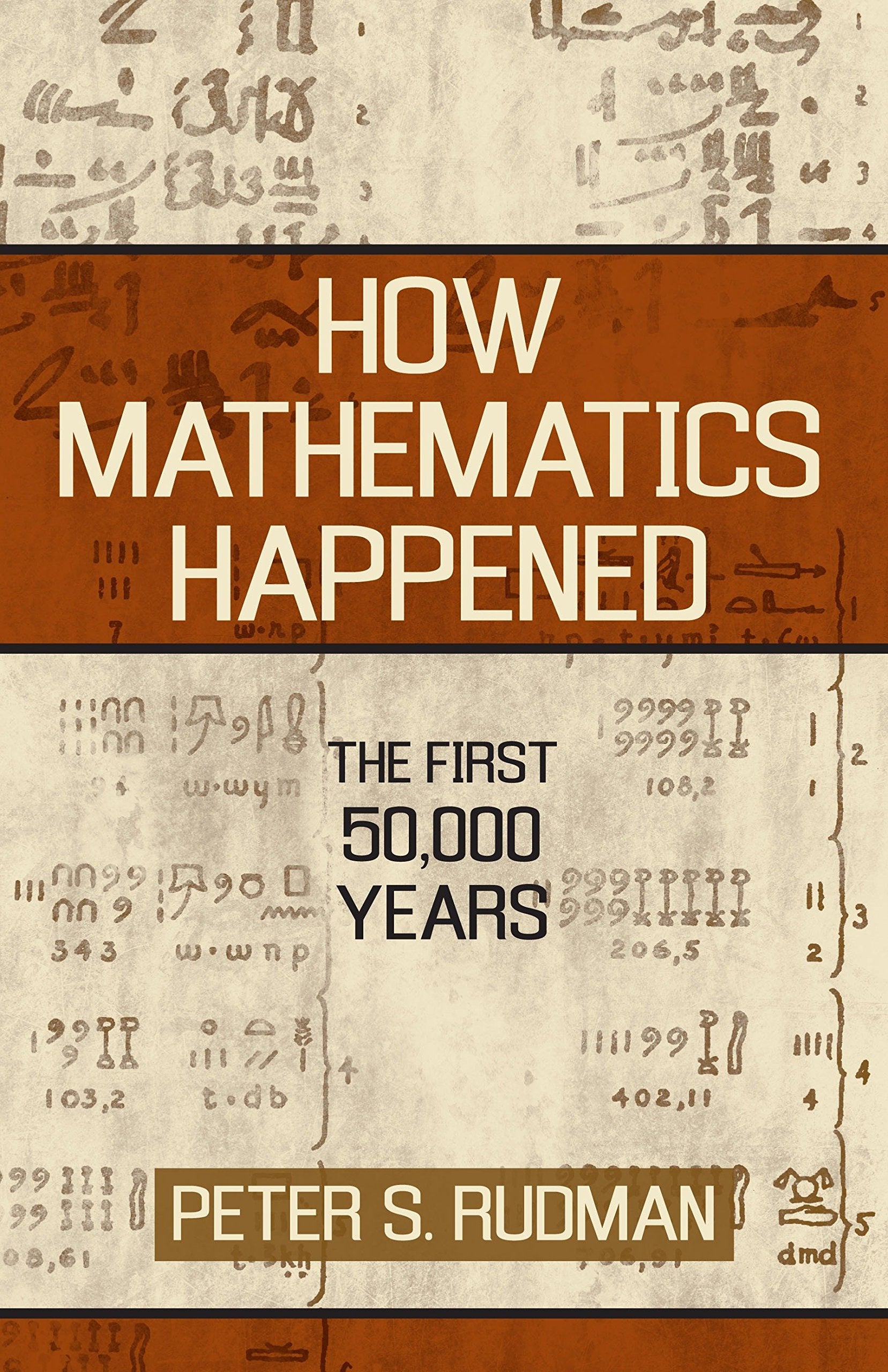
Title
How Mathematics Happened: The First 50,000 Years,New
Sold by Ergodebooks, an authorized reseller.
Returns accepted within 30 days | support@ergodebooks.com
Shipping Information
- Free Standard Shipping — United States only
- Processing Time: 3–5 business days
- Estimated Delivery: 6–10 business days after dispatch
- Double-boxed, fully insured & discreetly packaged
- Tracking number sent via email once dispatched
Returns & Refund
Returns accepted within 30 days of delivery.
Damaged or Defective Item
Free return shipping + replacement or full refund
Wrong Item Received
Free return shipping + replacement or full refund
Change of Mind
Return shipping at customer's expense · 25% restocking fee applies
Payment Option

In this fascinating discussion of ancient mathematics, author Peter Rudman does not just chronicle the archeological record of what mathematics was done; he digs deeper into the more important question of why it was done in a particular way. Why did the Egyptians use a bizarre method of expressing fractions? Why did the Babylonians use an awkward number system based on multiples of 60? Rudman answers such intriguing questions, arguing that some mathematical thinking is universal and timeless. The similarity of the Babylonian and Mayan number systems, two cultures widely separated in time and space, illustrates the argument. He then traces the evolution of number systems from finger counting in huntergatherer cultures to pebble counting in herderfarmer cultures of the Nile and TigrisEuphrates valleys, which defined the number systems that continued to be used even after the invention of writing. With separate chapters devoted to the remarkable Egyptian and Babylonian mathematics of the era from about 3500 to 2000 BCE, when all of the basic arithmetic operations and even quadratic algebra became doable, Rudman concludes his interpretation of the archeological record. Since some of the mathematics formerly credited to the Greeks is now known to be a prior Babylonian invention, Rudman adds a chapter that discusses the math used by Pythagoras, Eratosthenes, and Hippasus, which has Babylonian roots, illustrating the watershed difference in abstraction and rigor that the Greeks introduced. He also suggests that we might improve presentday teaching by taking note of how the Greeks taught math. Complete with sidebars offering recreational math brainteasers, this engrossing discussion of the evolution of mathematics will appeal to both scholars and lay readers with an interest in mathematics and its history.
⚠️ WARNING (California Proposition 65):
This product may contain chemicals known to the State of California to cause cancer, birth defects, or other reproductive harm.
For more information, please visit www.P65Warnings.ca.gov.
- Q: What is the main topic of 'How Mathematics Happened: The First 50,000 Years'? A: The book explores the history and evolution of mathematics from ancient cultures, discussing why various number systems were developed and how they reflect universal mathematical thinking.
- Q: Who is the author of this book? A: The author of 'How Mathematics Happened: The First 50,000 Years' is Peter Rudman.
- Q: What type of binding does this book have? A: This book is available in hardcover binding.
- Q: When was 'How Mathematics Happened' published? A: The book was published on February 5, 2007.
- Q: How many pages does this book contain? A: The book contains a total of 316 pages.
- Q: Is this book suitable for both scholars and lay readers? A: Yes, the book is designed to appeal to both scholars and lay readers interested in mathematics and its history.
- Q: What condition is the book in? A: The book is listed as being in good condition.
- Q: Does the book include any additional features? A: Yes, it includes sidebars with recreational math brainteasers.
- Q: What historical cultures does the book focus on? A: The book focuses on ancient cultures such as the Egyptians and Babylonians.
- Q: What is the unique perspective offered by the author? A: The author provides insights into why certain mathematical concepts developed in specific ways and how they influenced later mathematical thought.