
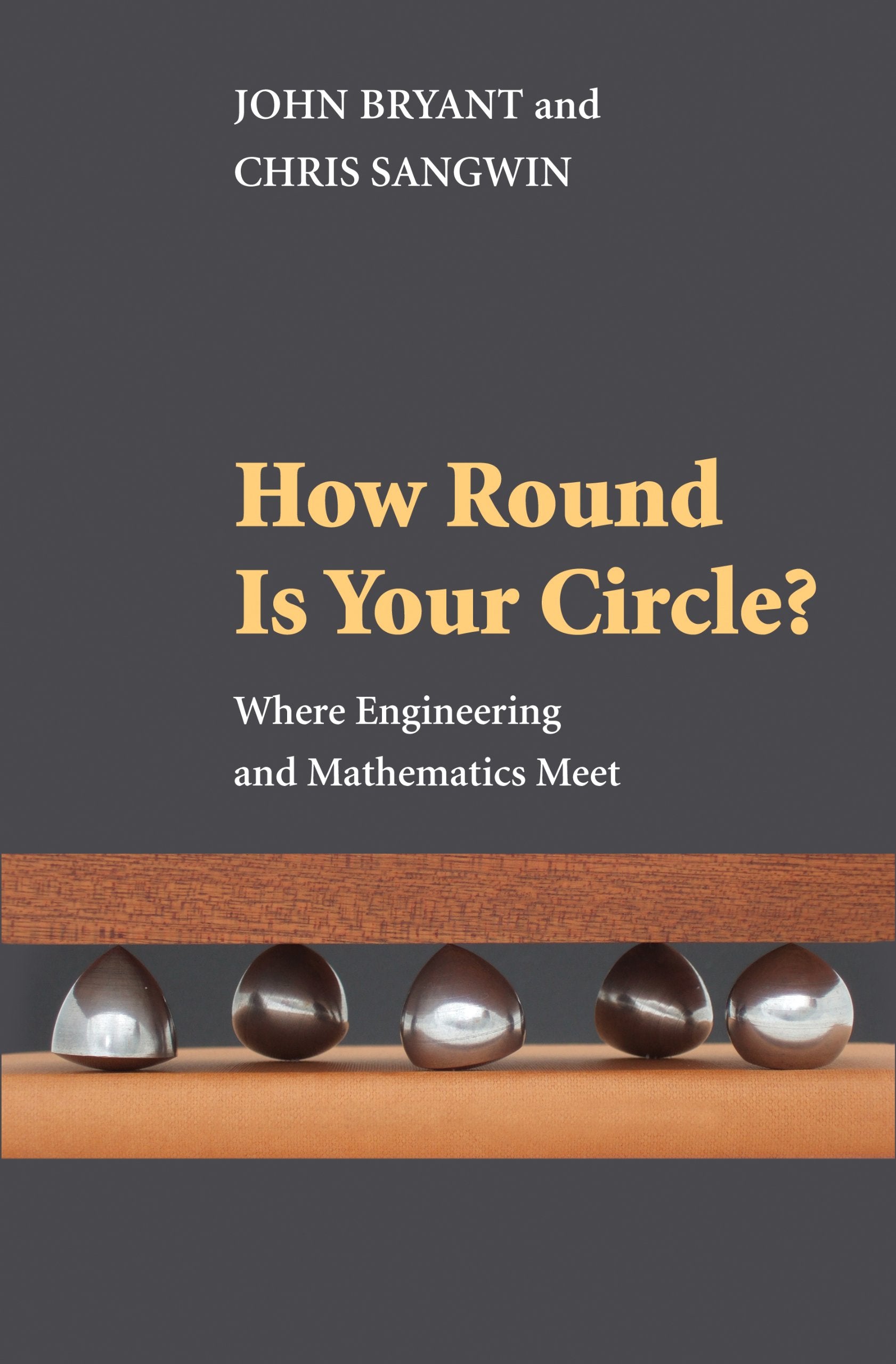
Title
How Round Is Your Circle?: Where Engineering And Mathematics Meet
Sold by Ergodebooks, an authorized reseller.
Returns accepted within 30 days | support@ergodebooks.com
Shipping Information
- Free Standard Shipping — United States only
- Processing Time: 3–5 business days
- Estimated Delivery: 6–10 business days after dispatch
- Double-boxed, fully insured & discreetly packaged
- Tracking number sent via email once dispatched
Returns & Refund
Returns accepted within 30 days of delivery.
Damaged or Defective Item
Free return shipping + replacement or full refund
Wrong Item Received
Free return shipping + replacement or full refund
Change of Mind
Return shipping at customer's expense · 25% restocking fee applies
Payment Option

How Do You Draw A Straight Line? How Do You Determine If A Circle Is Really Round? These May Sound Like Simple Or Even Trivial Mathematical Problems, But To An Engineer The Answers Can Mean The Difference Between Success And Failure. How Round Is Your Circle? Invites Readers To Explore Many Of The Same Fundamental Questions That Working Engineers Deal With Every Dayit'S Challenging, Handson, And Fun.John Bryant And Chris Sangwin Illustrate How Physical Models Are Created From Abstract Mathematical Ones. Using Elementary Geometry And Trigonometry, They Guide Readers Through Paperandpencil Reconstructions Of Mathematical Problems And Show Them How To Construct Actual Physical Models Themselvesdirections Included. It'S An Effective And Entertaining Way To Explain How Applied Mathematics And Engineering Work Together To Solve Problems, Everything From Keeping A Piston Aligned In Its Cylinder To Ensuring That Automotive Driveshafts Rotate Smoothly. Intriguingly, Checking The Roundness Of A Manufactured Object Is Trickier Than One Might Think. When Does The Width Of A Saw Blade Affect An Engineer'S Calculationsor, For That Matter, The Width Of A Physical Line? When Does A Measurement Need To Be Exact And When Will An Approximation Suffice? Bryant And Sangwin Tackle Questions Like These And Enliven Their Discussions With Many Fascinating Highlights From Engineering History. Generously Illustrated, How Round Is Your Circle? Reveals Some Of The Hidden Complexities In Everyday Things.
⚠️ WARNING (California Proposition 65):
This product may contain chemicals known to the State of California to cause cancer, birth defects, or other reproductive harm.
For more information, please visit www.P65Warnings.ca.gov.
- Q: What is the page count of 'How Round Is Your Circle'? A: This book has three hundred twenty pages. It provides a comprehensive exploration of engineering and mathematics.
- Q: What type of binding does this book have? A: This book is hardcover bound. The hardcover ensures durability and sturdiness for repeated use.
- Q: Who are the authors of this book? A: The authors are John Bryant and Chris Sangwin. They are known for their expertise in mathematics and engineering.
- Q: What age group is this book suitable for? A: This book is suitable for readers aged twelve and up. It explores complex concepts in an engaging and understandable way.
- Q: Can beginners understand the content of this book? A: Yes, beginners can understand the content. The authors explain concepts using simple language and practical examples.
- Q: How can I apply the concepts from this book? A: You can apply the concepts by engaging in hands-on activities outlined in the book. It encourages the construction of physical models to understand engineering principles.
- Q: What are the dimensions of 'How Round Is Your Circle'? A: The book measures six point five inches in length, one point twenty-six inches in width, and nine point five inches in height. These dimensions make it easy to handle and store.
- Q: Is there any specific material used in the book's construction? A: The book is printed on standard paper typically used for hardcover books. This material provides a good balance between durability and readability.
- Q: How should I store this book to maintain its condition? A: Store the book upright in a cool, dry place. Avoid direct sunlight to preserve the cover and pages.
- Q: What measures should I take to clean the book? A: To clean the book, use a dry cloth to gently wipe the cover and pages. Avoid using moisture to prevent damage.
- Q: What if my book arrives damaged? A: If your book arrives damaged, you should contact the seller for a replacement or refund. Most sellers have a return policy for such issues.
- Q: Is this book appropriate for educational settings? A: Yes, this book is appropriate for educational settings. It is often used to teach engineering and mathematics concepts in schools.
- Q: Can I use this book for self-study? A: Yes, this book is excellent for self-study. It includes practical examples and exercises to reinforce learning.
- Q: What topics does this book cover? A: The book covers topics at the intersection of engineering and mathematics, including geometry, trigonometry, and practical problem-solving.
- Q: Is this book part of a series? A: No, 'How Round Is Your Circle?' is a standalone publication. It does not belong to a specific series.