If you have any questions, you are always welcome to contact us. We'll get back to you as soon as possible, withing 24 hours on weekdays.
Customer service
All questions about your order, return and delivery must be sent to our customer service team by e-mail at yourstore@yourdomain.com
Sale & Press
If you are interested in selling our products, need more information about our brand or wish to make a collaboration, please contact us at press@yourdomain.com
Help
If you have any questions, you are always welcome to contact us. We'll get back to you as soon as possible, withing 24 hours on weekdays.
Customer service
All questions about your order, return and delivery must be sent to our customer service team by e-mail at yourstore@yourdomain.com
Sale & Press
If you are interested in selling our products, need more information about our brand or wish to make a collaboration, please contact us at press@yourdomain.com
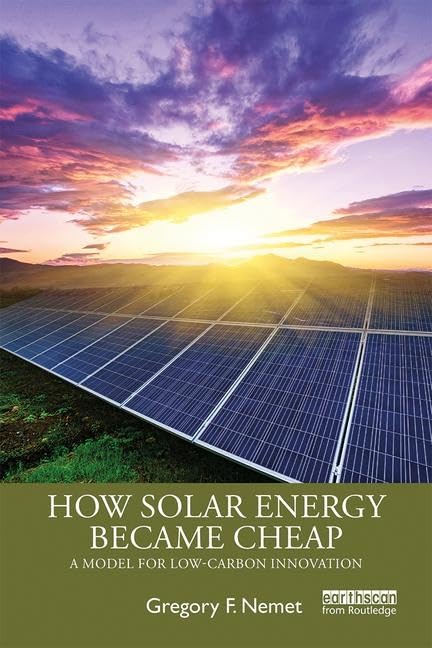
Solar energy is a substantial global industry, one that has generated trade disputes among superpowers, threatened the solvency of large energy companies, and prompted serious reconsideration of electric utility regulation rooted in the 1930s. One of the biggest payoffs from solars success is not the clean inexpensive electricity it can produce, but the lessons it provides for innovation in other technologies needed to address climate change.Despite the large literature on solar, including analyses of increasingly detailed datasets, the question as to how solar became inexpensive and why it took so long still remains unanswered. Drawing on developments in the US, Japan, Germany, Australia, and China, this book provides a truly comprehensive and international explanation for how solar has become inexpensive. Understanding the reasons for solars success enables us to take full advantage of solars potential. It can also teach us how to support other lowcarbon technologies with analogous properties, including small modular nuclear reactors and direct air capture. However, the urgency of addressing climate change means that a key challenge in applying the solar model is in finding ways to speed up innovation. Offering suggestions and policy recommendations for accelerated innovation is another key contribution of this book.This book will be of great interest to students and scholars of energy technology and innovation, climate change and energy analysis and policy, as well as practitioners and policymakers working in the existing and emerging energy industries.
⚠️ WARNING (California Proposition 65):
This product may contain chemicals known to the State of California to cause cancer,
birth defects, or other reproductive harm.
For MAP (Minimum Advertised Price) violations and Intellectual Property (IP) or Trademark concerns, please contact:
support@ergodebooks.com
⚠️ California Proposition 65 Warning: Some products sold on this website may expose you to chemicals known to the State of California to cause cancer, birth defects, or other reproductive harm. For more information, visit www.P65Warnings.ca.gov.