If you have any questions, you are always welcome to contact us. We'll get back to you as soon as possible, withing 24 hours on weekdays.
Customer service
All questions about your order, return and delivery must be sent to our customer service team by e-mail at yourstore@yourdomain.com
Sale & Press
If you are interested in selling our products, need more information about our brand or wish to make a collaboration, please contact us at press@yourdomain.com
Help
If you have any questions, you are always welcome to contact us. We'll get back to you as soon as possible, withing 24 hours on weekdays.
Customer service
All questions about your order, return and delivery must be sent to our customer service team by e-mail at yourstore@yourdomain.com
Sale & Press
If you are interested in selling our products, need more information about our brand or wish to make a collaboration, please contact us at press@yourdomain.com
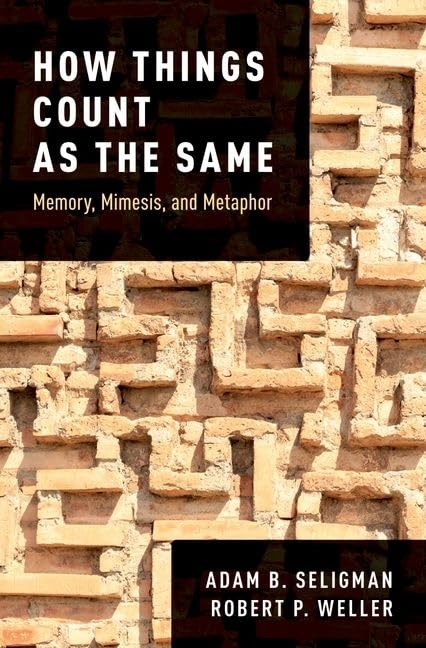
In their third book together, Adam B. Seligman and Robert P. Weller address a seemingly simple question: What counts as the same? Given the myriad differences that divide one individual from another, why do we recognize anyone as somehow sharing a common fate with us? For that matter, how do we live in harmony with groups who may not share the sense of a common fate? Such relationships lie at the heart of the problems of pluralism that increasingly face so much of the world today.Note that "counting as" the same differs from "being" the same. Counting as the same is not an empirical question about how much or how little one person shares with another or one event shares with a previous event. Nothing is actually the same. That is why, as humans, we construct sameness all the time. In the process, of course, we also construct difference.Creating sameness and difference leaves us with the perennial problem of how to live with difference instead of seeing it as a threat. How Things Count as the Same suggests that there are multiple ways in which we can count things as the same, and that each of them fosters different kinds of group dynamics and different sets of benefits and risks for the creation of plural societies. While there might be many ways to understand how people construct sameness, three stand out as especially important and form the focus of the book's analysis: Memory, Mimesis, and Metaphor.
⚠️ WARNING (California Proposition 65):
This product may contain chemicals known to the State of California to cause cancer,
birth defects, or other reproductive harm.
For MAP (Minimum Advertised Price) violations and Intellectual Property (IP) or Trademark concerns, please contact:
support@ergodebooks.com
⚠️ California Proposition 65 Warning: Some products sold on this website may expose you to chemicals known to the State of California to cause cancer, birth defects, or other reproductive harm. For more information, visit www.P65Warnings.ca.gov.