
Title
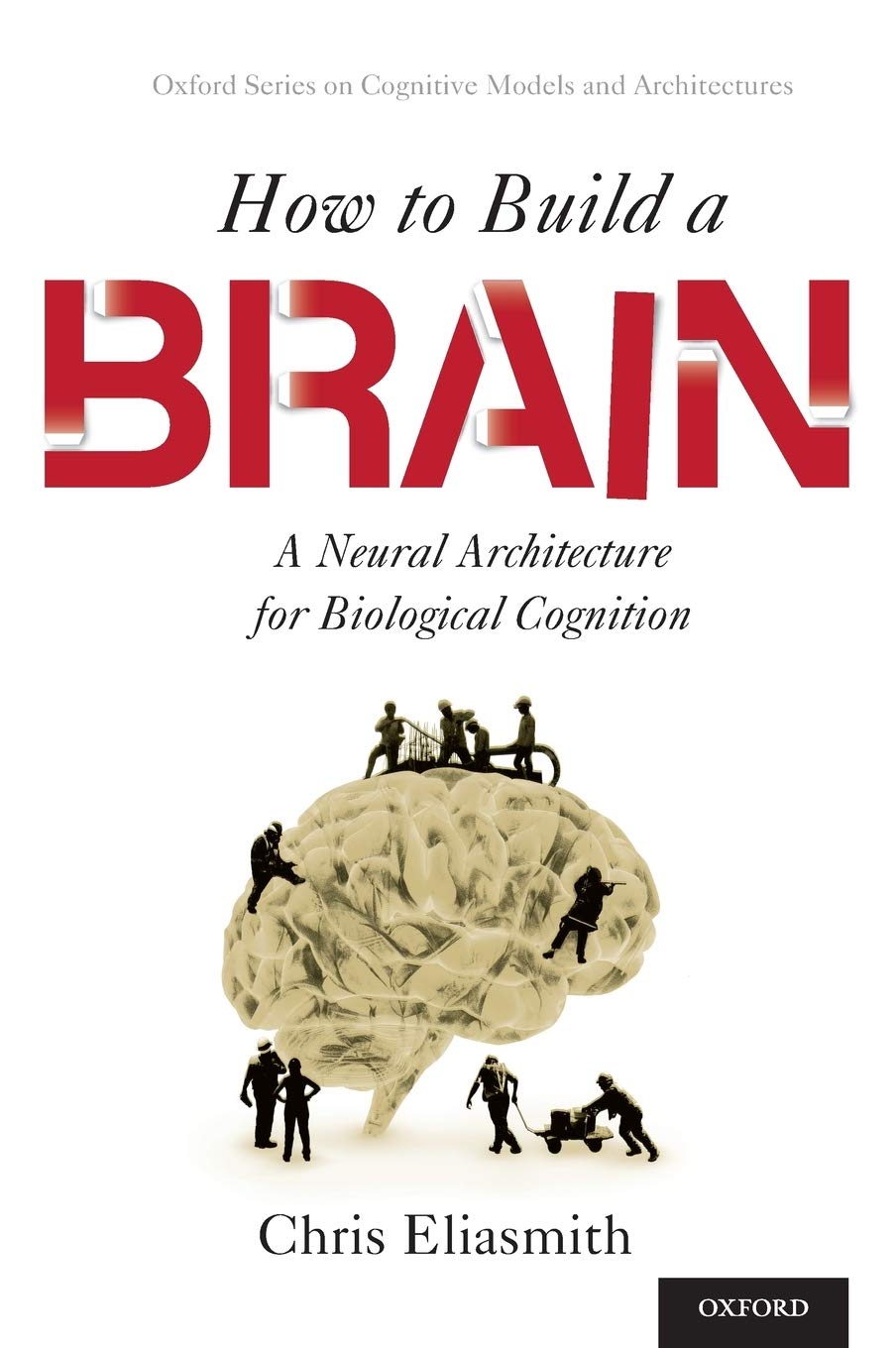
How to Build a Brain: A Neural Architecture for Biological Cognition (Oxford Series on Cognitive Models and Architectures),Used
Sold by Ergodebooks, an authorized reseller.
Returns accepted within 30 days | support@ergodebooks.com
Shipping Information
- Free Standard Shipping — United States only
- Processing Time: 3–5 business days
- Estimated Delivery: 6–10 business days after dispatch
- Double-boxed, fully insured & discreetly packaged
- Tracking number sent via email once dispatched
Returns & Refund
Returns accepted within 30 days of delivery.
Damaged or Defective Item
Free return shipping + replacement or full refund
Wrong Item Received
Free return shipping + replacement or full refund
Change of Mind
Return shipping at customer's expense · 25% restocking fee applies
Payment Option

One goal of researchers in neuroscience, psychology, and artificial intelligence is to build theoretical models that are able to explain the flexibility and adaptiveness of biological systems. How to build a brain provides a detailed guided exploration of a new cognitive architecture that takes biological detail seriously, while addressing cognitive phenomena. The Semantic Pointer Architecture (SPA) introduced in this book provides a set of tools for constructing a wide range of biologically constrained perceptual, cognitive, and motor models.Examples of such models are provided, and they are shown to explain a wide range of data including single cell recordings, neural population activity, reaction times, error rates, choice behavior, and fMRI signals. Each of these models introduces a major feature of biological cognition addressed in the book, including semantics, syntax, control, learning, and memory. These models are not introduced as independent considerations of brain function, but instead integrated to give rise to what is currently the world's largest functional brain model.The last half of this book compares the Semantic Pointer Architecture with the current stateoftheart, addressing issues of theory construction in the behavioral sciences, semantic compositionality, and scalability, among other considerations. The book concludes with a discussion of conceptual challenges raised by this architecture, and identifies several outstanding challenges for this, and other, cognitive architectures.Along the way, the book considers neural coding, concept representation, neural dynamics, working memory, neuroanatomy, reinforcement learning, and spiketiming dependent plasticity. The book includes 8 detailed, handson tutorials exploiting the free Nengo neural simulation environment, providing practical experience with the concepts and models presented throughout.
⚠️ WARNING (California Proposition 65):
This product may contain chemicals known to the State of California to cause cancer, birth defects, or other reproductive harm.
For more information, please visit www.P65Warnings.ca.gov.