
Title
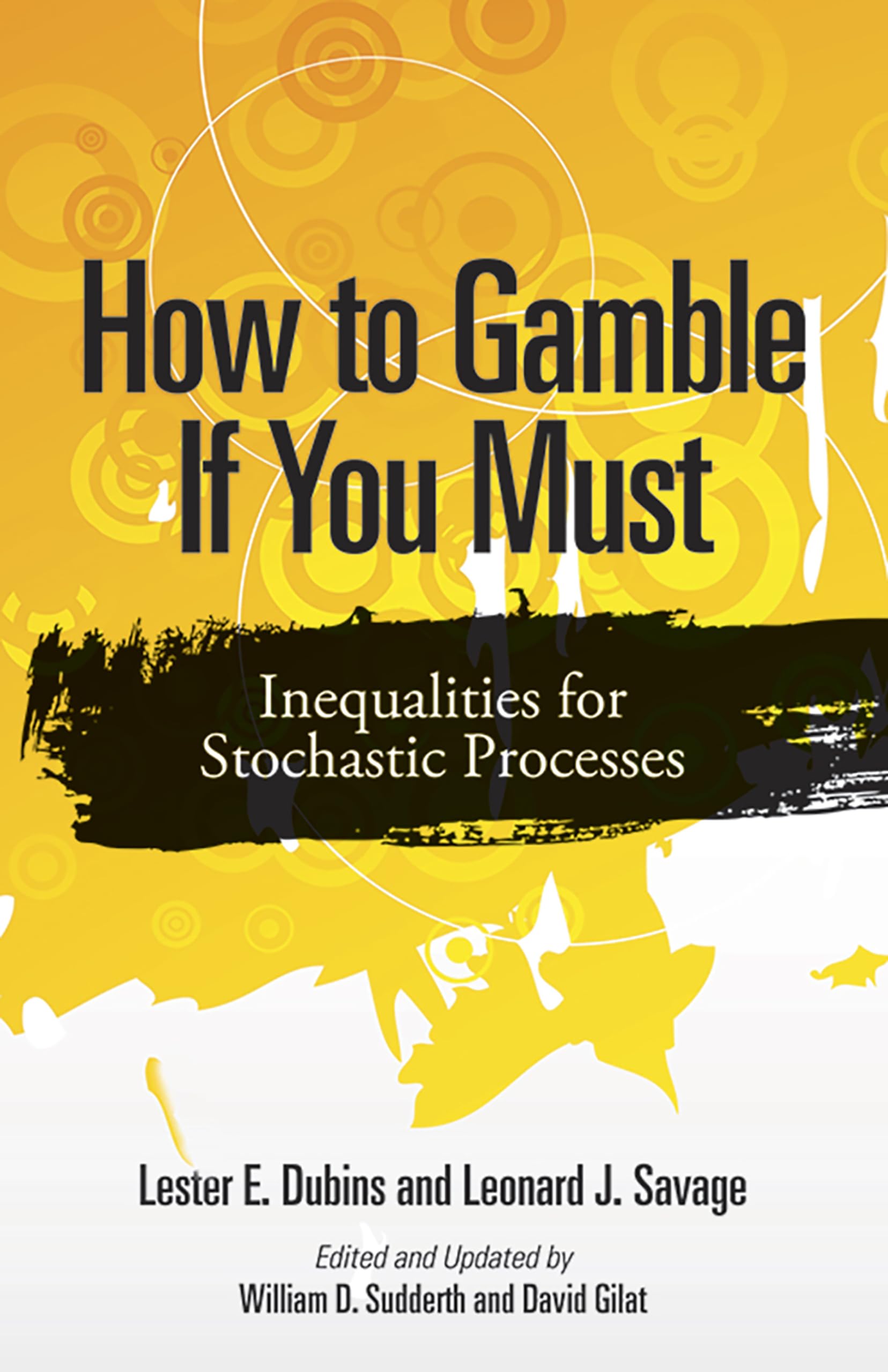
How To Gamble If You Must: Inequalities For Stochastic Processes (Dover Books On Mathematics)
Sold by Ergodebooks, an authorized reseller.
Returns accepted within 30 days | support@ergodebooks.com
Shipping Information
- Free Standard Shipping — United States only
- Processing Time: 3–5 business days
- Estimated Delivery: 6–10 business days after dispatch
- Double-boxed, fully insured & discreetly packaged
- Tracking number sent via email once dispatched
Returns & Refund
Returns accepted within 30 days of delivery.
Damaged or Defective Item
Free return shipping + replacement or full refund
Wrong Item Received
Free return shipping + replacement or full refund
Change of Mind
Return shipping at customer's expense · 25% restocking fee applies
Payment Option

This Classic Of Advanced Statistics Is Geared Toward Graduatelevel Readers And Uses The Concepts Of Gambling To Develop Important Ideas In Probability Theory. The Authors Have Distilled The Essence Of Many Years' Research Into A Dozen Concise Chapters. Strongly Recommended By The Journal Of The American Statistical Association Upon Its Initial Publication, This Revised And Updated Edition Features Contributions From Two Wellknown Statisticians That Include A New Preface, Updated References, And Findings From Recent Research.Following An Introductory Chapter, The Book Formulates The Gambler'S Problem And Discusses Gambling Strategies. Succeeding Chapters Explore The Properties Associated With Casinos And Certain Measures Of Subfairness. Concluding Chapters Relate The Scope Of The Gambler'S Problems To More General Mathematical Ideas, Including Dynamic Programming, Bayesian Statistics, And Stochastic Processes.
⚠️ WARNING (California Proposition 65):
This product may contain chemicals known to the State of California to cause cancer, birth defects, or other reproductive harm.
For more information, please visit www.P65Warnings.ca.gov.
- Q: How many pages are in the book? A: This book contains three hundred four pages. It offers an in-depth exploration of advanced statistics and probability theory.
- Q: What is the binding type of this book? A: The binding type is paperback. This makes it lightweight and easy to handle for readers.
- Q: What are the dimensions of the book? A: The book measures five point four inches in length, zero point nine one inches in width, and eight point four inches in height. These dimensions make it a compact volume suitable for various reading environments.
- Q: What level of reader is this book suitable for? A: This book is geared toward graduate-level readers. It uses complex concepts in gambling and probability theory, making it suitable for advanced study.
- Q: How is the content structured in the book? A: The content is structured into twelve concise chapters. It covers topics from gambling strategies to advanced mathematical ideas.
- Q: Does this book include updated research findings? A: Yes, this edition features findings from recent research. It also includes contributions from well-known statisticians and an updated Preface.
- Q: How should I care for this paperback book? A: To care for this book, store it in a cool, dry place away from direct sunlight. This helps maintain its quality and prevents fading.
- Q: Is there a specific way to clean the book? A: Yes, gently wipe the cover with a soft, dry cloth. Avoid using water or cleaning solutions, as they may damage the pages.
- Q: What should I do if the book arrives damaged? A: If the book arrives damaged, contact the seller for return instructions. Most sellers offer a return policy for items that arrive in poor condition.
- Q: Is this book good for beginners in statistics? A: No, this book is not ideal for beginners. It is intended for readers with a solid foundation in statistics and probability.
- Q: How does this book compare to other statistics books? A: This book focuses specifically on gambling and stochastic processes, offering a unique perspective compared to general statistics texts.
- Q: Are there any prerequisites to understand this book? A: Yes, a background in advanced statistics and probability theory is recommended. Familiarity with mathematical concepts is essential for comprehension.
- Q: What if I need help understanding the concepts in the book? A: If you need help, consider joining a study group or seeking online resources. Additionally, some readers find it helpful to consult academic articles related to the topics covered.
- Q: Is there an online version available? A: Availability of an online version may vary. Check with the publisher or online retailers for digital formats.
- Q: Who are the authors of this book? A: The authors are Lester E. Dubins and other contributors. Their expertise adds depth and credibility to the book's content.
- Q: Does this book have any illustrations or graphs? A: Yes, the book includes illustrations and graphs. These visual aids help clarify complex concepts in the text.