
Title
How To Read And Do Proofs: An Introduction To Mathematical Thought Processes,New
Sold by Ergodebooks, an authorized reseller.
Returns accepted within 30 days | support@ergodebooks.com
Shipping Information
- Free Standard Shipping — United States only
- Processing Time: 3–5 business days
- Estimated Delivery: 6–10 business days after dispatch
- Double-boxed, fully insured & discreetly packaged
- Tracking number sent via email once dispatched
Returns & Refund
Returns accepted within 30 days of delivery.
Damaged or Defective Item
Free return shipping + replacement or full refund
Wrong Item Received
Free return shipping + replacement or full refund
Change of Mind
Return shipping at customer's expense · 25% restocking fee applies
Payment Option

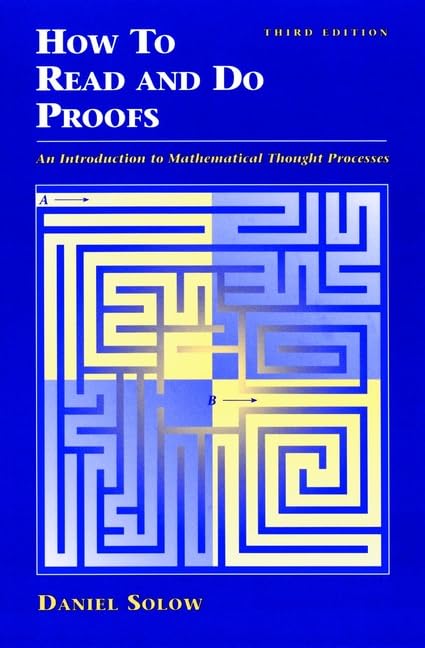
This Book Categorizes, Identifies And Explains The Various Techniques That Are Used Repeatedly In All Proofs And Explains How To Read Proofs That Arise In Mathematical Literature By Understanding Which Techniques Are Used And How They Are Applied.
⚠️ WARNING (California Proposition 65):
This product may contain chemicals known to the State of California to cause cancer, birth defects, or other reproductive harm.
For more information, please visit www.P65Warnings.ca.gov.
- Q: How many pages does this book have? A: This book has two hundred twenty-four pages. It provides a comprehensive guide to understanding mathematical proofs.
- Q: What is the binding type of this book? A: This book is paperback bound. This makes it lightweight and easy to carry, ideal for students.
- Q: What are the dimensions of this book? A: The book measures four point five five inches in length, one point four two inches in width, and three point one seven inches in height. These dimensions make it portable.
- Q: Who is the author of this book? A: The author of this book is Daniel Solow. He is known for his expertise in mathematics and logical reasoning.
- Q: What is the main focus of this book? A: The main focus of this book is to teach readers how to read and understand mathematical proofs. It categorizes and explains techniques used in proofs.
- Q: Is this book suitable for beginners? A: Yes, this book is suitable for beginners. It breaks down complex concepts into understandable techniques for novice learners.
- Q: How do I effectively use this book? A: To effectively use this book, read it chapter by chapter, practicing the techniques explained. It’s beneficial to work through examples provided.
- Q: Is this book appropriate for high school students? A: Yes, this book is appropriate for high school students. It helps build foundational skills in reading and understanding proofs.
- Q: Can this book help with college-level mathematics? A: Yes, this book can help with college-level mathematics. It provides essential skills for engaging with advanced mathematical literature.
- Q: How should I store this book to keep it in good condition? A: Store this book upright on a shelf away from direct sunlight. This will help prevent wear and tear and keep the pages intact.
- Q: What if my book arrives damaged? A: If your book arrives damaged, you should contact the seller for a return or exchange. Most sellers provide a satisfaction guarantee.
- Q: Are there any special care instructions for this book? A: There are no special care instructions for this book. Just handle it with care to avoid bending pages or damaging the cover.
- Q: Does this book have any hazardous materials? A: No, this book does not contain any hazardous materials. It is a standard paperback book safe for all readers.
- Q: Is this book good for self-study? A: Yes, this book is excellent for self-study. It provides clear explanations and techniques that can be practiced independently.
- Q: What category does this book fall under? A: This book falls under the category of Logic. It is specifically focused on mathematical thought processes.