If you have any questions, you are always welcome to contact us. We'll get back to you as soon as possible, withing 24 hours on weekdays.
Customer service
All questions about your order, return and delivery must be sent to our customer service team by e-mail at yourstore@yourdomain.com
Sale & Press
If you are interested in selling our products, need more information about our brand or wish to make a collaboration, please contact us at press@yourdomain.com
Help
If you have any questions, you are always welcome to contact us. We'll get back to you as soon as possible, withing 24 hours on weekdays.
Customer service
All questions about your order, return and delivery must be sent to our customer service team by e-mail at yourstore@yourdomain.com
Sale & Press
If you are interested in selling our products, need more information about our brand or wish to make a collaboration, please contact us at press@yourdomain.com
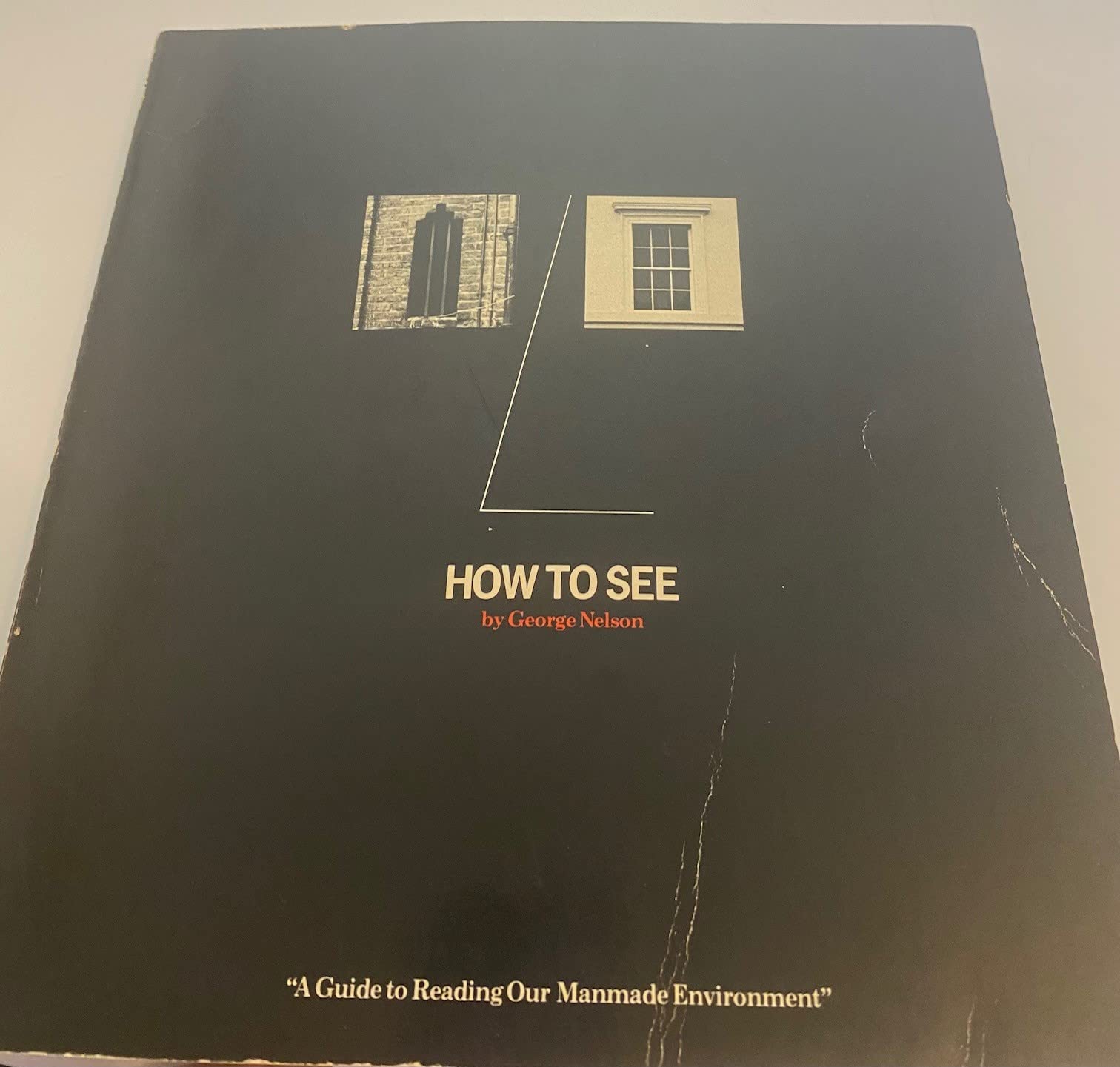
First softcover edition, Little, Brown and Company, 1977, illustrated throughout in b/w, square 4to, 8 1/2 x 9 1/4 inches, 233 pages. Polymath George Nelson made his mark in architecture, industrial design, graphic design, but of his many talents, it is his writing skills that go under appreciated. 'How To See' is the perfect primer for the uninitiated; more than a guide to visual appreciation, this is a book about how to recognize, evaluate, and understand the objects and landscape of the manmade world around us. George Nelson was an outstanding designer. We all know that. But my hunch is that, in a hundred years, hell be even better remembered for his thinking and writing about design. In each chapter Nelson discusses a way to understand and interpret the visual information presented through photographic illustrations the book is appropriately subtitled A Guide to Reading our Man Made Environment.Stanley Abercrombie, architect and writer. The text, as well as the photographs, are insightful, inspiring, provocative and Nelson's text is written with an entertaining wit. This book, now considered a classic, can be appreciated by students and design buffs alike.
⚠️ WARNING (California Proposition 65):
This product may contain chemicals known to the State of California to cause cancer,
birth defects, or other reproductive harm.
For MAP (Minimum Advertised Price) violations and Intellectual Property (IP) or Trademark concerns, please contact:
support@ergodebooks.com
⚠️ California Proposition 65 Warning: Some products sold on this website may expose you to chemicals known to the State of California to cause cancer, birth defects, or other reproductive harm. For more information, visit www.P65Warnings.ca.gov.