
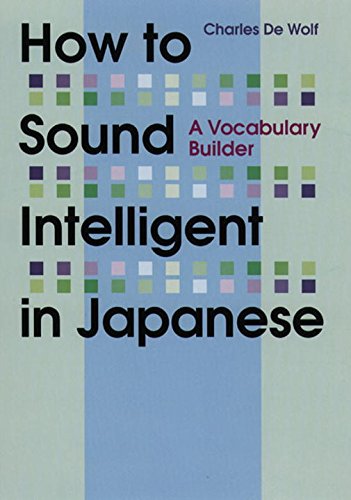
Title
How to Sound Intelligent in Japanese: A Vocabulary Builder,Used
Sold by Ergodebooks, an authorized reseller.
Returns accepted within 30 days | support@ergodebooks.com
Shipping Information
- Free Standard Shipping — United States only
- Processing Time: 3–5 business days
- Estimated Delivery: 6–10 business days after dispatch
- Double-boxed, fully insured & discreetly packaged
- Tracking number sent via email once dispatched
Returns & Refund
Returns accepted within 30 days of delivery.
Damaged or Defective Item
Free return shipping + replacement or full refund
Wrong Item Received
Free return shipping + replacement or full refund
Change of Mind
Return shipping at customer's expense · 25% restocking fee applies
Payment Option

For every student, a time eventually comes when basic grammar is no longer the problem. You can say a few words about the weather, or the fact that, yes, you are feeling hungry, or explain that you are going out for the day and actually be understood. Beyond that, however, the going gets tough. You cannot make pertinent comments about philosophy, politics, art, science, law, or business simply because you lack the necessary vocabulary. In fact, you may not be able to say that you are interested in 'philosophy' at all, because you don't know the Japanese word for it. How do you go about acquiring this specialized vocabulary (most of which consists of kanji compounds)? Usually by spending hundreds of hours reading Japanese books or picking through a dictionary.This book is an attempt to shorten that process by collecting a good number of the more commonly used key words from crucial areas of human endeavor. Now, without spending years mastering the written language, you can occasionally come up with the right word at the right moment in a conversation that is striving toward comprehensibility. This can even be done by students who do not have a strong grasp of kanji, for they can learn the words as sounds.The areas covered in the book are ideas and theories; philosophy and religion; politics and government; the fine arts, humanities, and social sciences; science and technology; law and justice; and business and economics. This division allows the student to go the category where vocabulary is needed and learn the key words given there, rather than floundering around in a dictionary and hoping one has found what is needed. A further advantage of this arrangement is that certain kanji tend to be repeated over and over in certain categories: for example, the kanji read 'gaku' in the science section of the book. This type of repetition allows the student to get a feeling for certain kanji and usages.Beginning students can pick up individual words and put them in sentences of their own making, no matter how simple, and advanced students can get a better understanding of context by reading the sample sentences in the book. Since no one, even in their native tongue, can hope to be proficient in every field, advance students can quickly pick up key words in areas they are unfamiliar with.Previously published in the Power Japanese series under the same title.
⚠️ WARNING (California Proposition 65):
This product may contain chemicals known to the State of California to cause cancer, birth defects, or other reproductive harm.
For more information, please visit www.P65Warnings.ca.gov.