
Title
Human Hierarchies: A General Theory,Used
Sold by Ergodebooks, an authorized reseller.
Returns accepted within 30 days | support@ergodebooks.com
Shipping Information
- Free Standard Shipping — United States only
- Processing Time: 3–5 business days
- Estimated Delivery: 6–10 business days after dispatch
- Double-boxed, fully insured & discreetly packaged
- Tracking number sent via email once dispatched
Returns & Refund
Returns accepted within 30 days of delivery.
Damaged or Defective Item
Free return shipping + replacement or full refund
Wrong Item Received
Free return shipping + replacement or full refund
Change of Mind
Return shipping at customer's expense · 25% restocking fee applies
Payment Option

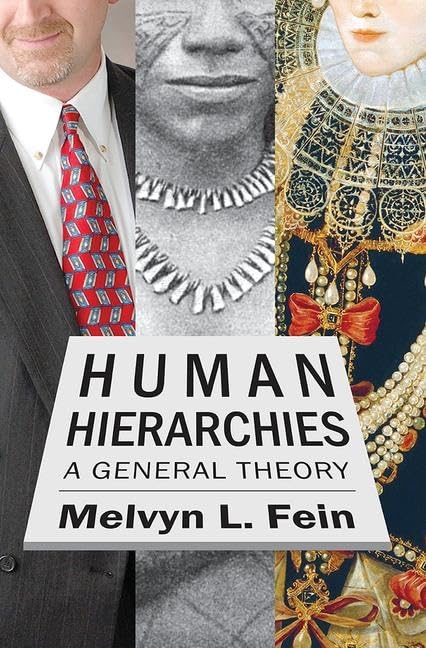
Human beings are hierarchical animals. Always and everywhere, people have developed social ranking systems. These differ dramatically in how they are organized, but the underlying causal mechanisms that create and sustain them are the same. Whether they are on the top or bottom of the heap, people attempt to be superior to some other persons or group. This is the root of Melvyn L. Fein's thesis presented in Human Hierarchies: A General Theory.Fein traces the development of changes from huntergatherer times to our own technocommercial society. In moving from small to large communities, humans went from facetoface contests for superiority to more anonymous and symbolic ones. Societies evolved from hunting bands where the parties knew each other through bigmen societies, chieftainships, agrarian empires, patronage chains, caste societies, estate systems, and marketoriented democracies. Where once small groupings were organized primarily by strong forces such as personal relationships, the now standard large groupings are more dependent on weaker forces such as those provided by social roles.Bureaucracies and professional roles have become prominent. Bureaucracies allow largescale organizations to maintain control of people by limiting the potential destructiveness of unregulated tests of strength and by clarifying chains of command. Their rigidity and unresponsiveness requires that they be supplemented by professional roles. At the same time, a proliferation of selfmotivated experts delegate authority downward, thereby introducing a more flexible decentralization. This analysis is a unique and significant advance in both the sociology and anthropology of stratification among humans.
⚠️ WARNING (California Proposition 65):
This product may contain chemicals known to the State of California to cause cancer, birth defects, or other reproductive harm.
For more information, please visit www.P65Warnings.ca.gov.