
Title
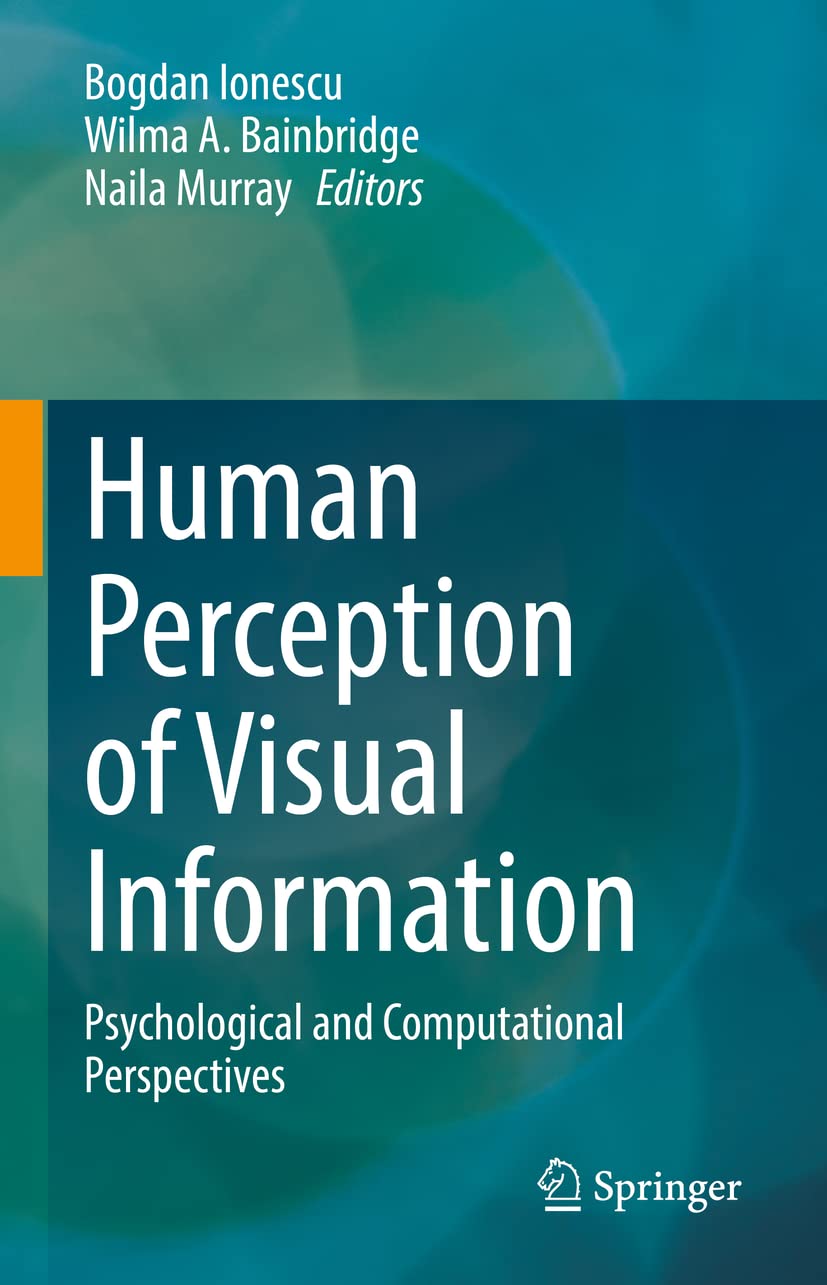
Human Perception of Visual Information: Psychological and Computational Perspectives,Used
Sold by Ergodebooks, an authorized reseller.
Returns accepted within 30 days | support@ergodebooks.com
Shipping Information
- Free Standard Shipping — United States only
- Processing Time: 3–5 business days
- Estimated Delivery: 6–10 business days after dispatch
- Double-boxed, fully insured & discreetly packaged
- Tracking number sent via email once dispatched
Returns & Refund
Returns accepted within 30 days of delivery.
Damaged or Defective Item
Free return shipping + replacement or full refund
Wrong Item Received
Free return shipping + replacement or full refund
Change of Mind
Return shipping at customer's expense · 25% restocking fee applies
Payment Option

Recent years have witnessed important advancements in our understanding of the psychological underpinnings of subjective properties of visual information, such as aesthetics, memorability, or induced emotions. Concurrently, computational models of objective visual properties such as semantic labelling and geometric relationships have made significant breakthroughs using the latest achievements in machine learning and largescale data collection. There has also been limited but important work exploiting these breakthroughs to improve computational modelling of subjective visual properties. The time is ripe to explore how advances in both of these fields of study can be mutually enriching and lead to further progress.This book combines perspectives from psychology and machine learning to showcase a new, unified understanding of how images and videos influence highlevel visual perception particularly interestingness, affective values and emotions, aesthetic values, memorability, novelty, complexity, visual composition and stylistic attributes, and creativity. These humanbased metrics are interesting for a very broad range of current applications, ranging from content retrieval and search, storytelling, to targeted advertising, education and learning, and content filtering.Work already exists in the literature that studies the psychological aspects of these notions or investigates potential correlations between two or more of these human concepts. Attempts at building computational models capable of predicting such notions can also be found, using stateoftheart machine learning techniques. Nevertheless their performance proves that there is still room for improvement, as the tasks are by nature highly challenging and multifaceted, requiring thought on both the psychological implications of the human concepts, as well as their translation to machines.
⚠️ WARNING (California Proposition 65):
This product may contain chemicals known to the State of California to cause cancer, birth defects, or other reproductive harm.
For more information, please visit www.P65Warnings.ca.gov.