
Title
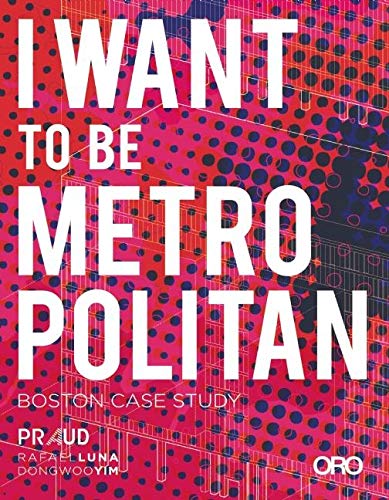
I Want To Be Metropolitan: Boston Case Study,Used
Sold by Ergodebooks, an authorized reseller.
Returns accepted within 30 days | support@ergodebooks.com
Shipping Information
- Free Standard Shipping — United States only
- Processing Time: 3–5 business days
- Estimated Delivery: 6–10 business days after dispatch
- Double-boxed, fully insured & discreetly packaged
- Tracking number sent via email once dispatched
Returns & Refund
Returns accepted within 30 days of delivery.
Damaged or Defective Item
Free return shipping + replacement or full refund
Wrong Item Received
Free return shipping + replacement or full refund
Change of Mind
Return shipping at customer's expense · 25% restocking fee applies
Payment Option

I Want to be METROPOLITAN is a research project on small scale metropolises, MINI Metropolis, using Boston as a case study to provide a different reading of the city. The study focuses on showing the efforts that the city of Boston has made in order to grow with metropolitan characteristics while remaining at a much smaller scale than cities like New York, London, or Tokyo. The morphology of Boston has been achieved through different metropolitan interventions that occur on different scales. These are divided on an infrastructural scale, urban scale, and architectural scale. By means of analyzing these different aspects, we can compose a vision of a future Boston, or Fictitious Boston, derived from its metropolitan potential.The book is structured into four chapters addressing the different scales of analysis. The first chapter compiles general data of the city, and provides a background view of the infrastructural efforts that the city has done to accommodate its population. Examples of these are the Big Dig, land reclamation, and its transportation network. These are efforts that are very difficult to find in other cities of similar scale, and provide the first clue towards the potential of the future of Boston and its current success.The second chapter identifies Boston's polycentrality, a characteristic that appears in big metropolitan cities like Tokyo. Rather than having a single civic center or a downtown, Boston accommodates different urban cores such as an industrial core, an institutional core, a commercial core, and others within the confinement of its limited area. The chapter is subdivided into separate sections to explain each core and their significance in the city.In homage to ''Made in Tokyo'', chapter three catalogs hybrid buildings in Boston, referencing the ambiguity of these buildings being born out of a metropolitan context and transported to a less dense setting. Not to be confused with mixeduse buildings, hybrid buildings emerge mostly in metropolises with high density and land value, providing new, interesting ways of life in the city. Interestingly, hybrid buildings also emerge in Boston, which registers another clue of Boston's metropolitan potential.In present days, urban topics and strategies mainly focus on cities with extreme conditions such as high density, increasing congestion, and fast growth. This book intends to create a dialogue that addresses the missing topics in urbanism for smaller, slower, and much more stable cities. Chapter four concludes the study by introducing our vision of new projects for the city of Boston to generate an open conversation about the topic. This leads us to the possible implementation of the research topic and methodology on other cities similar in size and pace to Boston.
⚠️ WARNING (California Proposition 65):
This product may contain chemicals known to the State of California to cause cancer, birth defects, or other reproductive harm.
For more information, please visit www.P65Warnings.ca.gov.