
Title
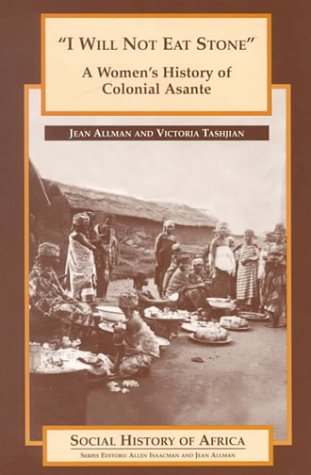
I Will Not Eat Stone: A Women'S History Of Colonial Asante (Social History Of Africa)
Sold by Ergodebooks, an authorized reseller.
Returns accepted within 30 days | support@ergodebooks.com
Shipping Information
- Free Standard Shipping — United States only
- Processing Time: 3–5 business days
- Estimated Delivery: 6–10 business days after dispatch
- Double-boxed, fully insured & discreetly packaged
- Tracking number sent via email once dispatched
Returns & Refund
Returns accepted within 30 days of delivery.
Damaged or Defective Item
Free return shipping + replacement or full refund
Wrong Item Received
Free return shipping + replacement or full refund
Change of Mind
Return shipping at customer's expense · 25% restocking fee applies
Payment Option

This Long Awaited And Definitive Work On Gender In Asante During The Early Twentieth Century Provides A Needed Balance To Emphasis On Chiefship And External Relations Evident Thus Far In The Historical Scholarship On Colonial And Precolonial Asante. I Am Certainly Looking Forward To Using This Book In Every Possible African Studies Course I Teach. Gracia Clark, Department Of Anthropology, Indiana Universityby Bringing Women Into The Mainstream Of Asante Historiography, The Authors Move Us Towards That Singularly Elusive Goal: The Realization Of A Comprehensive Asante Social History. Ivor Wilks Professor Emeritus, African History Northwestern Universityin An Admirable Collaborative Effort, Jean Allman And Victoria Tashjian Focus On Commodity Production, Family Labor And Reproduction In Colonial Asante. The Authors Demonstrate How Broader Social And Economic Forces Cash Cropping, Trade, Monetization Of The Economy, British Rule, And Christian Missions Recast The Terms Of Domestic Struggle In Asante And How Ordinary Men And Women Negotiated That Ever Shifting Landscape. By Centering Their Analysis On Women, Allman And Tashjian Recover The Broader History Of A Society Whose Past Has Largely Been Understood In Terms Of The State, Political Evolution, Trade, And The Careers Of Political Elites. Based On The Recollections Of Asante Women And Men Born During The Years 1900 To 1925 And On Rich Archival Sources,I Will Not Eat Stone Captures The Resilience And Tenacity Of A Generation Of Asante Women And Their Struggles In Defense Of Social And Economic Autonomy.
⚠️ WARNING (California Proposition 65):
This product may contain chemicals known to the State of California to cause cancer, birth defects, or other reproductive harm.
For more information, please visit www.P65Warnings.ca.gov.
- Q: What is the main focus of 'I Will Not Eat Stone'? A: The book focuses on women's roles and experiences in Asante during the early twentieth century, highlighting their struggles within the context of colonialism and social change.
- Q: Who are the authors of this book? A: 'I Will Not Eat Stone' is authored by Victoria Tashjian and Jean Allman, both of whom are experts in African history and gender studies.
- Q: What is the publication date of the book? A: The book was published on July 30, 2000.
- Q: How many pages does the book contain? A: The book contains a total of 312 pages.
- Q: What is the condition of the used book being sold? A: The condition of the used book is described as 'Very Good'.
- Q: Is this book suitable for academic courses? A: Yes, this book is highly recommended for African studies courses, offering valuable insights into gender and social history.
- Q: What type of binding does the book have? A: The book is available in paperback binding.
- Q: What are the key themes explored in the book? A: Key themes include women's labor, commodity production, family dynamics, and the impact of colonial forces on Asante society.
- Q: Does the book include primary sources? A: Yes, the authors utilize recollections from Asante women and men, as well as rich archival sources.
- Q: Can this book serve as a resource for gender studies? A: Absolutely, it provides a comprehensive analysis of women's historical roles and contributions in colonial Asante, making it a valuable resource for gender studies.