
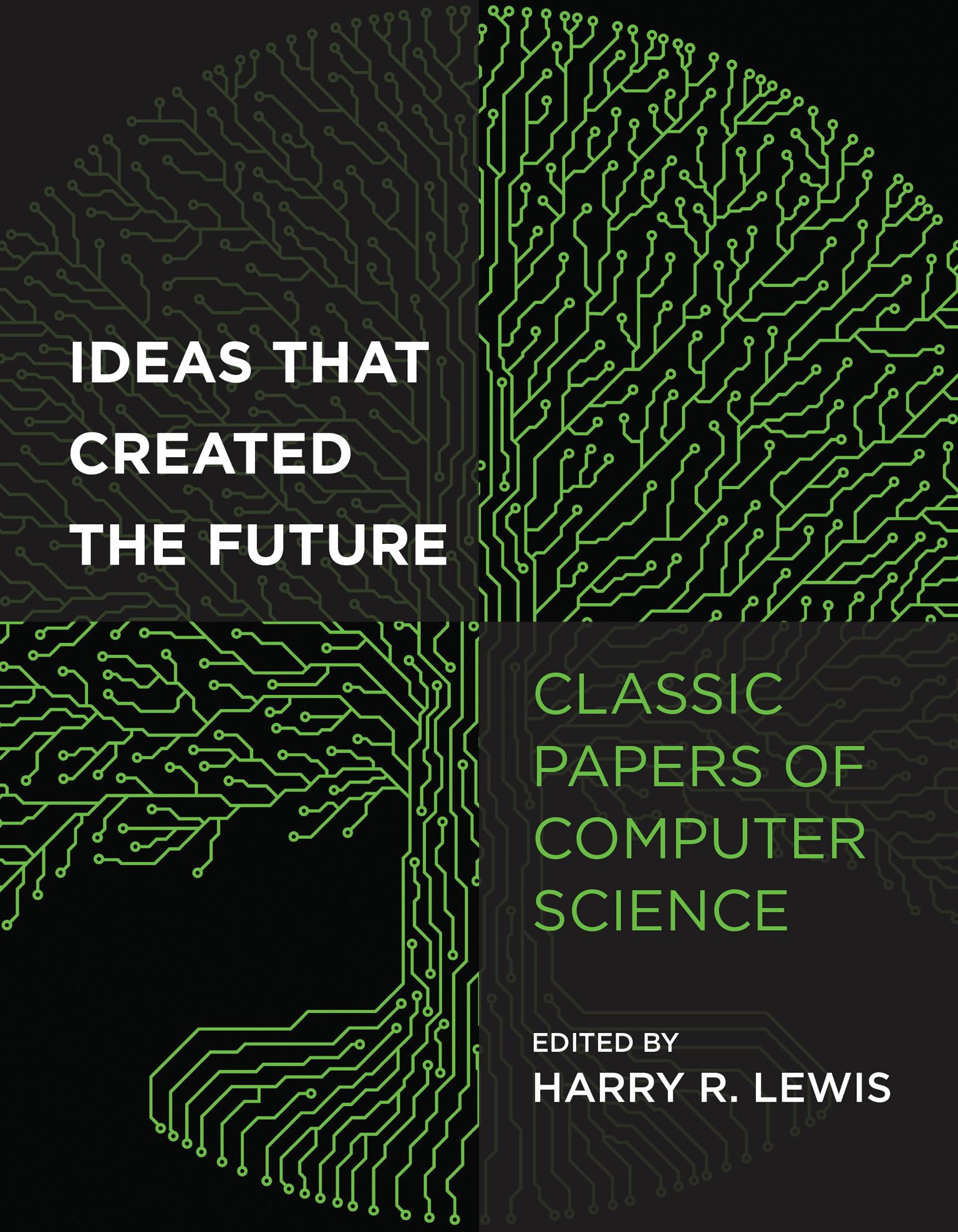
Title
Ideas That Created the Future: Classic Papers of Computer Science,Used
Sold by Ergodebooks, an authorized reseller.
Returns accepted within 30 days | support@ergodebooks.com
Shipping Information
- Free Standard Shipping — United States only
- Processing Time: 3–5 business days
- Estimated Delivery: 6–10 business days after dispatch
- Double-boxed, fully insured & discreetly packaged
- Tracking number sent via email once dispatched
Returns & Refund
Returns accepted within 30 days of delivery.
Damaged or Defective Item
Free return shipping + replacement or full refund
Wrong Item Received
Free return shipping + replacement or full refund
Change of Mind
Return shipping at customer's expense · 25% restocking fee applies
Payment Option

Classic papers by thinkers ranging from from Aristotle and Leibniz to Norbert Wiener and Gordon Moore that chart the evolution of computer science.Ideas That Created the Future collects fortysix classic papers in computer science that map the evolution of the field. It covers all aspects of computer science: theory and practice, architectures and algorithms, and logic and software systems, with an emphasis on the period of 19361980 but also including important early work. Offering papers by thinkers ranging from Aristotle and Leibniz to Alan Turing and Nobert Wiener, the book documents the discoveries and inventions that created today's digital world. Each paper is accompanied by a brief essay by Harry Lewis, the volume's editor, offering historical and intellectual context.
⚠️ WARNING (California Proposition 65):
This product may contain chemicals known to the State of California to cause cancer, birth defects, or other reproductive harm.
For more information, please visit www.P65Warnings.ca.gov.
- Q: What is the page count of the book? A: The book has five hundred twenty pages. This extensive collection provides a deep dive into the evolution of computer science.
- Q: What is the binding type of this book? A: It is paperback. This makes it lightweight and flexible for easy reading.
- Q: What are the dimensions of the book? A: The book measures seven point zero six inches in length, zero point eight eight inches in width, and nine point zero two inches in height. Its compact size makes it portable.
- Q: Who is the author of 'Ideas That Created the Future'? A: The author is Harry R. Lewis. He is also the editor who provides context for each paper included in the book.
- Q: What genre does this book fall under? A: The book falls under the Computer Science genre. It features classic papers that shape the field's history and development.
- Q: Is this book suitable for beginners in computer science? A: Yes, it is suitable for beginners. The classic papers provide foundational knowledge that can benefit newcomers to the field.
- Q: Can this book be used as a reference for academic studies? A: Yes, it can be used as a reference for academic studies. It contains significant historical papers essential for understanding computer science.
- Q: How can I read this book effectively? A: To read this book effectively, take notes on key concepts and themes. Engaging with the essays can enhance understanding of the papers.
- Q: Is this book appropriate for children? A: No, this book is not specifically appropriate for children. It addresses advanced concepts in computer science that may be too complex for younger readers.
- Q: How should I store this book? A: Store this book in a dry and cool place. Keeping it upright on a shelf will help maintain its shape and prevent damage.
- Q: What if the book arrives damaged? A: If the book arrives damaged, you should contact the seller for a return or exchange. Ensure to keep the original packaging for returns.
- Q: Are there any specific care instructions for this book? A: No specific care instructions are needed. Simply avoid exposing it to moisture and direct sunlight to prolong its lifespan.
- Q: What is the historical context of the papers included? A: The papers included span from Aristotle to Norbert Wiener, charting the evolution of computer science from 1936 to 1980. This context enriches the reader's understanding.
- Q: Is this book useful for professional development? A: Yes, it is useful for professional development. The insights from classic papers can enhance knowledge and inspire innovation in the field.
- Q: What makes this collection unique? A: This collection is unique because it compiles classic papers that are foundational to computer science, accompanied by editorial context from a respected scholar.