
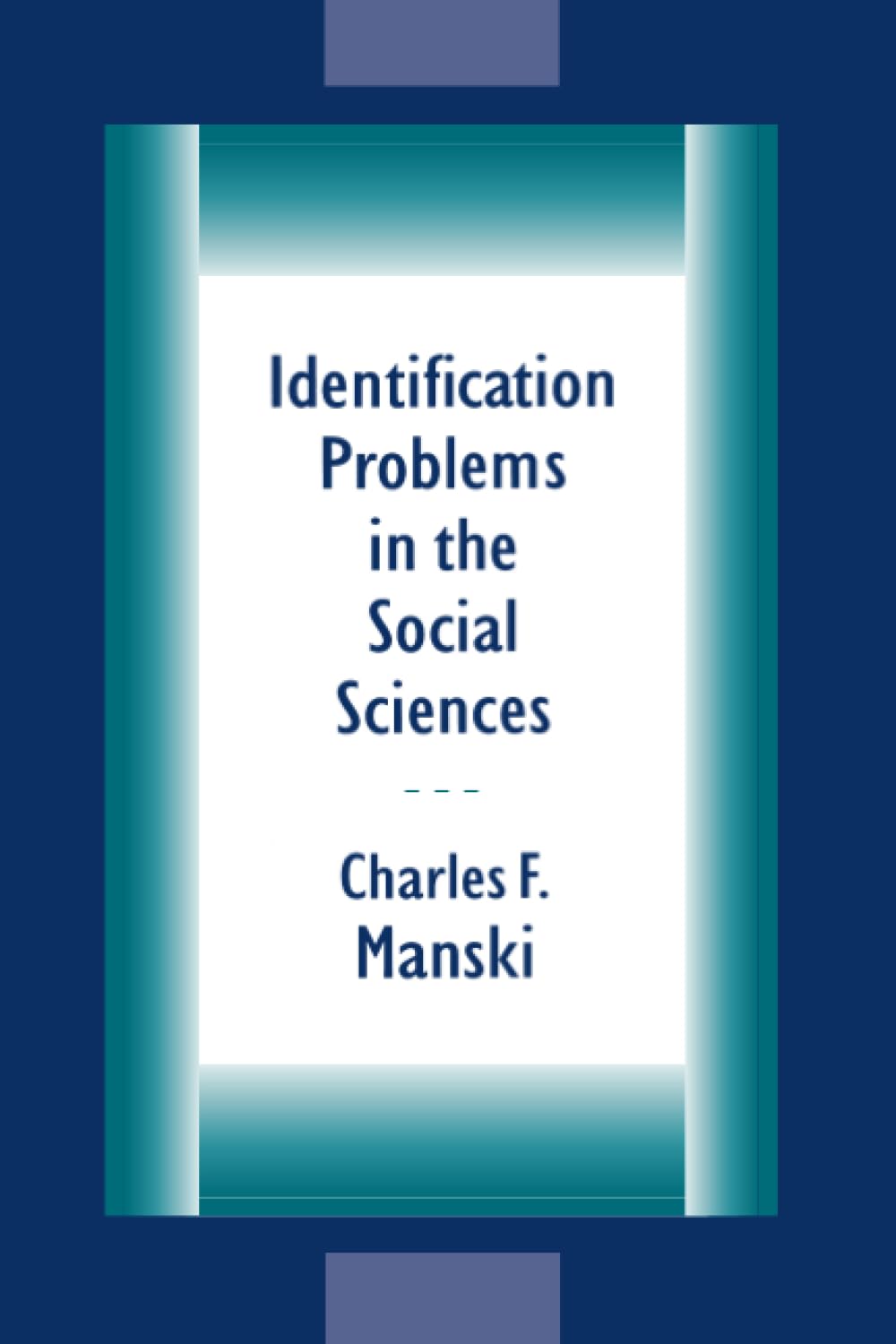
Title
Identification Problems in the Social Sciences,New
Sold by Ergodebooks, an authorized reseller.
Returns accepted within 30 days | support@ergodebooks.com
Shipping Information
- Free Standard Shipping — United States only
- Processing Time: 3–5 business days
- Estimated Delivery: 6–10 business days after dispatch
- Double-boxed, fully insured & discreetly packaged
- Tracking number sent via email once dispatched
Returns & Refund
Returns accepted within 30 days of delivery.
Damaged or Defective Item
Free return shipping + replacement or full refund
Wrong Item Received
Free return shipping + replacement or full refund
Change of Mind
Return shipping at customer's expense · 25% restocking fee applies
Payment Option

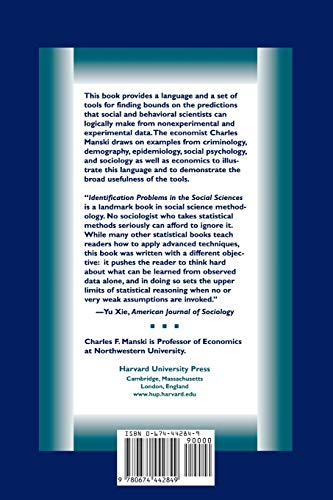
This book provides a language and a set of tools for finding bounds on the predictions that social and behavioral scientists can logically make from nonexperimental and experimental data. The economist Charles Manski draws on examples from criminology, demography, epidemiology, social psychology, and sociology as well as economics to illustrate this language and to demonstrate the broad usefulness of the tools.There are many traditional ways to present identification problems in econometrics, sociology, and psychometrics. Some of these are primarily statistical in nature, using concepts such as flat likelihood functions and nondistinct parameter estimates. Manski's strategy is to divorce identification from purely statistical concepts and to present the logic of identification analysis in ways that are accessible to a wide audience in the social and behavioral sciences. In each case, problems are motivated by real examples with real policy importance, the mathematics is kept to a minimum, and the deductions on identifiability are derived giving fresh insights.Manski begins with the conceptual problem of extrapolating predictions from one population to some new population or to the future. He then analyzes in depth the fundamental selection problem that arises whenever a scientist tries to predict the effects of treatments on outcomes. He carefully specifies assumptions and develops his nonparametric methods of bounding predictions. Manski shows how these tools should be used to investigate common problems such as predicting the effect of family structure on children's outcomes and the effect of policing on crime rates.Successive chapters deal with topics ranging from the use of experiments to evaluate social programs, to the use of casecontrol sampling by epidemiologists studying the association of risk factors and disease, to the use of intentions data by demographers seeking to predict future fertility. The book closes by examining two central identification problems in the analysis of social interactions: the classical simultaneity problem of econometrics and the reflection problem faced in analyses of neighborhood and contextual effects.
⚠️ WARNING (California Proposition 65):
This product may contain chemicals known to the State of California to cause cancer, birth defects, or other reproductive harm.
For more information, please visit www.P65Warnings.ca.gov.