If you have any questions, you are always welcome to contact us. We'll get back to you as soon as possible, withing 24 hours on weekdays.
Customer service
All questions about your order, return and delivery must be sent to our customer service team by e-mail at yourstore@yourdomain.com
Sale & Press
If you are interested in selling our products, need more information about our brand or wish to make a collaboration, please contact us at press@yourdomain.com
Help
If you have any questions, you are always welcome to contact us. We'll get back to you as soon as possible, withing 24 hours on weekdays.
Customer service
All questions about your order, return and delivery must be sent to our customer service team by e-mail at yourstore@yourdomain.com
Sale & Press
If you are interested in selling our products, need more information about our brand or wish to make a collaboration, please contact us at press@yourdomain.com
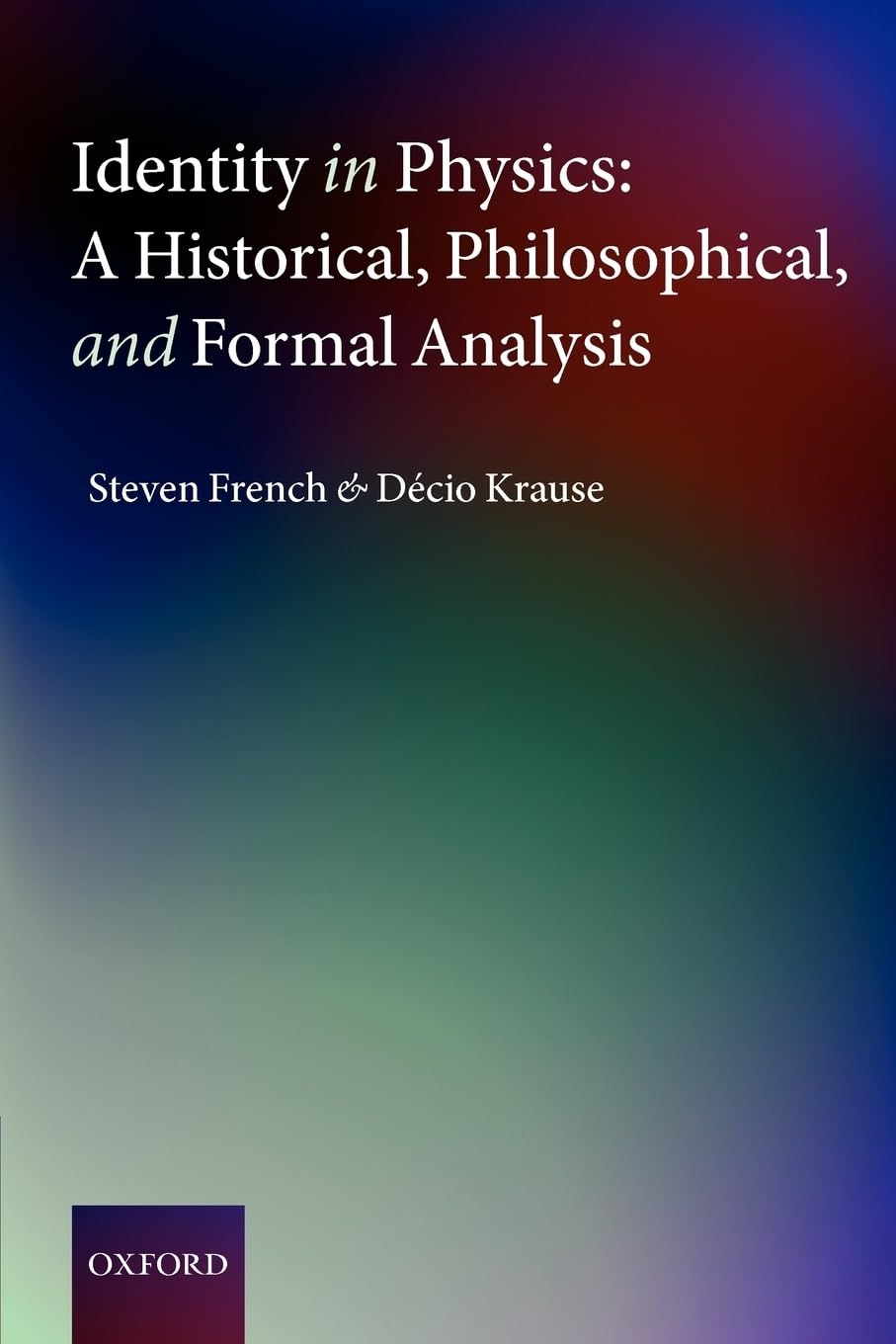
Can quantum particles be regarded as individuals, just like books, tables and people? According to the 'received' view articulated by several physicists in the immediate aftermath of the quantum revolution quantum physics itself tells us they cannot: quantum particles, unlike their classical counterparts, must be regarded as 'nonindividuals' in some sense. However, recent work has indicated that this is not the whole story and that the theory is also consistent with the position that such particles can be taken to be individuals, albeit at a metaphysical price.Drawing on philosophical accounts of identity and individuality, as well as the histories of both classical and quantum physics, the authors explore these two alternative metaphysical packages. In particular, they argue that if quantum particles are regarded as individuals, then Leibniz's famous Principle of the Identity of Indiscernibles is in fact violated. Recent discussions of this conclusion are analysed in detail and, again, the costs involved in saving the Principle are carefully considered.Taking the alternative package, the authors deploy recent work in nonstandard logic and set theory to indicate how we can make sense of the idea that objects can be nonindividuals. The concluding chapter suggests how these results might then be extended to quantum field theory.Identity in Physics brings together a range of work in this area and further develops the authors' own contributions to the debate. Uniquely, as the title indicates, it situates this work in the appropriate formal, historical, and philosophical contexts.
⚠️ WARNING (California Proposition 65):
This product may contain chemicals known to the State of California to cause cancer,
birth defects, or other reproductive harm.
For MAP (Minimum Advertised Price) violations and Intellectual Property (IP) or Trademark concerns, please contact:
support@ergodebooks.com
⚠️ California Proposition 65 Warning: Some products sold on this website may expose you to chemicals known to the State of California to cause cancer, birth defects, or other reproductive harm. For more information, visit www.P65Warnings.ca.gov.