If you have any questions, you are always welcome to contact us. We'll get back to you as soon as possible, withing 24 hours on weekdays.
Customer service
All questions about your order, return and delivery must be sent to our customer service team by e-mail at yourstore@yourdomain.com
Sale & Press
If you are interested in selling our products, need more information about our brand or wish to make a collaboration, please contact us at press@yourdomain.com
Help
If you have any questions, you are always welcome to contact us. We'll get back to you as soon as possible, withing 24 hours on weekdays.
Customer service
All questions about your order, return and delivery must be sent to our customer service team by e-mail at yourstore@yourdomain.com
Sale & Press
If you are interested in selling our products, need more information about our brand or wish to make a collaboration, please contact us at press@yourdomain.com
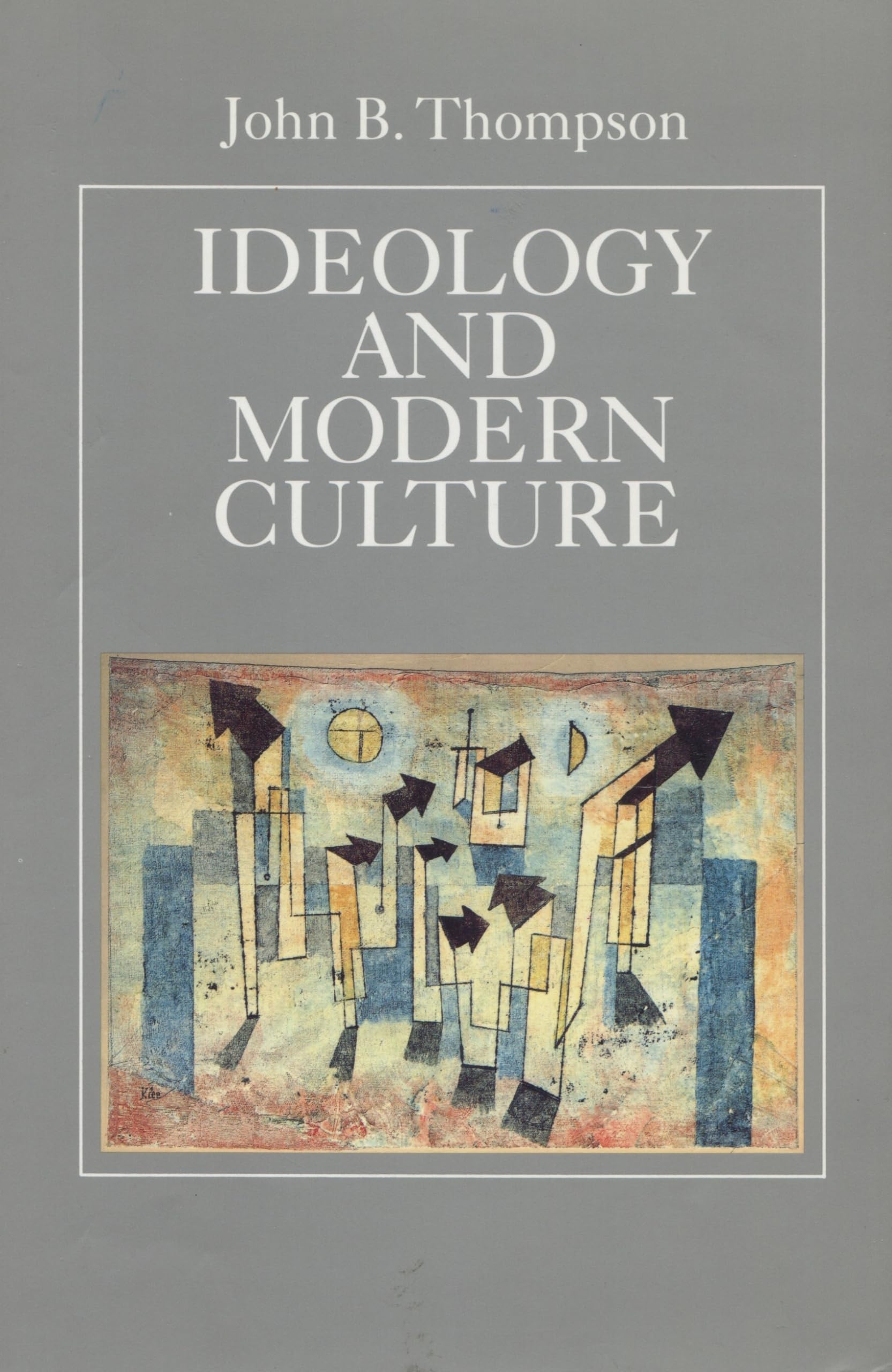
In this major work, informed by materials from several disciplines and theoretical orientations, the author develops a distinctive new account of the theory of ideology and relates it to the analysis of culture and mass communication in modern societies.In the two centuries since is first appeared in France, the concept of ideology has undergone many transformations. It has been twisted, reformulated, recast, and finally filtered back into the everyday language of social and political life. Although there is much that is misleading and erroneous in the traditions of ideology, the author shows that it still defines a terrain of analysis that remains central to contemporary social sciences and continues to be the site of lively theoretical debate.The key to his analysis is what he terms the 'mediazation' of the culturethe general process by which the transmission of symbolic forms becomes increasingly reliant on the technical and institutional apparatuses of the media industries. Building on the work of Geertz and others, the author asserts that symbolic forms are embedded in such structured social contexts as power relations, forms of conflict, and inequalities in the distribution of resources, and that any discussion of mass communication must embrace its political as well as epistemological content.
⚠️ WARNING (California Proposition 65):
This product may contain chemicals known to the State of California to cause cancer,
birth defects, or other reproductive harm.
For MAP (Minimum Advertised Price) violations and Intellectual Property (IP) or Trademark concerns, please contact:
support@ergodebooks.com
⚠️ California Proposition 65 Warning: Some products sold on this website may expose you to chemicals known to the State of California to cause cancer, birth defects, or other reproductive harm. For more information, visit www.P65Warnings.ca.gov.