
Title
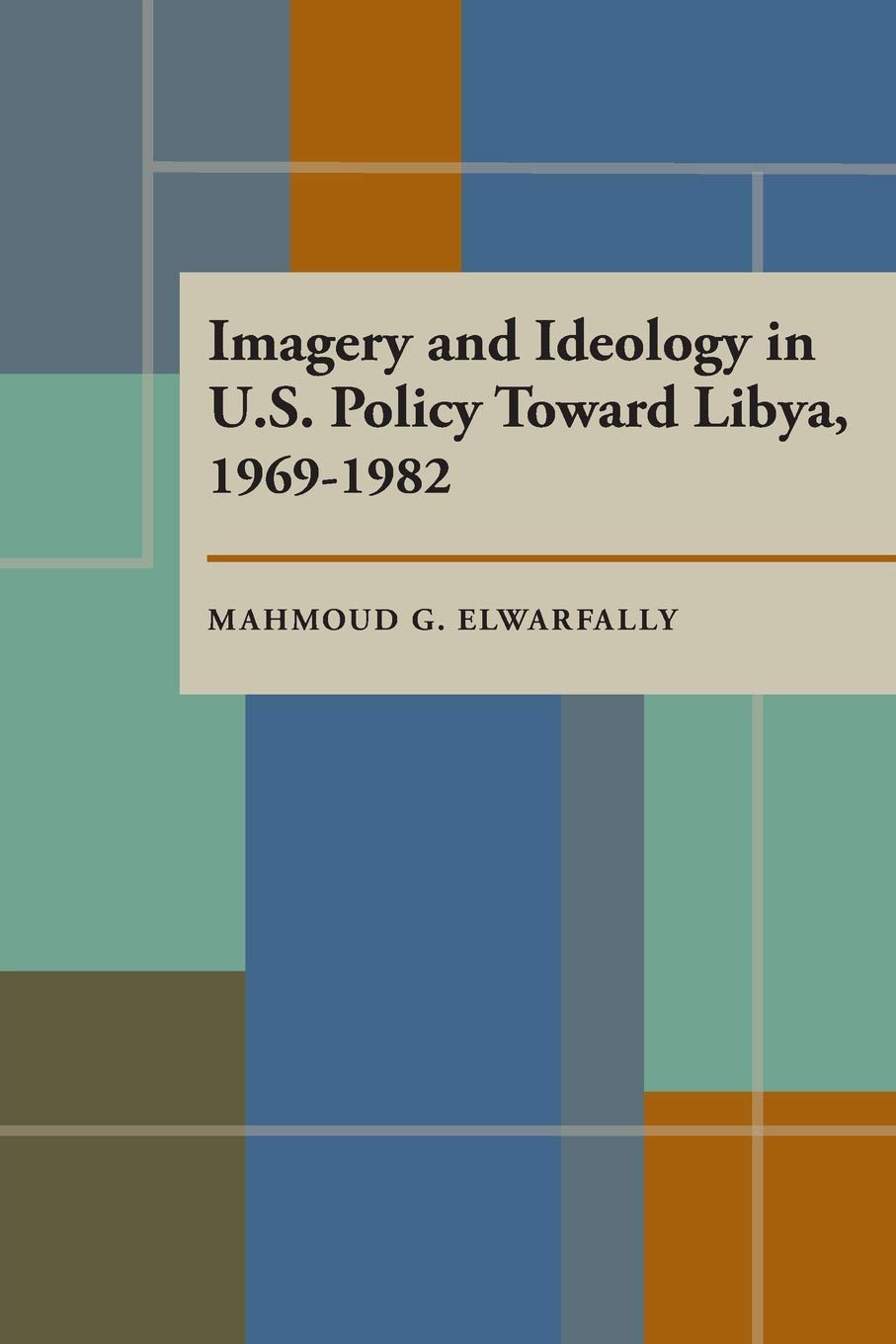
Imagery And Ideology In U.S. Policy Toward Libya 19691982,Used
Sold by Ergodebooks, an authorized reseller.
Returns accepted within 30 days | support@ergodebooks.com
Shipping Information
- Free Standard Shipping — United States only
- Processing Time: 3–5 business days
- Estimated Delivery: 6–10 business days after dispatch
- Double-boxed, fully insured & discreetly packaged
- Tracking number sent via email once dispatched
Returns & Refund
Returns accepted within 30 days of delivery.
Damaged or Defective Item
Free return shipping + replacement or full refund
Wrong Item Received
Free return shipping + replacement or full refund
Change of Mind
Return shipping at customer's expense · 25% restocking fee applies
Payment Option

Product Description How close to reality was the official U.S. image of Libya through the NixonFord, Carter, and Reagan administrations? After recounting the actions of Libya and the United States in the Middle East since 1969, ElWahrfally concludes that it was very far from accurate.Using personal interviews as well as scholarly research, ElWarfally demonstrates that recent U.S. relations with Libya, regardless of rhetoric, have been primarily determined by whether or not Libya serves U.S. interests in the region: maintaining access to Middle Eastern oil, protecting Israel, and limiting Soviet expansionism. Just as the official image of Libya has veered from one extreme to another, U.S. policy responses have also often conflicted with the publicly stated view.The Nixon administration was at first friendly toward Libya, even though Qaddafi ejected the U.S. military and nationalized the oil industry, because of Libya's avowed anticommunism and U.S. dependence on Libyan oil. After 1976, the official U.S. image was more hostile, and Libya was attacked as a destabilizing influence in the Middle East. Outrage reached new heights during the Reagan administration, which made several unsuccessful covert attempts to unseat Qaddafi, mounted an embargo and military provocations, and in 1986 bombed Libya on a pretext later revealed to be false. Combining theory with current history, this book demonstrates that fixed ideas and misinterpretation of events may have more to do with foreign policy behavior than facts do. Suggesting a new direction for research into relations between the superpowers and the Third World, it will interest scholars, students, and policymakers concerned with the Middle East. Review 'Mahmoud ElWarfally, a former Libyan diplomat and now a practicing member of the academic community, has prepared a balanced assessment of evolving U.S.Libyan relations.Annals of the American Academy of Political and Social SciencesElWarfally brings a keen understanding of the American foreignpolicy process to bear on his impressive knowledge of Libyan domestic and foreign policy. . . . That he is able to tie Quaddafi's domestic goals as they changed during the period examined to Libya's international behavior makes the book doubly valuable.PerspectiveThis is an interesting and challenging book on a topical subject, namely, US foreign policy toward Libya. The author evaluates the reasons behind the policies of the Nixon, Ford, Carter, and Reagan administrations within a wellconstructed theoretical framework. . . . A useful framework for such an analysis, [one that] questions certain basic assumptions concerning the relation between US policy and the behavior of Third World nations and their leaders.Middle East Journal About the Author Mahmoud G. ElWarfally was a Libyan diplomat and professor of political science at the University of Garyounis.
⚠️ WARNING (California Proposition 65):
This product may contain chemicals known to the State of California to cause cancer, birth defects, or other reproductive harm.
For more information, please visit www.P65Warnings.ca.gov.