
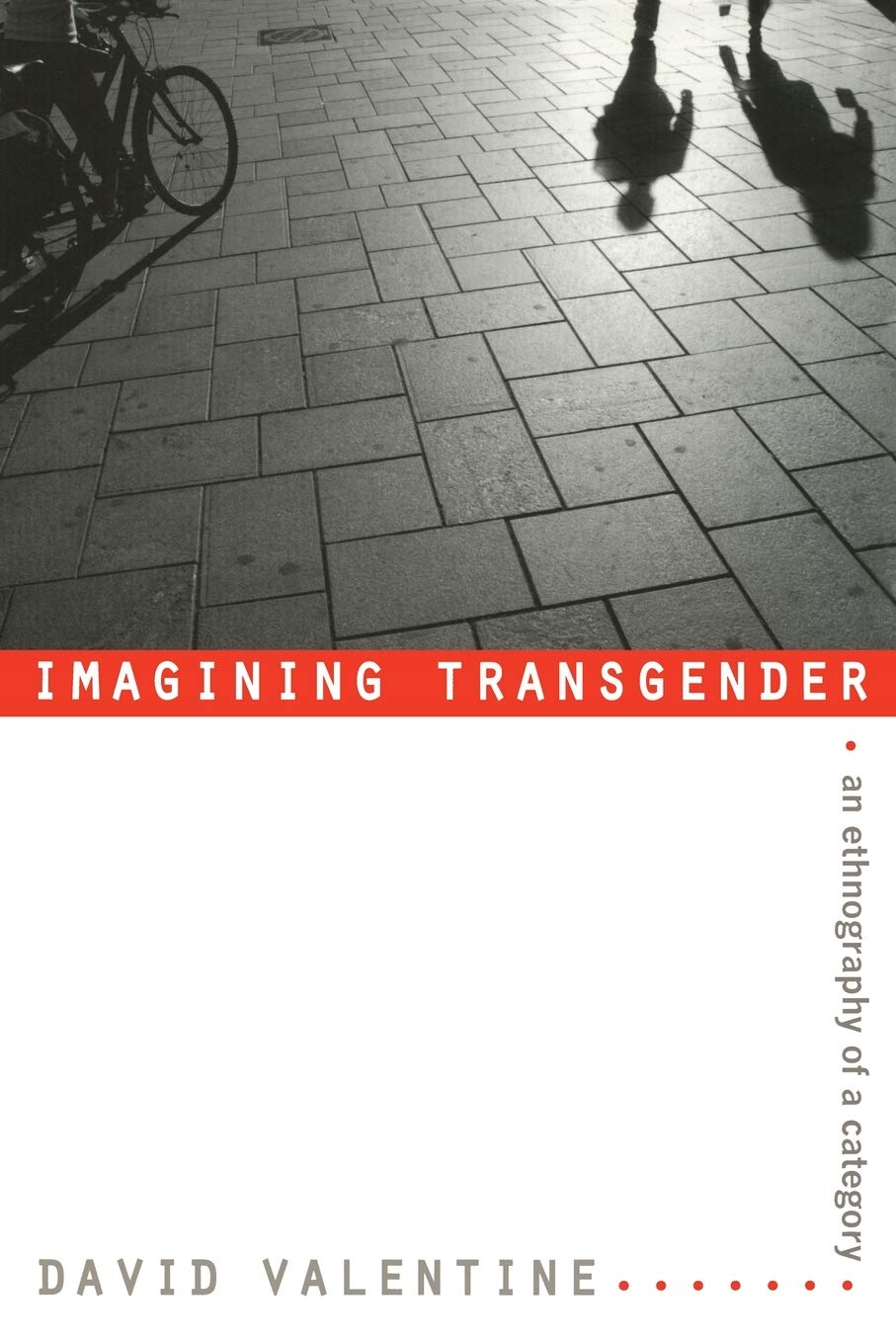
Title

Imagining Transgender: An Ethnography Of A Category
Sold by Ergodebooks, an authorized reseller.
Returns accepted within 30 days | support@ergodebooks.com
Shipping Information
- Free Standard Shipping — United States only
- Processing Time: 3–5 business days
- Estimated Delivery: 6–10 business days after dispatch
- Double-boxed, fully insured & discreetly packaged
- Tracking number sent via email once dispatched
Returns & Refund
Returns accepted within 30 days of delivery.
Damaged or Defective Item
Free return shipping + replacement or full refund
Wrong Item Received
Free return shipping + replacement or full refund
Change of Mind
Return shipping at customer's expense · 25% restocking fee applies
Payment Option

Imagining Transgender Is An Ethnography Of The Emergence And Institutionalization Of Transgender As A Category Of Collective Identity And Political Activism. Embraced By Activists In The Early 1990S To Advocate For Gendervariant People, The Category Quickly Gained Momentum In Public Health, Social Service, Scholarly, And Legislative Contexts. Working As A Safersex Activist In Manhattan During The Late 1990S, David Valentine Conducted Ethnographic Research Among Mostly Maletofemale Transgenderidentified People At Drag Balls, Support Groups, Crossdresser Organizations, Clinics, Bars, And Clubs. However, He Found That Many Of Those Labeled Transgender By Activists Did Not Know The Term Or Resisted Its Use. Instead, They Selfidentified As Gay, A Category Of Sexual Rather Than Gendered Identity And One Rejected In Turn By The Activists Who Claimed These Subjects As Transgender. Valentine Analyzes The Reasons For And Potential Consequences Of This Difference, And How Social Theory Is Implicated In It.Valentine Argues That Transgender Has Been Adopted So Rapidly In The Contemporary United States Because It Clarifies A Model Of Gender And Sexuality That Has Been Gaining Traction Within Feminism, Psychiatry, And Mainstream Gay And Lesbian Politics Since The 1970S: A Paradigm In Which Gender And Sexuality Are Distinct Arenas Of Human Experience. This Distinction And The Identity Categories Based On It Erase The Experiences Of Some Gendervariant Peopleparticularly Poor Persons Of Colorwho Conceive Of Gender And Sexuality In Other Terms. While Recognizing The Important Advances Transgender Has Facilitated, Valentine Argues That A Broad Vision Of Social Justice Must Include, Simultaneously, An Attentiveness To The Politics Of Language And A Recognition Of How Social Theoretical Models And Broader Political Economies Are Embedded In The Daytoday Politics Of Identity.
⚠️ WARNING (California Proposition 65):
This product may contain chemicals known to the State of California to cause cancer, birth defects, or other reproductive harm.
For more information, please visit www.P65Warnings.ca.gov.
- Q: How many pages does the book have? A: The book has three hundred twenty pages. It provides an in-depth exploration of transgender identity and activism.
- Q: What is the binding type of this book? A: The book is available in paperback binding. This makes it lightweight and easy to carry.
- Q: What are the dimensions of the book? A: The dimensions of the book are six inches in length, zero point eight inches in width, and nine point zero two inches in height.
- Q: Who is the author of this book? A: The author of the book is David Valentine. He conducted ethnographic research on transgender identity during the late 1990s.
- Q: What is the main theme of this book? A: The main theme of the book is the emergence and institutionalization of transgender as a category of identity. It discusses the complexities of gender and sexuality.
- Q: How do I use this book for research? A: You can use this book for research by reading it to understand the social dynamics of transgender identity. It's suitable for both academic and personal exploration.
- Q: Is this book suitable for beginners in gender studies? A: Yes, this book is suitable for beginners in gender studies. It provides foundational insights into transgender activism and identity.
- Q: What reading level is this book appropriate for? A: This book is appropriate for college-level readers and above. It contains complex themes that require critical thinking.
- Q: Can I use this book in a classroom setting? A: Yes, this book can be used in a classroom setting. It offers valuable perspectives for discussions on gender and sexuality.
- Q: How should I store this book to keep it in good condition? A: You should store this book in a cool, dry place away from direct sunlight. This will help preserve its condition over time.
- Q: What if the book arrives damaged? A: If the book arrives damaged, you can contact the seller for a return or replacement. Keep your receipt for warranty purposes.
- Q: Is there a return policy for this book? A: Yes, there is a return policy for this book. Please check with the seller for specific details regarding their return process.
- Q: How do I clean the book if it gets dirty? A: To clean the book, gently wipe the cover with a dry cloth. Avoid using water or cleaning solutions that could damage the pages.
- Q: Are there any safety concerns with this book? A: No, there are no safety concerns with this book. It is intended for educational and informational purposes.
- Q: Is this book suitable for all audiences? A: Yes, this book is suitable for all audiences interested in gender studies and social justice. However, it may contain complex discussions.