
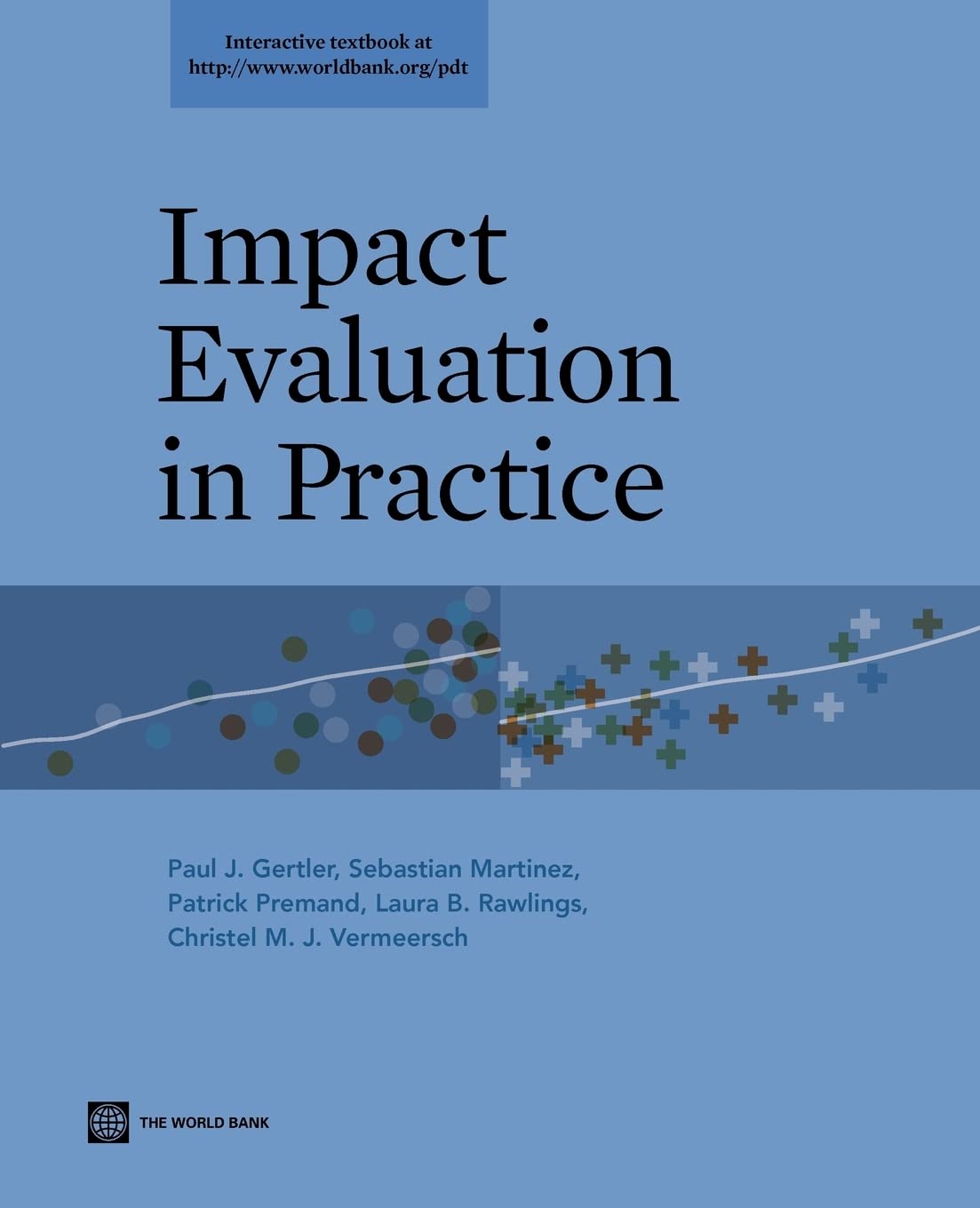
Title
Impact Evaluation In Practice (World Bank Training),New
Sold by Ergodebooks, an authorized reseller.
Returns accepted within 30 days | support@ergodebooks.com
Shipping Information
- Free Standard Shipping — United States only
- Processing Time: 3–5 business days
- Estimated Delivery: 6–10 business days after dispatch
- Double-boxed, fully insured & discreetly packaged
- Tracking number sent via email once dispatched
Returns & Refund
Returns accepted within 30 days of delivery.
Damaged or Defective Item
Free return shipping + replacement or full refund
Wrong Item Received
Free return shipping + replacement or full refund
Change of Mind
Return shipping at customer's expense · 25% restocking fee applies
Payment Option

This book offers an accessible introduction to the topic of impact evaluation and its practice in development. While the book is geared principally towards development practitioners and policymakers designing prospective impact evaluations, we trust that it will be a valuable resource for students and others interested in using impact evaluation. Prospective impact evaluations should be used selectively to assess whether or not a program has achieved its intended results, or to test alternatives for achieving those results. We consider that more and better impact evaluation will help strengthen the evidence base for development policies and programs around the world. If governments and development practitioners can make policy decisions based on evidence including evidence generated through impact evaluation our hope is that development resources will be spent more effectively, and ultimately have a greater impact on reducing poverty and improving peoples lives. The three chapters in this handbook provide a nontechnical introduction to impact evaluations, including Why Evaluate in Chapter 1, How to Evaluate in Chapter 2 and How to Implement Impact Evaluations in Chapter 3. These elements are the basic tools needed in order to successfully carry out an impact evaluation.From a methodological standpoint our approach to impact evaluation is largely pragmatic: we think that the most appropriate methods should be identified to fit the operational context, and not the other way around. This is best achieved at the outset of the program, through the design of prospective impact evaluation that can be built into the projects implementation. We argue that gaining consensus between key stakeholders and identifying an evaluation design that fits the political and operational context is as important as the method itself. We also believe strongly that impact evaluations should be upfront about their limitations and caveats. Finally, we strongly encourage policymakers and program managers to consider impact evaluations in a logical framework that clearly sets out the causal pathways by which the program works to produce outputs and influence final outcomes, and to combine impact evaluations with monitoring and selected complementary evaluation approach to gain a full picture of performance.This book builds on a core set of teaching materials developed for the Turning Promises to Evidence workshops organized by the office of the Chief Economist for Human Development (HDNCE) in partnership with regional units and the Development Economics Research Group (DECRG) at the World Bank.
⚠️ WARNING (California Proposition 65):
This product may contain chemicals known to the State of California to cause cancer, birth defects, or other reproductive harm.
For more information, please visit www.P65Warnings.ca.gov.
- Q: How many pages does this book have? A: This book has two hundred sixty-two pages. It offers an in-depth look at impact evaluation in development.
- Q: What are the dimensions of this book? A: The dimensions of this book are seven point twenty-four inches in length, nine point twenty-five inches in height, and zero point fifty-nine inches in width.
- Q: What type of binding does this book have? A: This book is available in paperback binding. This makes it lightweight and easy to carry.
- Q: Who is the author of this book? A: The author of this book is Paul J. Gertler. He is known for his expertise in development economics.
- Q: What is the main focus of this book? A: The main focus of this book is impact evaluation in practice. It aims to guide development practitioners and policymakers.
- Q: Is this book suitable for students? A: Yes, this book is suitable for students interested in impact evaluation. It provides accessible information on the topic.
- Q: How can I implement the evaluations discussed in this book? A: To implement the evaluations, follow the guidelines provided in the three chapters. Each chapter outlines steps for effective impact evaluations.
- Q: Is this book good for beginners in impact evaluation? A: Yes, this book is excellent for beginners. It offers a non-technical introduction to the concepts of impact evaluation.
- Q: Can policymakers benefit from this book? A: Yes, policymakers can benefit from this book. It emphasizes the importance of using evidence from impact evaluations for decision-making.
- Q: How should I care for this book? A: To care for this book, keep it in a dry place and avoid exposure to direct sunlight. This will help maintain its condition.
- Q: Is there a warranty for this book? A: No, there is typically no warranty for books. You should check the return policy of the seller if you encounter issues.
- Q: What should I do if my book arrives damaged? A: If your book arrives damaged, contact the seller immediately for a return or replacement. Provide photos of the damage for quicker resolution.
- Q: Does this book contain any technical jargon? A: No, this book does not contain significant technical jargon. It is designed to be accessible to all readers.
- Q: Is this book a good resource for development practitioners? A: Yes, this book is an excellent resource for development practitioners. It provides practical tools for conducting impact evaluations.
- Q: What is the publication date of this book? A: The publication date of this book is not specified here. Please check with the seller for detailed publication information.