If you have any questions, you are always welcome to contact us. We'll get back to you as soon as possible, withing 24 hours on weekdays.
Customer service
All questions about your order, return and delivery must be sent to our customer service team by e-mail at yourstore@yourdomain.com
Sale & Press
If you are interested in selling our products, need more information about our brand or wish to make a collaboration, please contact us at press@yourdomain.com
Help
If you have any questions, you are always welcome to contact us. We'll get back to you as soon as possible, withing 24 hours on weekdays.
Customer service
All questions about your order, return and delivery must be sent to our customer service team by e-mail at yourstore@yourdomain.com
Sale & Press
If you are interested in selling our products, need more information about our brand or wish to make a collaboration, please contact us at press@yourdomain.com
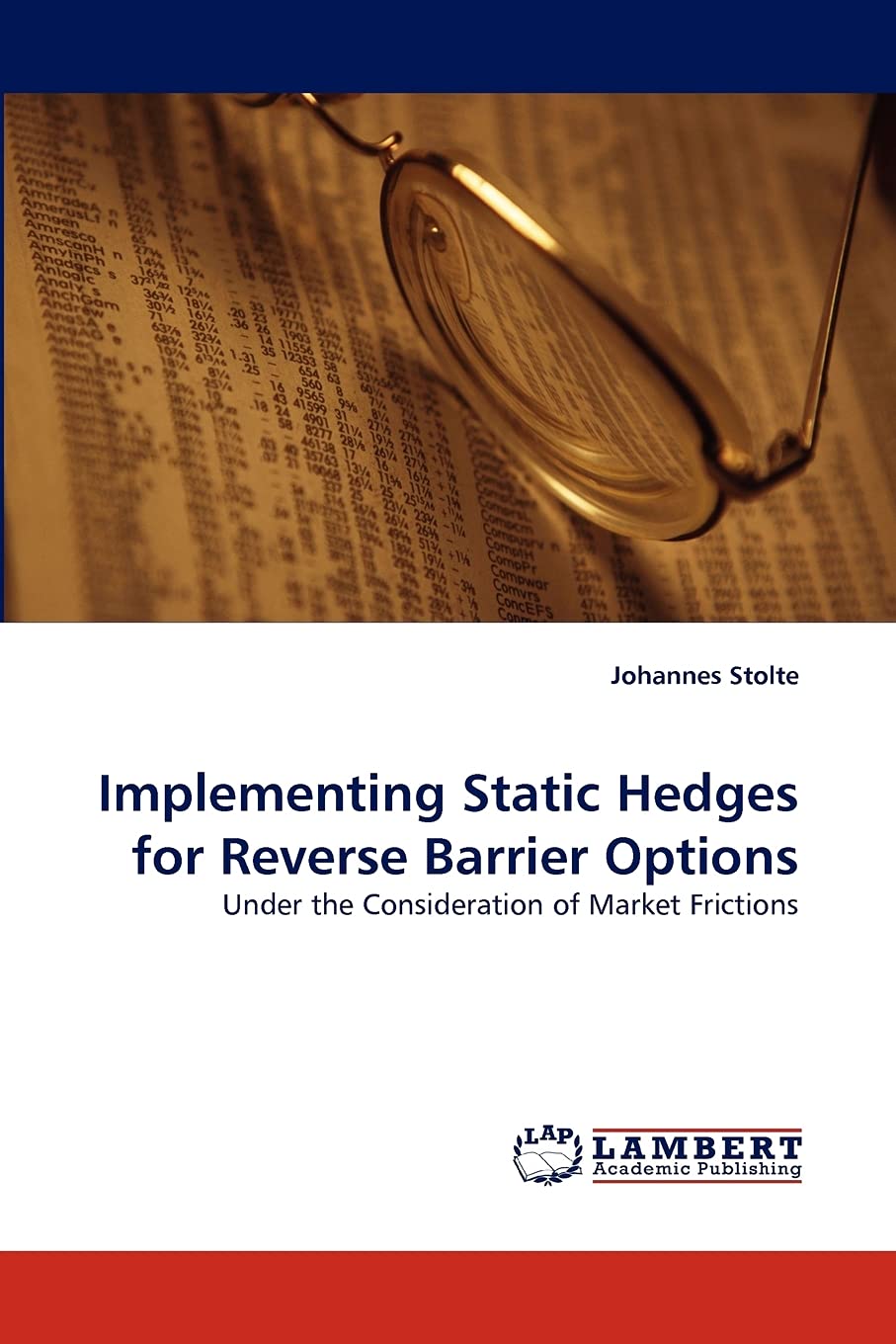
Barrier options are the most actively traded type of exotic equity derivative today. Especially reverse barrier options, like the upandout call considered here, are extremely difficult to hedge however. A number of interesting and sophisticated approaches of static hedging have therefore been proposed in the literature. To implement any of these static hedges under the consideration of observed market frictions many adjustments need to be addressed. This paper discusses the necessary adjustments for a large number of static hedges. As an example, DAX index options that are traded on the EUREX will be considered. In addition, hedge performance is analyzed with regard to a discounted hedge error. It turns out that only a few of the proposed static hedges perform satisfactory for an upandout call option with a barrier at 120%. It further seems unrealistic to hedge many different volatility levels or jump components in practice, as is proposed by some recent studies.
⚠️ WARNING (California Proposition 65):
This product may contain chemicals known to the State of California to cause cancer,
birth defects, or other reproductive harm.
For MAP (Minimum Advertised Price) violations and Intellectual Property (IP) or Trademark concerns, please contact:
support@ergodebooks.com
⚠️ California Proposition 65 Warning: Some products sold on this website may expose you to chemicals known to the State of California to cause cancer, birth defects, or other reproductive harm. For more information, visit www.P65Warnings.ca.gov.