
Title
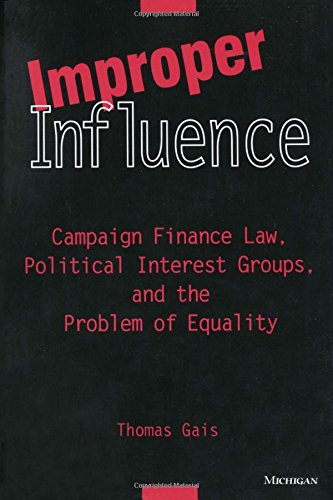
Improper Influence : Campaign Finance Law, Political Interest Groups, and the Problem of Equality,Used
Sold by Ergodebooks, an authorized reseller.
Returns accepted within 30 days | support@ergodebooks.com
Shipping Information
- Free Standard Shipping — United States only
- Processing Time: 3–5 business days
- Estimated Delivery: 6–10 business days after dispatch
- Double-boxed, fully insured & discreetly packaged
- Tracking number sent via email once dispatched
Returns & Refund
Returns accepted within 30 days of delivery.
Damaged or Defective Item
Free return shipping + replacement or full refund
Wrong Item Received
Free return shipping + replacement or full refund
Change of Mind
Return shipping at customer's expense · 25% restocking fee applies
Payment Option

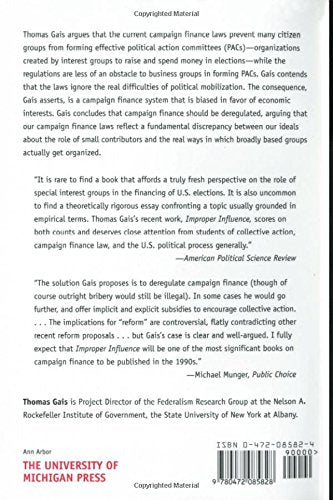
Why is there still so much dissatisfaction with the role of special interest groups in financing American election campaigns, even though no aspect of interest group politics has been so thoroughly regulated and constrained? This book argues that part of the answer lies in the laws themselves, which prevent many hardtoorganize citizen groups from forming effective political action committees (PACs), while actually helping business groups organize PACs.Thomas L. Gais points out that many laws that regulate group involvement in elections ignore the real difficulties of political mobilization, and he concludes that PACs and the campaign finance laws reflect a fundamental discrepancy between grassroots ideals and the ways in which broadly based groups actually get organized.". . . . of fundamental scholarly and practical importance. The implications for 'reform' are controversial, flatly contradicting other recent reform proposals . . . . I fully expect that Improper Influence will be one of the most significant books on campaign finance to be published in the 1990s." Michael Munger, Public Choice"It is rare to find a book that affords a truly fresh perspective on the role of special interest groups in the financing of U.S. elections. It is also uncommon to find a theoretically rigorous essay confronting a topic usually grounded in empirical terms. . . . Improper Influence scores high on both counts and deserves close attention from students of collective action, campaign finance law, and the U.S. political process more generally." American Political Science ReviewThomas L. Gais is Senior Fellow, The Nelson A. Rockefeller Institute of Government, State University of New York.
⚠️ WARNING (California Proposition 65):
This product may contain chemicals known to the State of California to cause cancer, birth defects, or other reproductive harm.
For more information, please visit www.P65Warnings.ca.gov.