
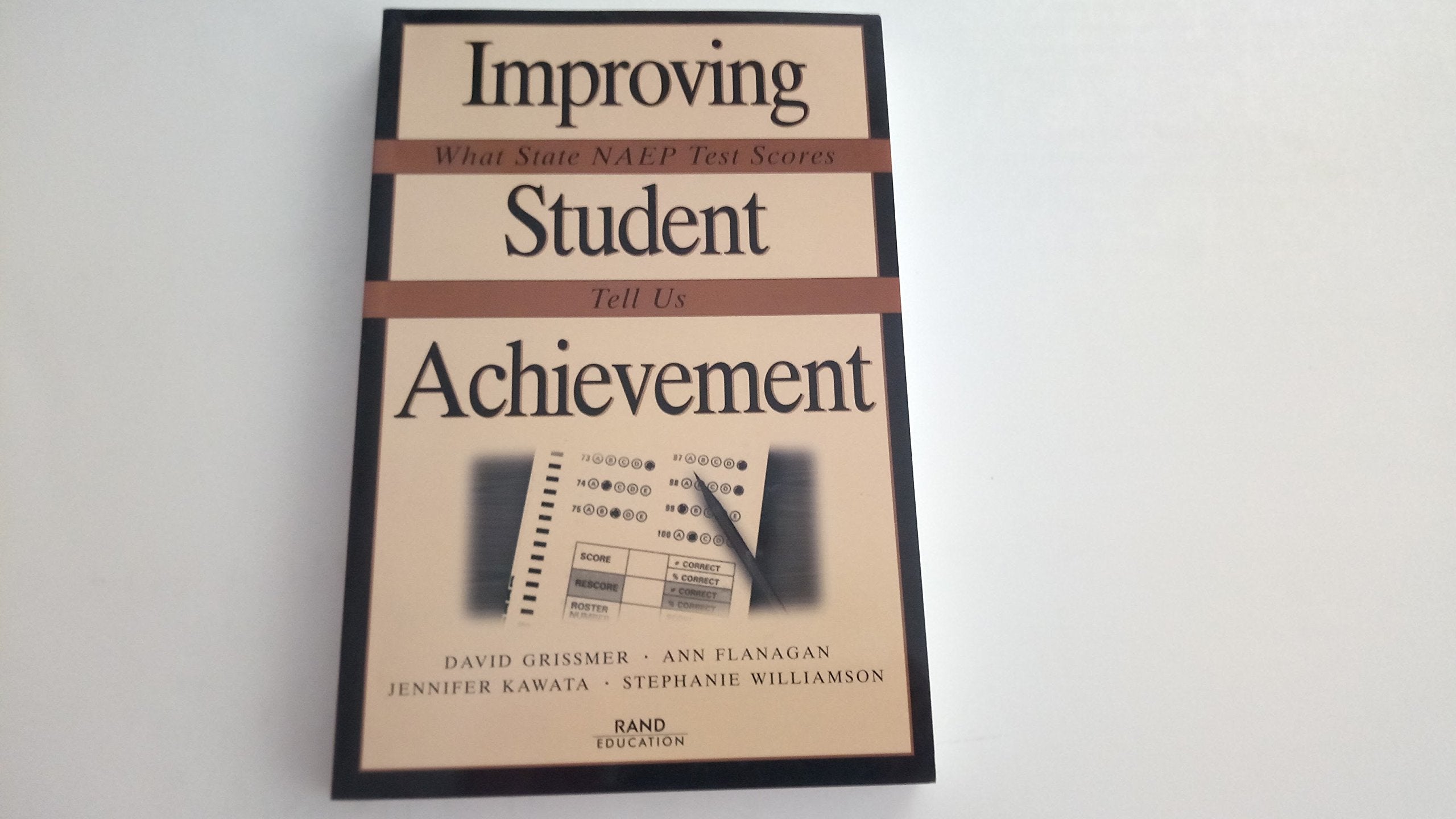
Title
Improving Student Achievement: What State Naep Test Scores Tell Us
Sold by Ergodebooks, an authorized reseller.
Returns accepted within 30 days | support@ergodebooks.com
Shipping Information
- Free Standard Shipping — United States only
- Processing Time: 3–5 business days
- Estimated Delivery: 6–10 business days after dispatch
- Double-boxed, fully insured & discreetly packaged
- Tracking number sent via email once dispatched
Returns & Refund
Returns accepted within 30 days of delivery.
Damaged or Defective Item
Free return shipping + replacement or full refund
Wrong Item Received
Free return shipping + replacement or full refund
Change of Mind
Return shipping at customer's expense · 25% restocking fee applies
Payment Option

Review Recommended For Undergraduates, Graduate Students, Researchers, Faculty, And Professionals. R. C. Morris Choice Magazine March 2001Recommended For Undergraduates, Graduate Students, Researchers, Faculty, And Professionals. R. C. Morris, Choice Magazine, March 2001 Product Description Fifty States, Fifty Different Educational Policies And Practices. Which Practices Are Best? The Authors Find That State Test Scores Differ Mainly Due To Population And Family Characteristics, Not Because Of Different Schools Or Policies. This Analysis Has Been Long Awaited By The 4.1 Million Educators In The K12 System Nationwide. From The Publisher Great Efforts Have Been Made To Improve The Nation'S Public K12Educational System Since The Early 1980S. States Have Been The Primaryinitiators Of This Educational Reform. States Have Leverage Toreform Education Because They Provide Approximately Onehalf Ofeducational Funding To Typical School Districts In The Nation And Setpolicies That Influence Who Teaches And What Is Taught. Furthermore,State Courts Also Play A Key Role In Deciding Whether Educationalfunds Are Adequate And Equitably Distributed. Even Before 1980, Thestates Had Diverse Educational Systems That Varied Widely In Terms Ofperpupil Spending, Resource Allocation, And Educational Policies.Reforms That Have Been Initiated Since Then Have Varied Widely Bystate In Terms Of The Pace And Types Of Reform, Ensuring A Continuingwidely Diverse Set Of Educational Systems Across States.Having 50 States Taking Different Approaches To Education Can Providea Powerful Advantage In The Long Run If Research And Evaluationcan Identify Successful And Unsuccessful Approaches. Identifyingwhat Works, In Turn, Can Help States Refine And Adapt Successful Policiesin A Continual And Ongoing Process Of Improving Education.Evaluating The Effects Of Different Levels Of Resources, Different Uses Ofresources, And Changing State Policies Then Becomes Critical To Improvingschools And Student Outcomes.Perhaps The Single Most Important Reason To Analyze Achievementresults Across States Is To Find Out Whether Public Education Isamenable To Reform And Improvement. The Crux Of The Current Policydebate About School Reform Is Whether The K12 System Of Publiceducation Is Reformable. Those Who Argue It Is Not Maintain Thatthe Present System Does Not Use Additional Resources Effectively Becauseof Its Bureaucratic Structure And Lack Of Appropriate Internalincentives To Change. According To This View, Improving Educationrequires Structural Reforms That Introduce Competition By Providingmore Choice Within The System And More Alternatives Outside Thesystem. Additional Resources Without This Kind Of Structural Reformwould Simply Be Wasted.The Alternative Position Sees Resource Constraints As The Key Issueparticularly With Respect To Disadvantaged Students. This View Assumesthat Additional Resources Can Be Used Effectively, But Only Iftargeted To Specific Programs And Types Of Students. This Positionhas Been Slowly Modified To Include A Different Type Of Structural Reform:Standardsbased Accountability Within The Public Educationsystem Through Defined Criteria And Measurements Of Achievementoutcomes. In This View, A Structure Of Accountability Is Needed Tofocus Resources On Meeting Achievement Standards. This Type Ofreform Has Been Implemented Primarily At The State Level, Beginningin A Few States In The Mid To Late 1980S And, With Varying Designs,Gradually Spreading Across States. If This Type Of Reform Is Successful,That Success Should Primarily Be Reflected In Differential Score Gainsacross States That Cannot Be Accounted For By Family Characteristicsor Changing Resources.Another Reason To Focus On Achievement Outcomes By State Is Thatabout Twothirds Of The Variance In Perpupil Spending Is Betweenstates, While Only Onethird Is Within States. While The State Courtscan Address Withinstate Inequalities, Federal Legislation Is The
⚠️ WARNING (California Proposition 65):
This product may contain chemicals known to the State of California to cause cancer, birth defects, or other reproductive harm.
For more information, please visit www.P65Warnings.ca.gov.
- Q: How many pages does the book have? A: The book has three hundred ten pages. It provides a comprehensive analysis of state educational policies and test scores.
- Q: What is the binding type of this book? A: This book is paperback bound. The paperback format makes it lightweight and easy to handle.
- Q: What are the dimensions of the book? A: The book measures seven point four eight inches in length, zero point six seven inches in width, and eight point nine eight inches in height. These dimensions make it a manageable size for reading.
- Q: Who is the author of this book? A: The author is David Grissmer. He is known for his expertise in educational assessment and policy.
- Q: Is this book suitable for undergraduate students? A: Yes, this book is recommended for undergraduate students. It provides insights that are beneficial for both undergraduates and graduate students.
- Q: Can graduate students benefit from this book? A: Yes, graduate students will find this book valuable. It includes research and analysis relevant to higher education and educational policy.
- Q: How should I store this book? A: Store the book in a cool, dry place away from direct sunlight. This helps preserve the quality of the paper and binding.
- Q: Is this book safe for children? A: Yes, this book is safe for older children, particularly those interested in education. However, it is primarily targeted at adults and students.
- Q: How do I keep this book in good condition? A: To keep the book in good condition, avoid bending the spine and store it upright on a shelf. This prevents damage to the pages and cover.
- Q: What audience is this book intended for? A: The book is intended for educators, researchers, and policy makers. It is specifically designed for those involved in K-12 education.
- Q: Is this book useful for educational researchers? A: Yes, educational researchers will find this book highly useful. It provides data and analysis on state test scores and educational practices.
- Q: Can I return the book if I don't like it? A: Yes, you can return the book if you are not satisfied with it. Check the retailer's return policy for specific details.
- Q: What if the book arrives damaged? A: If the book arrives damaged, you should contact the seller immediately for a replacement or refund. Most sellers have policies for damaged goods.
- Q: Is there a warranty for this book? A: No, there is typically no warranty for books. However, you may have return options based on the seller's policy.
- Q: Is this book part of a series? A: No, this book is not part of a series. It stands alone as a comprehensive analysis of state educational policies.
- Q: Is the content of this book up to date? A: Yes, the content is relevant to current educational debates and practices. However, always check for the latest research for the most current information.