
Title
Improving Urban Schools: Equity And Access In K12 Stem Education (Contemporary Perspectives On Access, Equity, And Achievement),Used
Sold by Ergodebooks, an authorized reseller.
Returns accepted within 30 days | support@ergodebooks.com
Shipping Information
- Free Standard Shipping — United States only
- Processing Time: 3–5 business days
- Estimated Delivery: 6–10 business days after dispatch
- Double-boxed, fully insured & discreetly packaged
- Tracking number sent via email once dispatched
Returns & Refund
Returns accepted within 30 days of delivery.
Damaged or Defective Item
Free return shipping + replacement or full refund
Wrong Item Received
Free return shipping + replacement or full refund
Change of Mind
Return shipping at customer's expense · 25% restocking fee applies
Payment Option

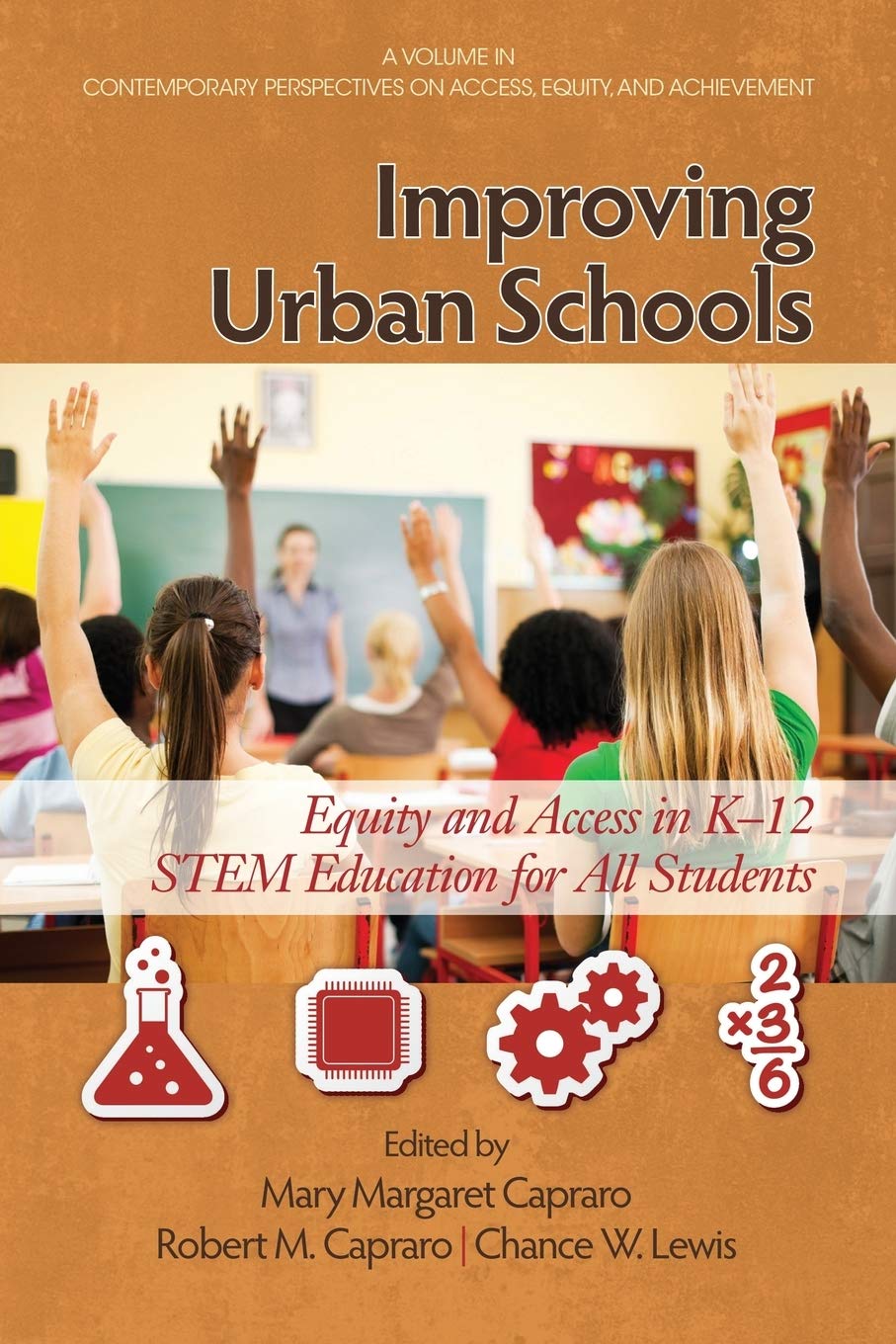
Although STEM (Science, Technology, Engineering, and Mathematics) has been diversely defined by various researchers (e.g. Buck Institute, 2003; Capraro & Slough, 2009; Scott, 2009; Wolf, 2008), during the last decade, STEM education has gained an increasing presence on the national agenda through initiatives from the National Science Foundation (NSF) and the Institute for Educational Sciences (IES). The rate of technological innovation and change has been tremendous over the past ten years, and this rapid increase will only continue. STEM literacy is the power to identify, apply, and integrate concepts from science, technology, engineering, and mathematics to understand complex problems and to innovate to solve them (Washington State STEM, 2011, Internet). In order for U.S. students to be on the forefront of this revolution, ALL of our schools need to be part of the STEM vision and guide students in acquiring STEM literacy. Understanding and addressing the challenge of achieving STEM literacy for ALL students begins with an understanding of its element and the connections between them. In order to remain competitive, the Committee on Prospering in the Global Economy has recommended that the US optimize its knowledgebased resources, particularly in science and technology (National Academies, 2007, p. 4). Optimizing knowledgebased resources needs to be the goal but is also a challenge for ALL educators (Scheurich & Huggins, 2009). Regardless, there is little disagreement that contemporary society is increasingly dependent on science, technology, engineering, and mathematics and thus comprehensive understandings are essential for those pursuing STEM careers. It is also generally agreed that PK12 students do not do well in STEM areas, both in terms of national standards and in terms of international comparisons (Kuenzi, Matthews, & Mangan, 2006; Capraro, Capraro, Yetkiner, Corlu, Ozel, Ye, & Kim, 2011). The question then becomes what might PK12 schools do to improve teachers and students STEM knowledge and skills? This book will look at equity and access issues in STEM education from PK12, university, and administrative and policy lenses.
⚠️ WARNING (California Proposition 65):
This product may contain chemicals known to the State of California to cause cancer, birth defects, or other reproductive harm.
For more information, please visit www.P65Warnings.ca.gov.