
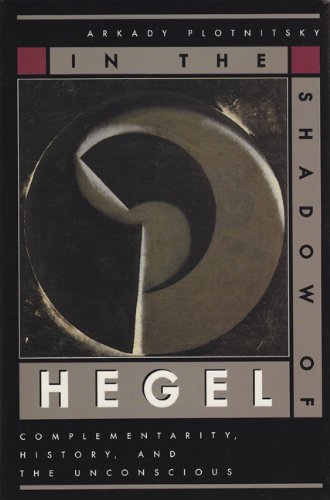
Title
In The Shadow Of Hegel: Complementarity, History, And The Unconscious,Used
Sold by Ergodebooks, an authorized reseller.
Returns accepted within 30 days | support@ergodebooks.com
Shipping Information
- Free Standard Shipping — United States only
- Processing Time: 3–5 business days
- Estimated Delivery: 6–10 business days after dispatch
- Double-boxed, fully insured & discreetly packaged
- Tracking number sent via email once dispatched
Returns & Refund
Returns accepted within 30 days of delivery.
Damaged or Defective Item
Free return shipping + replacement or full refund
Wrong Item Received
Free return shipping + replacement or full refund
Change of Mind
Return shipping at customer's expense · 25% restocking fee applies
Payment Option

In the Shadow of Hegel develops a new understanding of history operating against, but in the shadow of, the Hegelian logic of history as the unfolding of the Absolutely SelfConscious SpiritGeist. In this context Plotnitsky examines Hegel's significance for Marx, Nietzsche, Freud, Bataille, and, especially, Derrida, and exposes both the proximities and distances of the Hegelian and poststructuralist understanding of history.The book offers a general theoretical framework enabling the understanding of history it develops but with broader implications. This framework is introduced in the wake of poststructuralist thinking, following Nietzsche, under the rubric of complementaritya conceptual matrix drawn from Niels Bohr's interpretation of quantum mechanics, conjoined here with the matrix of general economy as developed, via Marx, Nietzsche, and Freud, in the works of Bataille and Derrida.Within this framework Plotnitsky relates history and the unconsciousHegel and Freudtransforming both concepts. He shows how history itself is complementary, specifically to the unconscious, which he sees as a central concept of postHegelian thought.Plotnitsky also explores the role of quantum mechanics and several other developments in modern mathematics and science, particularly those proceeding along the axis of general economy. He reveals reciprocity and interpenetrations between these fieldsfrom Newton to Riemann to Einstein and Bohr, on the one hand, and from Hegel to Nietzsche to Bataille to Lacan to Deleuze and Derrida, on the otherand by extensions new possibilities of conceptual and metaphorical traffic between different fields of intellectual inquiry.Arkady Plotnitsky holds an M.Sc. in mathematics from the University of St. Petersburg, Russia, and a Ph.D. in comparative literature from the University of Pennsylvania, where he teaches English and comparative literature. He is the author of Reconfigurations: Critical Theory and General Economy (UPF, 1993).
⚠️ WARNING (California Proposition 65):
This product may contain chemicals known to the State of California to cause cancer, birth defects, or other reproductive harm.
For more information, please visit www.P65Warnings.ca.gov.