If you have any questions, you are always welcome to contact us. We'll get back to you as soon as possible, withing 24 hours on weekdays.
Customer service
All questions about your order, return and delivery must be sent to our customer service team by e-mail at yourstore@yourdomain.com
Sale & Press
If you are interested in selling our products, need more information about our brand or wish to make a collaboration, please contact us at press@yourdomain.com
Help
If you have any questions, you are always welcome to contact us. We'll get back to you as soon as possible, withing 24 hours on weekdays.
Customer service
All questions about your order, return and delivery must be sent to our customer service team by e-mail at yourstore@yourdomain.com
Sale & Press
If you are interested in selling our products, need more information about our brand or wish to make a collaboration, please contact us at press@yourdomain.com
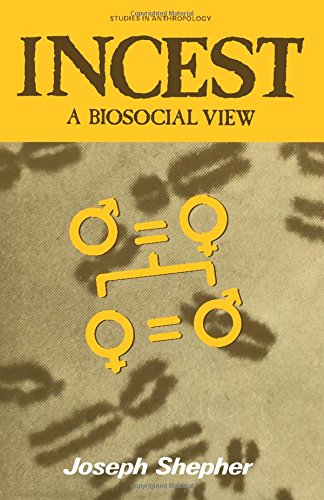
Incest: A Biosocial View focuses on the sociobiological theory of incest and compares it with other theoretical approaches to the problem. The argument made in this book is that the existence of culture does not lead to the exemption of Homo sapiens from the evolutionary process. Instead, it creates a coevolutionary process, of which the evolution of incest avoidance in human beings is the simplest, yet most instructive, example. Comprised of 11 chapters, this volume begins with an introduction to the problem of incest, followed by a discussion on the sociobiological theory in general and some important methodological issues. Epigenetic rules and the importance of reproduction are considered, along with inclusive fitness and kin selection; kinship altruism (nepotism); reciprocal altruism; mate selection and parental investment, parentchild and sibling conflict; aggression and social order; and the biosocial view of culture. The next three chapters survey the theories and empirical findings that led to the sociobiological theory of incest, with particular reference to the views of Edward Westermarck as well as the kibbutz and the simpua. The propositions of the sociobiological theory of incest are then outlined. The book concludes by summarizing the classic theories of incest and synthesizing them in light of the sociobiological theory. This monograph is relevant to psychoanalysts, sociologists, biologists, anthropologists, and psychologists studying the problem of incest.
⚠️ WARNING (California Proposition 65):
This product may contain chemicals known to the State of California to cause cancer,
birth defects, or other reproductive harm.
For MAP (Minimum Advertised Price) violations and Intellectual Property (IP) or Trademark concerns, please contact:
support@ergodebooks.com
⚠️ California Proposition 65 Warning: Some products sold on this website may expose you to chemicals known to the State of California to cause cancer, birth defects, or other reproductive harm. For more information, visit www.P65Warnings.ca.gov.