
Title
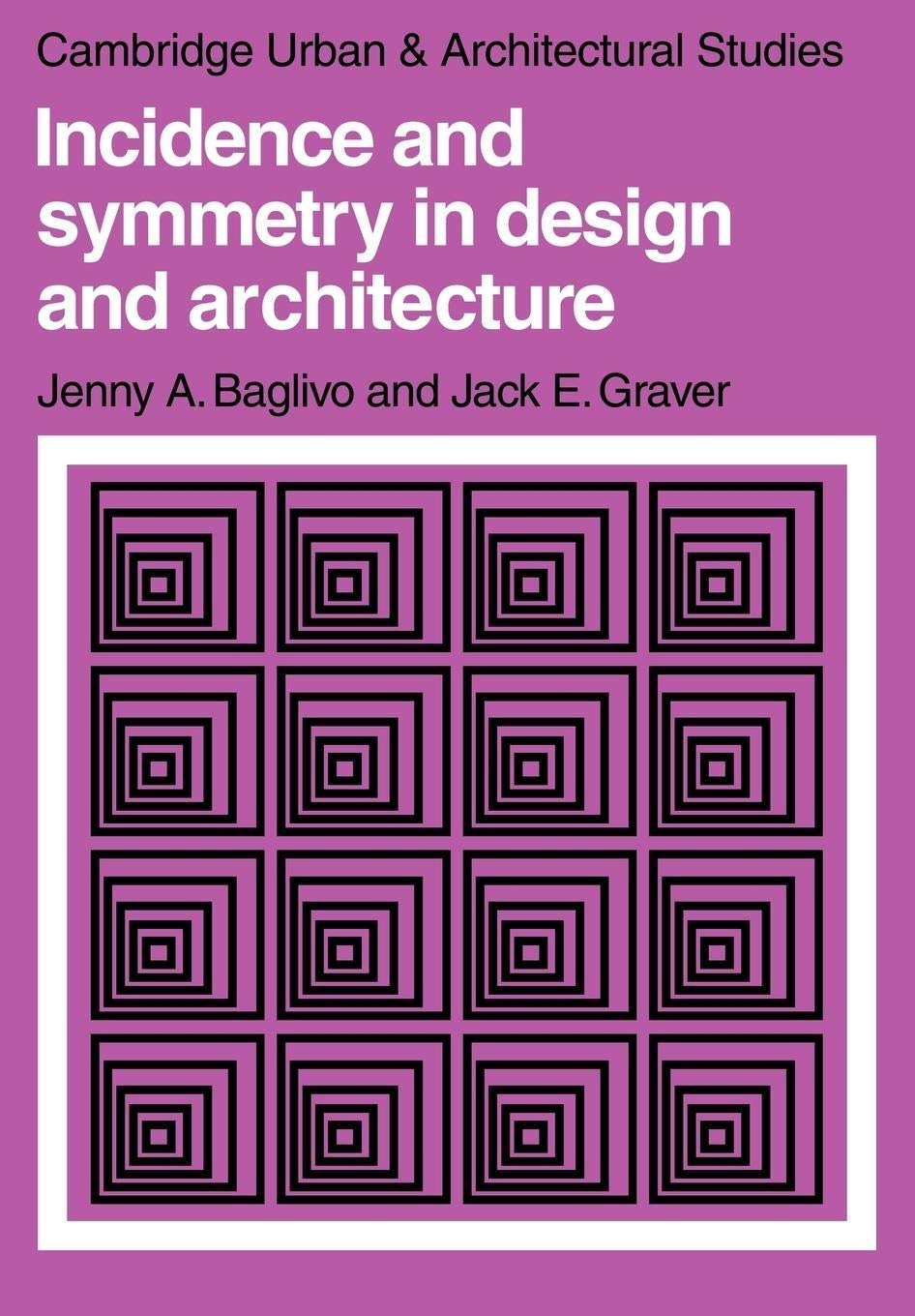
Incidence and Symmetry in Design and Architecture (Cambridge Urban and Architectural Studies, Series Number 7),Used
Sold by Ergodebooks, an authorized reseller.
Returns accepted within 30 days | support@ergodebooks.com
Shipping Information
- Free Standard Shipping — United States only
- Processing Time: 3–5 business days
- Estimated Delivery: 6–10 business days after dispatch
- Double-boxed, fully insured & discreetly packaged
- Tracking number sent via email once dispatched
Returns & Refund
Returns accepted within 30 days of delivery.
Damaged or Defective Item
Free return shipping + replacement or full refund
Wrong Item Received
Free return shipping + replacement or full refund
Change of Mind
Return shipping at customer's expense · 25% restocking fee applies
Payment Option

The initial purposes of this 1983 text were to develop mathematical topics relevant to the study of the incidence and symmetry structures of geometrical objects and to expand the reader's geometric intuition. The two fundamental mathematical topics employed in this endeavor are graph theory and the theory of transformation groups. Part I, Incidence, starts with two sections on the basics of graph theory and continues with a variety of specific applications of graph theory. Following this, the text becomes more theoretical; here graph theory is used to study surfaces other than the plane and the sphere. Part II, Symmetry, starts with a section on rigid motions or symmetries of the plane, which is followed by another on the classification of planar patterns. Additionally, an overview of symmetry in threedimensional space is provided, along with a reconciliation of graph theory and group theory in a study of enumeration problems in geometry.
⚠️ WARNING (California Proposition 65):
This product may contain chemicals known to the State of California to cause cancer, birth defects, or other reproductive harm.
For more information, please visit www.P65Warnings.ca.gov.
- Q: What is the page count of the book? A: The book has three hundred twenty pages. It provides a comprehensive exploration of incidence and symmetry in design and architecture.
- Q: What are the dimensions of this book? A: The book measures six point six nine inches in length, zero point seven five inches in width, and nine point six one inches in height. These dimensions make it a convenient size for reading and reference.
- Q: What type of binding does this book have? A: This book is paperback bound. This type of binding is lighter and more flexible compared to hardcover options, making it easy to carry.
- Q: How do I use this book for study? A: You can use this book as a reference for studying incidence and symmetry in architecture. It is suitable for students and professionals interested in mathematical applications in design.
- Q: Is this book suitable for beginners? A: Yes, this book is suitable for beginners. It starts with basic concepts in graph theory before advancing to more complex topics.
- Q: What age group is this book appropriate for? A: This book is appropriate for young adults and above. It discusses advanced mathematical concepts relevant to architecture and design.
- Q: How should I store this book to keep it in good condition? A: Store the book in a cool, dry place away from direct sunlight. This will help preserve the quality of the pages and binding.
- Q: Can this book be cleaned if it gets dirty? A: Yes, you can clean the book gently with a soft, dry cloth. Avoid using water or cleaning solutions to prevent damage to the cover and pages.
- Q: Is there a warranty or return policy for this book? A: Typically, used books come with a limited return policy. Check with the seller for specific return guidelines.
- Q: What if the book arrives damaged? A: If the book arrives damaged, contact the seller immediately for a return or exchange. Most sellers have procedures for handling damaged items.
- Q: How does this book compare to other architecture texts? A: This book focuses specifically on incidence and symmetry, making it unique compared to general architecture texts that cover broader topics.
- Q: Is this book helpful for architectural design projects? A: Yes, this book is helpful for architectural design projects. It provides mathematical insights that can enhance design strategies.
- Q: Can this book be used in academic courses? A: Yes, this book can be used in academic courses related to architecture and design. It complements various curricula focused on geometry and symmetry.
- Q: What makes this book unique in its field? A: This book uniquely integrates graph theory and transformation groups to explore symmetry in both two and three-dimensional spaces.
- Q: Who is the author of this book? A: The author of the book is Jenny Baglivo. She specializes in topics related to geometry and architecture.
- Q: Is this book a good resource for professionals in architecture? A: Yes, this book is a valuable resource for professionals in architecture. It offers deeper insights into mathematical concepts applied in the field.