
Title
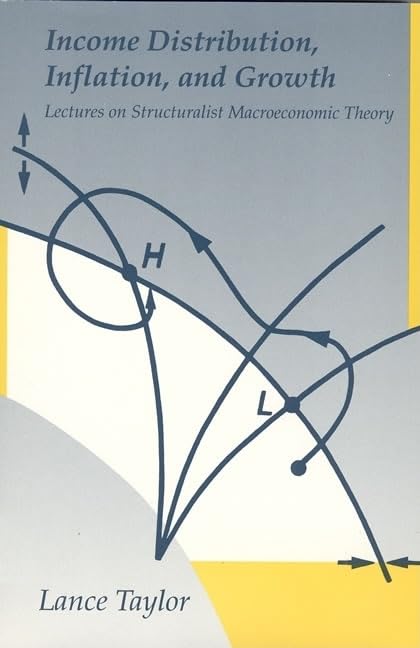
Income Distribution, Inflation, and Growth: Lectures on Structuralist Macroeconomic Theory,Used
Sold by Ergodebooks, an authorized reseller.
Returns accepted within 30 days | support@ergodebooks.com
Shipping Information
- Free Standard Shipping — United States only
- Processing Time: 3–5 business days
- Estimated Delivery: 6–10 business days after dispatch
- Double-boxed, fully insured & discreetly packaged
- Tracking number sent via email once dispatched
Returns & Refund
Returns accepted within 30 days of delivery.
Damaged or Defective Item
Free return shipping + replacement or full refund
Wrong Item Received
Free return shipping + replacement or full refund
Change of Mind
Return shipping at customer's expense · 25% restocking fee applies
Payment Option

Structuralist macroeconomics has emerged recently as the only viable theoretical alternative for economists and practitioners in developing countries. Lance Taylor's innovative work represents a landmark in this field. It codifies a new generation of structuralist macroeconomic models that incorporate the economic power relationships of key institutions and groups, integrates both finance and real macroeconomics, and covers a diverse range of experience in the developing world over the past three decades. In an introduction Taylor explains his methodology, describes assumptions underlying the models used, and reviews theories that relate economic growth and the role of financial assets. He then takes up basic structuralist models of a closed economy and moves on to consider the open economy cases. He incorporates the latest developments in the field (inflation, financial crisis, exchange rate management, increasing returns, and the like) in a treatment that departs substantially from economic orthodoxy. Taylor first addresses the question of how to specify closure or define the causal structure of macro models. He also considers how income redistribution influences growth and output and how income redistribution interacts with inflation. Next, an investmentdriven nonfull employment growth model draws on ideas introduced earlier to illustrate how different sorts of macroeconomic policies affect shortrun adjustment and growth prospects over time. Taylor then turns to the problems proposed by economic openness in a stylized semiindustrialized country, starting with international trade. A fixprice/flexprice model is developed, and additional models demonstrate cases of policy relevance as well as interactions between class conflict and growth.
⚠️ WARNING (California Proposition 65):
This product may contain chemicals known to the State of California to cause cancer, birth defects, or other reproductive harm.
For more information, please visit www.P65Warnings.ca.gov.