If you have any questions, you are always welcome to contact us. We'll get back to you as soon as possible, withing 24 hours on weekdays.
Customer service
All questions about your order, return and delivery must be sent to our customer service team by e-mail at yourstore@yourdomain.com
Sale & Press
If you are interested in selling our products, need more information about our brand or wish to make a collaboration, please contact us at press@yourdomain.com
Help
If you have any questions, you are always welcome to contact us. We'll get back to you as soon as possible, withing 24 hours on weekdays.
Customer service
All questions about your order, return and delivery must be sent to our customer service team by e-mail at yourstore@yourdomain.com
Sale & Press
If you are interested in selling our products, need more information about our brand or wish to make a collaboration, please contact us at press@yourdomain.com
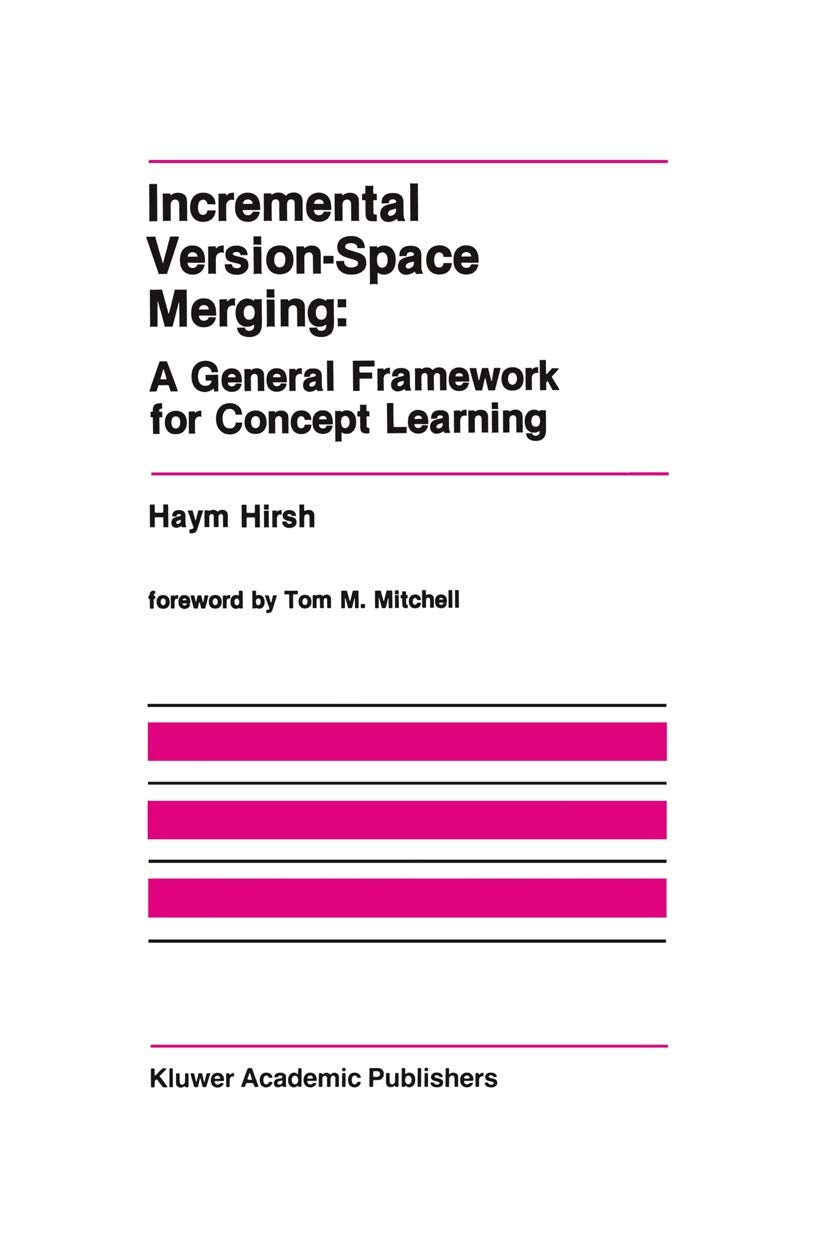
One of the most enjoyable experiences in science is hearing a simple but novel idea which instantly rings true, and whose consequences then begin to unfold in unforeseen directions. For me, this book presents such an idea and several of its ramifications. This book is concerned with machine learning. It focuses on a ques tion that is central to understanding how computers might learn: "how can a computer acquire the definition of some general concept by abstracting from specific training instances of the concept?" Although this question of how to automatically generalize from examples has been considered by many researchers over several decades, it remains only partly answered. The approach developed in this book, based on Haym Hirsh's Ph.D. dis sertation, leads to an algorithm which efficiently and exhaustively searches a space of hypotheses (possible generalizations of the data) to find all maxi mally consistent hypotheses, even in the presence of certain types of incon sistencies in the data. More generally, it provides a framework for integrat ing different types of constraints (e.g., training examples, prior knowledge) which allow the learner to reduce the set of hypotheses under consideration.
⚠️ WARNING (California Proposition 65):
This product may contain chemicals known to the State of California to cause cancer,
birth defects, or other reproductive harm.
For MAP (Minimum Advertised Price) violations and Intellectual Property (IP) or Trademark concerns, please contact:
support@ergodebooks.com
⚠️ California Proposition 65 Warning: Some products sold on this website may expose you to chemicals known to the State of California to cause cancer, birth defects, or other reproductive harm. For more information, visit www.P65Warnings.ca.gov.