

Title

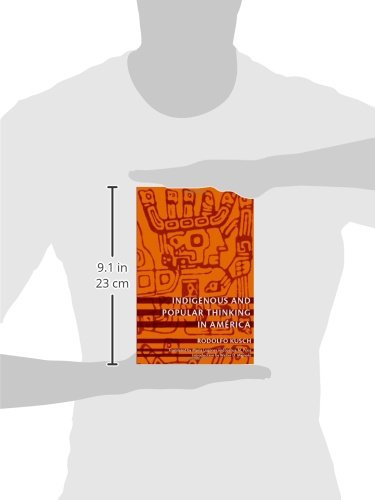
Indigenous And Popular Thinking In Amrica (Latin America Otherwise),Used
Sold by Ergodebooks, an authorized reseller.
Returns accepted within 30 days | support@ergodebooks.com
Shipping Information
- Free Standard Shipping — United States only
- Processing Time: 3–5 business days
- Estimated Delivery: 6–10 business days after dispatch
- Double-boxed, fully insured & discreetly packaged
- Tracking number sent via email once dispatched
Returns & Refund
Returns accepted within 30 days of delivery.
Damaged or Defective Item
Free return shipping + replacement or full refund
Wrong Item Received
Free return shipping + replacement or full refund
Change of Mind
Return shipping at customer's expense · 25% restocking fee applies
Payment Option

Originally Published In Mexico In 1970, Indigenous And Popular Thinking In Amrica Is The First Book By The Argentine Philosopher Rodolfo Kusch (192279) To Be Translated Into English. At Its Core Is A Binary Created By Colonization And The Devaluation Of Indigenous Practices And Cosmologies: An Opposition Between The Technologies And Rationalities Of European Modernity And The Popular Mode Of Thinking, Which Is Deeply Tied To Indian Ways Of Knowing And Being. Arguing That This Binary Cuts Through Amrica, Kusch Seeks To Identify And Recover The Indigenous And Popular Way Of Thinking, Which He Contends Is Dismissed Or Misunderstood By Many Urban Argentines, Including Leftist Intellectuals.Indigenous And Popular Thinking In Amrica Is A Record Of Kusch'S Attempt To Immerse Himself In The Indigenous Ways Of Knowing And Being. At First Glance, His Methodology Resembles Ethnography. He Speaks With And Observes Indigenous People And Mestizos In Peru, Bolivia, And Argentina. He Questions Them About Their Agricultural Practices And Economic Decisions; He Observes Rituals; He Asks Women In The Market The Meaning Of Indigenous Talismans; He Interviews Shamans; He Describes The Spatial Arrangement And The Contents Of Shrines, Altars, And Temples; And He Reproduces Diagrams Of Archaeological Sites, Which He Then Interprets At Length. Yet He Does Not Present A 'Them' To A Putative 'Us.' Instead, He Offers An Inroad To A Way Of Thinking And Being That Does Not Follow The Logic Or Fit Into The Categories Of Western Social Science And Philosophy. In His Introduction, Walter D. Mignolo Discusses Kusch'S Work And Its Relation To That Of Other Twentiethcentury Intellectuals, Argentine History, And Contemporary Scholarship On The Subaltern And Decoloniality.
⚠️ WARNING (California Proposition 65):
This product may contain chemicals known to the State of California to cause cancer, birth defects, or other reproductive harm.
For more information, please visit www.P65Warnings.ca.gov.
- Q: What are the dimensions of the book? A: The book measures six point fourteen inches in length, zero point seventy-five inches in width, and nine point twenty-five inches in height.
- Q: How many pages does this book have? A: This book contains two hundred ninety-six pages, providing a comprehensive exploration of its themes.
- Q: What type of binding does this book have? A: The book is bound in paperback, making it flexible and easy to handle for readers.
- Q: Who is the author of this book? A: The author of this book is Rodolfo Kusch, an Argentine philosopher known for his insights into indigenous thought.
- Q: What genre does this book belong to? A: This book falls under the Native American category, addressing themes related to indigenous and popular thinking.
- Q: Is this book suitable for casual readers? A: Yes, this book is suitable for casual readers interested in philosophy, indigenous cultures, and Latin American thought.
- Q: How does this book explore indigenous practices? A: The book immerses readers in indigenous ways of knowing by discussing agricultural practices and rituals observed by the author.
- Q: Is there an age recommendation for this book? A: There is no specific age recommendation, but it is generally suitable for adult readers and mature teenagers.
- Q: How should I care for this book? A: To care for this book, keep it in a dry environment away from direct sunlight to preserve the cover and pages.
- Q: Can I clean the book if it gets dirty? A: Yes, you can gently wipe the cover with a soft, dry cloth to remove any surface dirt.
- Q: What if the book arrives damaged? A: If the book arrives damaged, you should contact the seller for return options or a replacement.
- Q: Is there a return policy for this book? A: Yes, most sellers offer a return policy, typically allowing returns within a specified period.
- Q: How do I store this book properly? A: Store this book upright on a shelf, ensuring it’s not overloaded with other items to prevent bending.
- Q: Does this book include illustrations? A: Yes, this book features twenty illustrations, enriching the text with visual context.
- Q: How does this book compare to other works on indigenous thought? A: This book offers a unique perspective by integrating ethnographic methodology, unlike many other theoretical works.
- Q: Is this book part of a larger series? A: No, this book is a standalone work by Rodolfo Kusch, though it engages with broader themes in indigenous philosophy.