If you have any questions, you are always welcome to contact us. We'll get back to you as soon as possible, withing 24 hours on weekdays.
Customer service
All questions about your order, return and delivery must be sent to our customer service team by e-mail at yourstore@yourdomain.com
Sale & Press
If you are interested in selling our products, need more information about our brand or wish to make a collaboration, please contact us at press@yourdomain.com
Help
If you have any questions, you are always welcome to contact us. We'll get back to you as soon as possible, withing 24 hours on weekdays.
Customer service
All questions about your order, return and delivery must be sent to our customer service team by e-mail at yourstore@yourdomain.com
Sale & Press
If you are interested in selling our products, need more information about our brand or wish to make a collaboration, please contact us at press@yourdomain.com
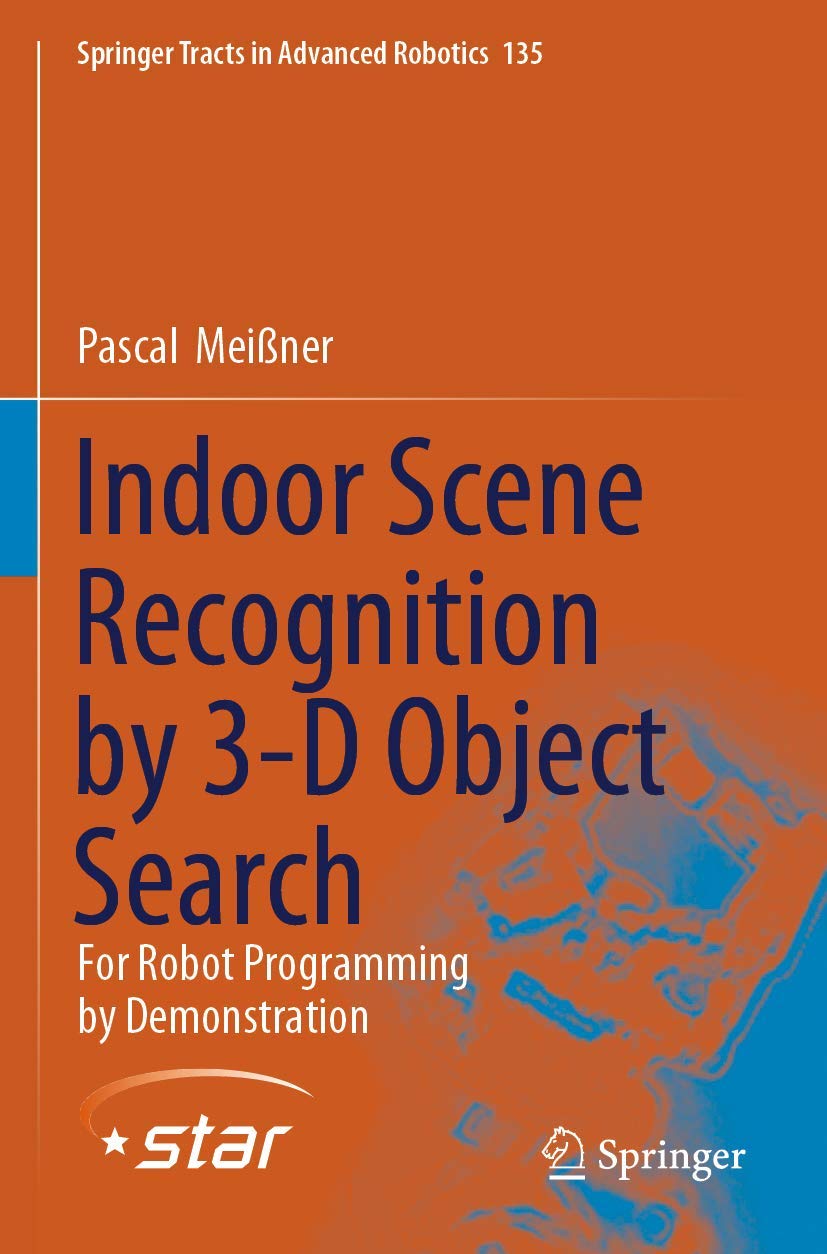
This book focuses on enabling mobile robots to recognize scenes in indoor environments, in order to allow them to determine which actions are appropriate at which points in time. In concrete terms, future robots will have to solve the classification problem represented by scene recognition sufficiently well for them to act independently in humancentered environments. To achieve accurate yet versatile indoor scene recognition, the book presents a hierarchical data structure for scenes the Implicit Shape Model trees. Further, it also provides training and recognition algorithms for these trees. In general, entire indoor scenes cannot be perceived from a single point of view. To address this problem the authors introduce Active Scene Recognition (ASR), a concept that embeds canonical scene recognition in a decisionmaking system that selects camera views for a mobile robot to drive to so that it can find objects not yet localized. The authors formalize the automatic selection of cameraviews as a NextBestView (NBV) problem to which they contribute an algorithmic solution, which focuses on realistic problem modeling while maintaining its computational efficiency. Lastly, the book introduces a method for predicting the poses of objects to be searched, establishing the otherwise missing link between scene recognition and NBV estimation.
⚠️ WARNING (California Proposition 65):
This product may contain chemicals known to the State of California to cause cancer,
birth defects, or other reproductive harm.
For MAP (Minimum Advertised Price) violations and Intellectual Property (IP) or Trademark concerns, please contact:
support@ergodebooks.com
⚠️ California Proposition 65 Warning: Some products sold on this website may expose you to chemicals known to the State of California to cause cancer, birth defects, or other reproductive harm. For more information, visit www.P65Warnings.ca.gov.