
Title
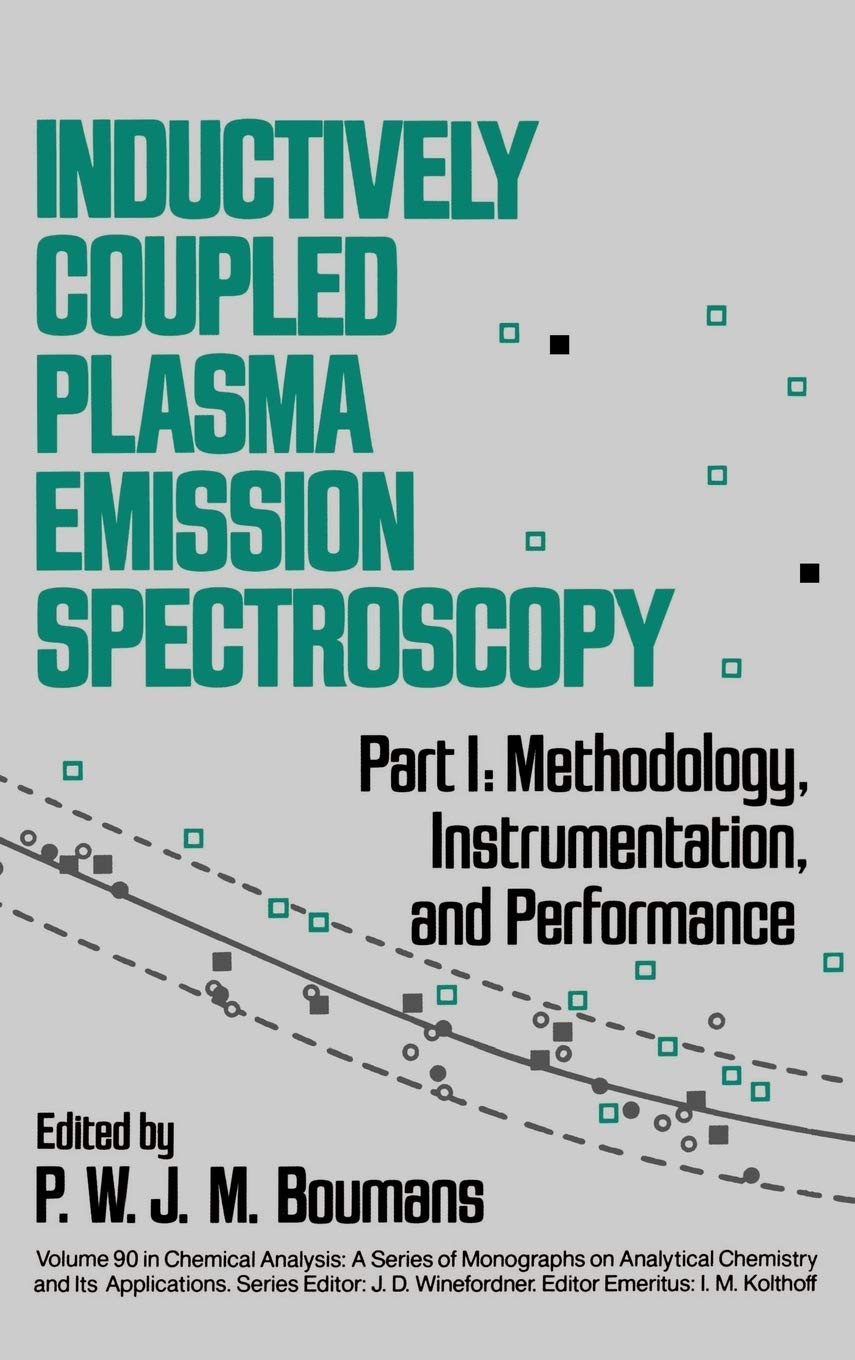
Inductively Coupled Plasma Emission Spectroscopy, Part 1: Methodology, Instrumentation and Performance (Chemical Analysis: A Ser,Used
Sold by Ergodebooks, an authorized reseller.
Returns accepted within 30 days | support@ergodebooks.com
Shipping Information
- Free Standard Shipping — United States only
- Processing Time: 3–5 business days
- Estimated Delivery: 6–10 business days after dispatch
- Double-boxed, fully insured & discreetly packaged
- Tracking number sent via email once dispatched
Returns & Refund
Returns accepted within 30 days of delivery.
Damaged or Defective Item
Free return shipping + replacement or full refund
Wrong Item Received
Free return shipping + replacement or full refund
Change of Mind
Return shipping at customer's expense · 25% restocking fee applies
Payment Option

In the 1960s, the development of inductively coupled plasmas (ICP) as excitation sources for atomic emission spectroscopy (AES) permitted, for the first time, the convenient, simultaneous determination of a number of chemical elements in solutions. In two selfcontained volumes, this is the first definitive text/reference on ICPAES since the introduction of this important analytical technique.Part 1 of Inductively Coupled Plasma Emission Spectroscopy covers the basis of ICPAES as an analytical method and discusses fundamental analytical concepts, performance, and figures of merit; principles of the instrumentation; the relation between ICP and other modern 'plasma sources;' and the connection between ICPAES, on one hand, and ICP atomic fluorescence spectroscopy and ICP mass spectroscopy, on the other.Part 2 examines applications and fundamentals of the technique. The overall treatment of the subject is tutorial, systematic, and consistent. The approach is scientific and rigorous, but mathematical formulae are used only when they promote clarity. Aside from filling a void in the AES literature, Inductively Coupled Plasma Emission Spectroscopy provides a critical survey of more than 20 years of research, development, and application in the field of ICP and related plasma sources. It is an excellent handbook for both novices and experts, and it serves as an aidememoire and major source of reference for analytical spectroscopists, analytical chemists, physical chemists and physicists, including those who are researchers, technicians, and applied analysts.
⚠️ WARNING (California Proposition 65):
This product may contain chemicals known to the State of California to cause cancer, birth defects, or other reproductive harm.
For more information, please visit www.P65Warnings.ca.gov.
- Q: What is Inductively Coupled Plasma Emission Spectroscopy (ICP-AES)? A: Inductively Coupled Plasma Emission Spectroscopy (ICP-AES) is an analytical technique that uses inductively coupled plasma as an excitation source to determine the concentration of multiple chemical elements in solutions simultaneously.
- Q: Who is the author of this book? A: The book is authored by P. W. J. M. Boumans.
- Q: How many pages does this book have? A: The book contains 608 pages.
- Q: What topics are covered in Part 1 of this book? A: Part 1 covers the basis of ICP-AES, fundamental analytical concepts, performance metrics, instrumentation principles, and the relationship between ICP and other plasma sources.
- Q: Is this book suitable for beginners in analytical chemistry? A: Yes, the book is designed to be a comprehensive resource for both novices and experts, making it suitable for individuals new to ICP-AES and analytical chemistry.
- Q: When was this book published? A: The book was published on February 4, 1987.
- Q: What type of binding does this book have? A: This book is available in hardcover binding.
- Q: Does the book include mathematical formulas? A: Mathematical formulas are used in the book, but only when they enhance clarity and understanding of the concepts.
- Q: What is the condition of the book being sold? A: The book is listed as 'New'.
- Q: What is the focus of the second part of the book? A: Part 2 of the book focuses on the applications and fundamentals of inductively coupled plasma emission spectroscopy.