If you have any questions, you are always welcome to contact us. We'll get back to you as soon as possible, withing 24 hours on weekdays.
Customer service
All questions about your order, return and delivery must be sent to our customer service team by e-mail at yourstore@yourdomain.com
Sale & Press
If you are interested in selling our products, need more information about our brand or wish to make a collaboration, please contact us at press@yourdomain.com
Help
If you have any questions, you are always welcome to contact us. We'll get back to you as soon as possible, withing 24 hours on weekdays.
Customer service
All questions about your order, return and delivery must be sent to our customer service team by e-mail at yourstore@yourdomain.com
Sale & Press
If you are interested in selling our products, need more information about our brand or wish to make a collaboration, please contact us at press@yourdomain.com
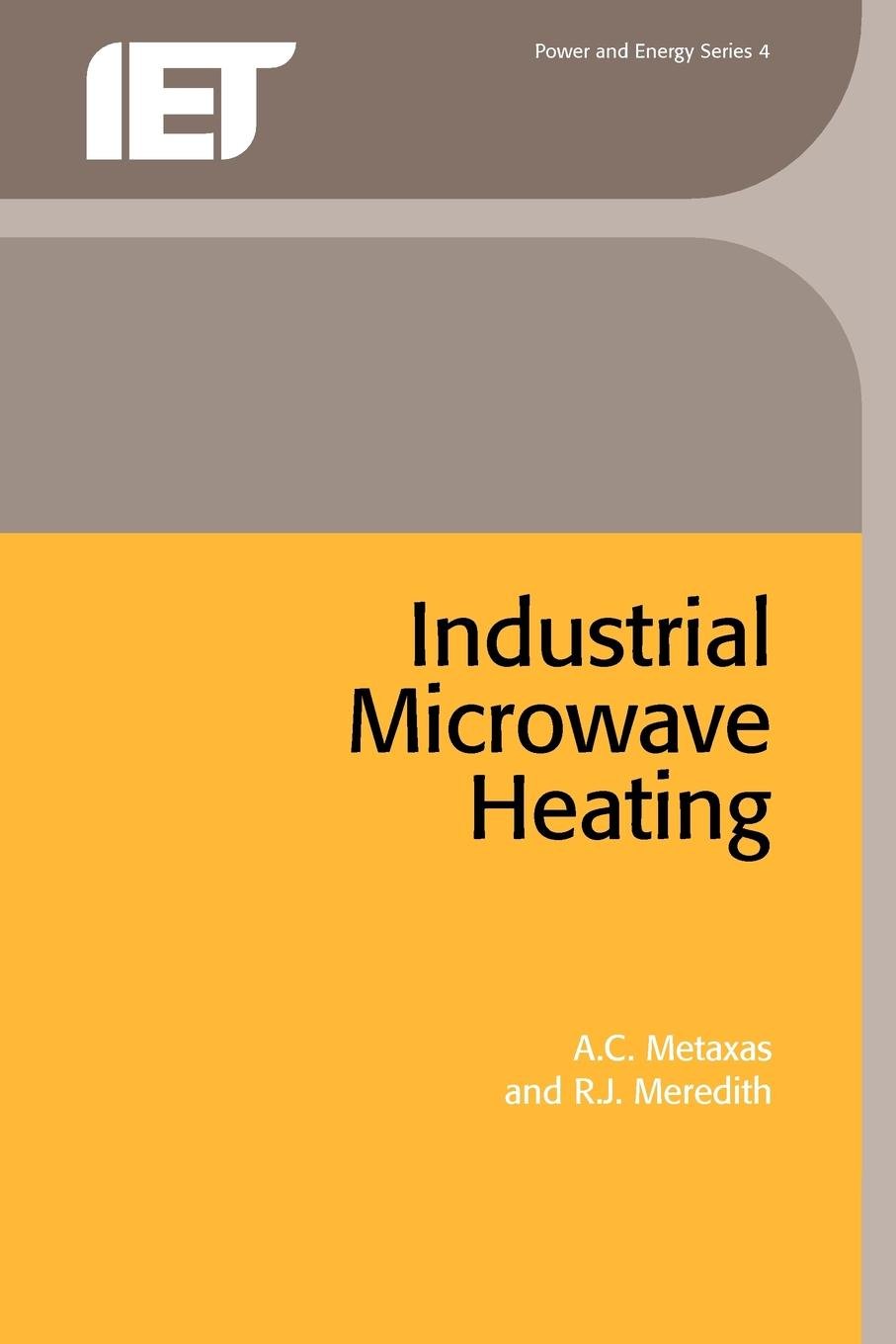
This book offers a broad coverage of the theory and practice of industrial microwave heating. It introduces the physical processes behind dipolar and conductivity loss mechanisms and follows with a thorough presentation of dielectric property data of many industrial materials as a function of the moisture content, temperature and frequency, focussing on the interpretation of such data as regards the suitabiliy for processing these materials with microwave energy. The basic equations which govern the power dissipation, attenuation, phase constant, penetration depth and skin depth are derived from first principles while the transport equations of heat, mass and pressure are qualitatively described, giving particular emphasis to the physical mechanisms behind high frequency drying. The book provides established procedures backed by theoretical formulations for the design of industrial travelling wave and multimode applicators. It also provides extensive coverage of single mode fundamental or higher order resonant cavities and outlines a number of atypical applicator structures. It describes the essential features of processing with microwaves under vacuum and presents a brief introduction to the mechanisms which lead to gas breakdown. It stresses the need for a degree of hybridisation with other electrical or conventional heating systems and discusses a few such schemes. The book outlines a number of systems for limiting leakage from online industrial microwave systems and concludes with an extensive discussion of successful industrial applications.
⚠️ WARNING (California Proposition 65):
This product may contain chemicals known to the State of California to cause cancer,
birth defects, or other reproductive harm.
For MAP (Minimum Advertised Price) violations and Intellectual Property (IP) or Trademark concerns, please contact:
support@ergodebooks.com
⚠️ California Proposition 65 Warning: Some products sold on this website may expose you to chemicals known to the State of California to cause cancer, birth defects, or other reproductive harm. For more information, visit www.P65Warnings.ca.gov.