If you have any questions, you are always welcome to contact us. We'll get back to you as soon as possible, withing 24 hours on weekdays.
Customer service
All questions about your order, return and delivery must be sent to our customer service team by e-mail at yourstore@yourdomain.com
Sale & Press
If you are interested in selling our products, need more information about our brand or wish to make a collaboration, please contact us at press@yourdomain.com
Help
If you have any questions, you are always welcome to contact us. We'll get back to you as soon as possible, withing 24 hours on weekdays.
Customer service
All questions about your order, return and delivery must be sent to our customer service team by e-mail at yourstore@yourdomain.com
Sale & Press
If you are interested in selling our products, need more information about our brand or wish to make a collaboration, please contact us at press@yourdomain.com
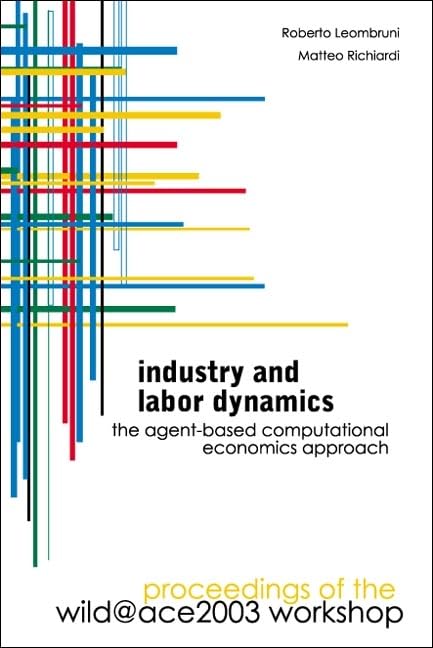
This book presents the contributions to the first Wild@Ace conference. The acronym stands for "Workshop on Industrial and Labor Dynamics The AgentBased Computational Aproach", and it has been the first event ever focusing on the very promising use of the agentbased simulation approach for investigation of labor economics and industrial organization issues.Agentbased models are computer models in which a multitude of agents each embodied in a specific software code interact. These agents can represent individuals households, firms, institutions, etc. Moreover, "special" agents can be added to observe and monitor individual and collective behavior. One of the main purpose of writing an ACE model is to gain intuitions on the twoway feedback between the microstructure and the macrostructure of a phenomenon of interest. How is it that simple aggregate regularities may arise from individual disorder? Or that a nice structure at an individual level may lead to a complete absence of regularity in the aggregate? How is it that the complex interaction of very simple individuals may lead to surprisingly complicated aggregate dynamics? Or that sophisticated agents may be unable to organize themselves in any interesting way?The book includes contributions by some of the most distinguished researchers in the field, such as the economists Alan Kirman, Giovanni Dosi, Leigh Tesfatsion and Mauro Gallegati, and the sociologist Nigel Gilbert.
⚠️ WARNING (California Proposition 65):
This product may contain chemicals known to the State of California to cause cancer,
birth defects, or other reproductive harm.
For MAP (Minimum Advertised Price) violations and Intellectual Property (IP) or Trademark concerns, please contact:
support@ergodebooks.com
⚠️ California Proposition 65 Warning: Some products sold on this website may expose you to chemicals known to the State of California to cause cancer, birth defects, or other reproductive harm. For more information, visit www.P65Warnings.ca.gov.