
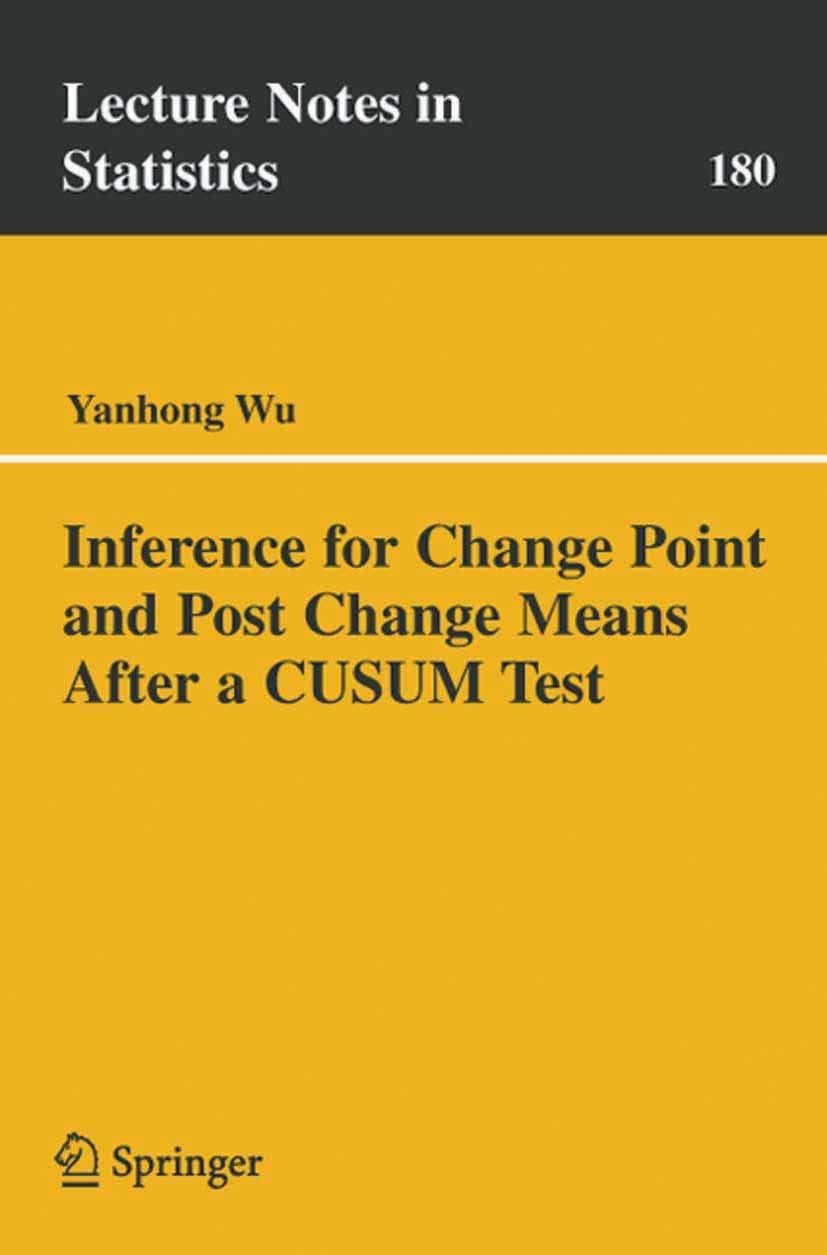
Title
Inference For Change Point And Post Change Means After A Cusum Test (Lecture Notes In Statistics, 180)
Sold by Ergodebooks, an authorized reseller.
Returns accepted within 30 days | support@ergodebooks.com
Shipping Information
- Free Standard Shipping — United States only
- Processing Time: 3–5 business days
- Estimated Delivery: 6–10 business days after dispatch
- Double-boxed, fully insured & discreetly packaged
- Tracking number sent via email once dispatched
Returns & Refund
Returns accepted within 30 days of delivery.
Damaged or Defective Item
Free return shipping + replacement or full refund
Wrong Item Received
Free return shipping + replacement or full refund
Change of Mind
Return shipping at customer's expense · 25% restocking fee applies
Payment Option

The changepoint problem has attracted many statistical researchers and practitioners during the last few decades. Here, we only concentrate on the sequential changepoint problem. Starting from the Shewhart chart with app cations to quality control [see Shewhart (1931)], several monitoring procedures have been developed for a quick detection of change. The three most studied monitoring procedures are the CUSUM procedure [Page (1954)], the EWMA procedure [Roberts (1959)] and the Shiryayev?Roberts procedure [Shiryayev (1963) and Roberts (1966)]. Extensive studies have been conducted on the p formancesofthesemonitoringproceduresandcomparisonsintermsofthedelay detection time. Lai (1995) made a review on the state of the art on these charts and proposed several possible generalizations in order to detect a change in the case of the unknown postchange parameter case. In particular, a wind limited version of the generalized likelihood ratio testing procedure studied by Siegmund and Venkatraman (1993) is proposed for a more practical treatment even when the observations are correlated. In this work, our main emphasis is on the inference problem for the chan point and the postchange parameters after a signal of change is made. More speci?cally, due to its convenient form and statistical properties, most d cussions are concentrated on the CUSUM procedure. Our goal is to provide some quantitative evaluations on the statistical properties of estimators for the changepoint and the postchange parameters.
⚠️ WARNING (California Proposition 65):
This product may contain chemicals known to the State of California to cause cancer, birth defects, or other reproductive harm.
For more information, please visit www.P65Warnings.ca.gov.