
Title
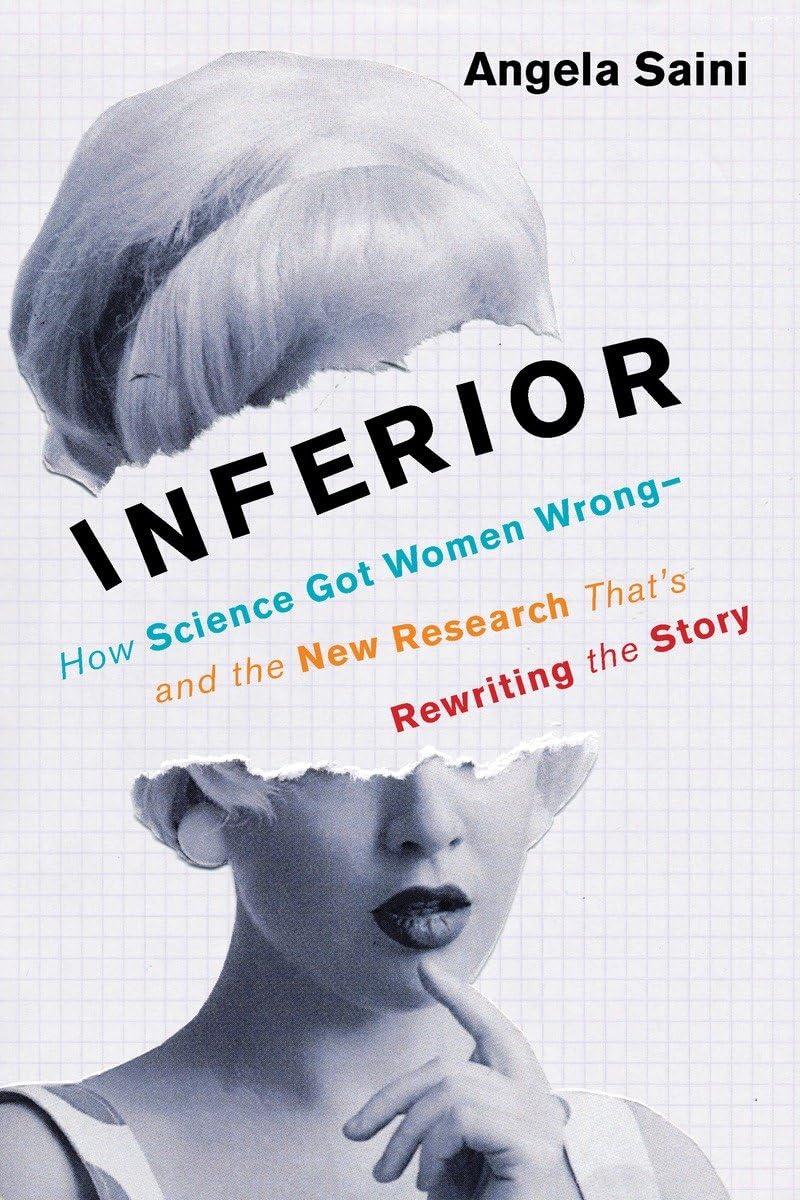
Inferior: How Science Got Women Wrongand The New Research That'S Rewriting The Story,Used
Sold by Ergodebooks, an authorized reseller.
Returns accepted within 30 days | support@ergodebooks.com
Shipping Information
- Free Standard Shipping — United States only
- Processing Time: 3–5 business days
- Estimated Delivery: 6–10 business days after dispatch
- Double-boxed, fully insured & discreetly packaged
- Tracking number sent via email once dispatched
Returns & Refund
Returns accepted within 30 days of delivery.
Damaged or Defective Item
Free return shipping + replacement or full refund
Wrong Item Received
Free return shipping + replacement or full refund
Change of Mind
Return shipping at customer's expense · 25% restocking fee applies
Payment Option

What science has gotten so shamefully wrong about women, and the fight, by both female and male scientists, to rewrite what we thought we knewFor hundreds of years it was common sense: women were the inferior sex. Their bodies were weaker, their minds feebler, their role subservient. No less a scientist than Charles Darwin asserted that women were at a lower stage of evolution, and for decades, scientistsmost of them male, of courseclaimed to find evidence to support this.Whether looking at intelligence or emotion, cognition or behavior, science has continued to tell us that men and women are fundamentally different. Biologists claim that women are better suited to raising families or are, more gently, uniquely empathetic. Men, on the other hand, continue to be described as excelling at tasks that require logic, spatial reasoning, and motor skills. But a huge wave of research is now revealing an alternative version of what we thought we knew. The new woman revealed by this scientific data is as strong, strategic, and smart as anyone else.In Inferior, acclaimed science writer Angela Saini weaves together a fascinatingand sorely necessarynew science of women. As Saini takes readers on a journey to uncover sciences failure to understand women, she finds that were still living with the legacy of an establishment thats just beginning to recover from centuries of entrenched exclusion and prejudice. Sexist assumptions are stubbornly persistent: even in recent years, researchers have insisted that women are choosy and monogamous while men are naturally promiscuous, or that the way mens and womens brains are wired confirms longdiscredited gender stereotypes.As Saini reveals, however, groundbreaking research is finally rediscovering womens bodies and minds. Inferior investigates the gender wars in biology, psychology, and anthropology, and delves into cuttingedge scientific studies to uncover a fascinating new portrait of womens brains, bodies, and role in human evolution.
⚠️ WARNING (California Proposition 65):
This product may contain chemicals known to the State of California to cause cancer, birth defects, or other reproductive harm.
For more information, please visit www.P65Warnings.ca.gov.
- Q: What is the page count of the book Inferior? A: The book Inferior has two hundred twenty-four pages. This length allows for an in-depth exploration of its themes.
- Q: What are the dimensions of the book? A: The book measures six point two inches in length, zero point nine one inches in width, and nine point three inches in height. These dimensions make it a standard hardcover size.
- Q: Who is the author of Inferior? A: The author of Inferior is Angela Saini. She is an acclaimed science writer known for her insightful exploration of gender and science.
- Q: What type of binding does the book have? A: Inferior is bound in hardcover. This durable binding is ideal for long-term use and display.
- Q: What genre does Inferior belong to? A: Inferior belongs to the genre of Evolution. It discusses scientific perspectives on gender and women's roles.
- Q: Is Inferior suitable for young readers? A: Inferior is not specifically targeted at young readers. The content is more suited for adults and mature teens interested in science and gender studies.
- Q: How can I use the insights from Inferior? A: Readers can apply the insights from Inferior to understand the historical context of gender biases in science. This can inform discussions and research on gender equality.
- Q: Is there a particular audience for the book? A: The book is primarily aimed at readers interested in science, feminism, and social issues. It provides a critical examination of gender biases.
- Q: How do I keep the book in good condition? A: To keep Inferior in good condition, store it upright in a dry place away from direct sunlight. Avoid exposing it to moisture.
- Q: Are there any safety concerns with this book? A: There are no specific safety concerns with the book Inferior. It is intended for informational purposes without hazardous materials.
- Q: What if I receive a damaged copy of Inferior? A: If you receive a damaged copy of Inferior, contact the seller for a return or replacement. Most retailers have policies for damaged items.
- Q: Can I return the book if I'm not satisfied? A: Yes, you can typically return the book if you're not satisfied, depending on the retailer's return policy. Make sure to check their specific terms.
- Q: How does Inferior compare to other books on gender studies? A: Inferior offers a unique perspective by integrating scientific research with discussions on gender. This makes it stand out among other gender studies texts.
- Q: Is Inferior recommended for academic use? A: Yes, Inferior is recommended for academic use, especially in gender studies, sociology, and psychology courses. It provides valuable insights and references.
- Q: What themes are explored in Inferior? A: Inferior explores themes of gender bias, scientific research on women, and the evolution of gender roles. It challenges long-held misconceptions.
- Q: Does the book provide solutions to gender biases? A: While Inferior discusses issues of gender bias, it primarily focuses on uncovering truths and presenting new research rather than offering direct solutions.